

What Is Office Relocation Cost per Employee in Dubai?
Office relocation cost per employee in Dubai is the total relocation budget divided by total headcount, expressed as a single AED figure per staff member. The metric converts a large, variable project cost into a unit rate that finance teams compare across office sites, vendors, and move dates. A 40-person move costing AED 80,000 carries a per-employee cost of AED 2,000.
The figure sits inside the wider commercial relocation budget, alongside transport, packing, IT migration, and building access charges. Per-employee costing strips out the noise of one large invoice and gives procurement a number that benchmarks cleanly against other Dubai office moves.
Three inputs shape the figure: the total project scope, the headcount at the new premises, and the complexity of the assets being moved. A finance-heavy floor in DIFC with dense IT infrastructure produces a higher per-employee rate than an open-plan startup in JLT with flat-pack desks.
What Does an Office Mover in Dubai Actually Do?
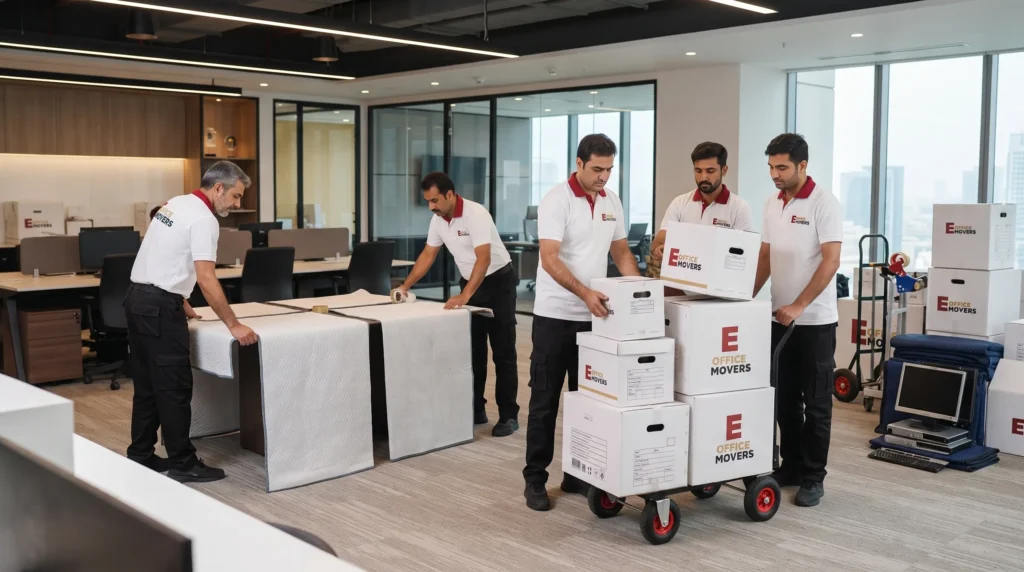
An office mover in Dubai is a commercial relocation contractor that disassembles, transports, and reinstates a complete workplace, including furniture, IT hardware, files, and fixtures. Commercial movers differ from residential movers in scope: they handle server racks, network cabinets, corporate asset registers, and phased moves that keep a business trading during the transition.
The standard scope covers a pre-move site survey, sequential labelling of every asset, dismantling of workstations and partitions, protective packing, transport, and reassembly at the destination. Full-service contractors add IT disconnection and reconnection, secure document handling, and post-move setup of meeting rooms and reception areas.
How Relocation Facilities Work in the UAE
Relocation facilities in the UAE operate under building management rules, free zone protocols, and DEWA account transfers that govern when and how a move proceeds. Most Dubai towers restrict goods movement to service lifts and designated loading bays, with move windows booked through building management in advance.
Free zone premises add a layer of operational control. Properties inside DMCC, JAFZA, and DIFC require gate passes, security clearance for the moving crew, and adherence to fixed access hours. Tenancy obligations tie into the move as well: the outgoing Ejari contract, the DEWA final settlement, and any fit-out deposit all sit on the relocation timeline. A move that ignores these gates stalls at the loading bay.
Why Do Dubai Businesses Calculate Relocation Cost per Employee?
Dubai businesses calculate relocation cost per employee to convert a single project invoice into a comparable budgeting unit that supports cleaner financial decisions. The unit rate answers a direct boardroom question: what does this move cost us per head. Four use cases drive the calculation.
- Budget control: A per-employee cap sets a hard ceiling before quotes arrive. Finance approves a target rate, and the relocation scope flexes to fit it rather than the budget expanding to fit the vendor.
- Cost comparison between office locations: A move from Business Bay to Dubai Marina and a move from Business Bay to JAFZA produce different per-employee figures because of distance, access rules, and free zone gate procedures. The unit rate exposes the cheaper option at a glance.
- Resource allocation during expansion or downsizing: Companies adding or shedding floor space model the relocation cost against the new headcount before signing a tenancy. A growing team absorbs a high fixed move cost more comfortably than a shrinking one.
- Financial planning for growing companies: Startups scaling from a 10-desk space to a 40-desk floor forecast the next move using the current per-employee rate, building relocation reserves into annual cash flow.
The metric also settles vendor negotiations. Two quotes that look similar in total value separate clearly once divided by headcount, and the gap usually traces back to IT scope or after-hours premiums.
What Factors Influence Office Relocation Cost per Employee in Dubai?

Office relocation cost per employee in Dubai is driven by nine measurable factors, ranging from physical volume to building access timing. Each factor moves the total project cost up or down before the headcount division happens.
- Office size: Larger floor plates hold more partitions, storage units, and fixtures, raising dismantling and reassembly labour. Square metreage correlates directly with crew hours.
- Number of employees: Headcount sets the volume of workstations, chairs, monitors, and personal pedestals, and it also forms the denominator in the per-employee calculation.
- Distance between locations: A short hop within Business Bay costs less in transport and crew time than a cross-city move from Jebel Ali to Deira. Distance affects fuel, lorry trips, and total move duration.
- Furniture and equipment volume: Bulky boardroom tables, modular partition systems, and heavy storage walls need more handling, protective wrapping, and lorry capacity than lightweight flat-pack furniture.
- IT infrastructure relocation: Server rooms, network cabinets, and data cabling carry the highest unit cost in any commercial move. Anti-static packing, rack rail handling, and structured reconnection add specialist labour and risk premiums.
- Packing and unpacking services: Full pack-and-unpack scope, including crate hire and sequential labelling, raises the rate against a self-pack arrangement where staff box their own desks.
- Building access restrictions: Service lift bookings, loading bay slots, and free zone gate passes shape crew efficiency. Restricted access stretches the timeline and the labour bill.
- Weekend or after-hours moving requirements: Moves scheduled outside business hours to avoid trading disruption carry a labour premium. Friday and public holiday windows in Dubai sit at the top of the rate band.
- Security and access systems: Door controllers, biometric readers, CCTV networks, and server room access panels require careful decommissioning and recommissioning, often coordinated with a separate security integrator.
The IT factor and the after-hours factor together explain most of the variance between two otherwise similar Dubai office moves.
What Is the Typical Office Relocation Cost per Employee in Dubai?
Typical office relocation cost per employee in Dubai ranges from AED 600 to AED 3,500, set by company size, IT density, and move timing. The figures below reflect market benchmark ranges observed across Dubai commercial relocations, not fixed quotes. A confirmed price follows a site survey, since access rules and asset volume change every project.
The table groups benchmark ranges by company size and the scope each band usually includes.
| Company Size | Headcount | Per-Employee Range (AED) | Scope Typically Included |
| Micro / startup | 1 to 10 | 600 to 1,200 | Basic packing, transport, furniture reassembly |
| Small SME | 11 to 30 | 800 to 1,800 | IT disconnection, furniture dismantling, labelling |
| Mid-size | 31 to 75 | 1,200 to 2,500 | Project management, server handling, partial after-hours |
| Large / corporate | 76 to 200+ | 1,500 to 3,500 | Phased move, full IT cutover, after-hours, security systems |
The ranges widen at the top end for two reasons. Corporate moves carry dense IT infrastructure, and they often run in phases across weekends to protect trading hours. A 150-person professional services firm in DIFC with a redundant data setup sits near the AED 3,500 mark, while a 12-person agency in JLT with cloud-only IT sits near AED 800.
Fixed per-employee pricing without a survey misleads more than it helps. Two companies of identical headcount produce different totals once IT scope, building access, and furniture volume enter the calculation.
How Do You Calculate Office Relocation Cost per Employee?
Calculate office relocation cost per employee by dividing the total project cost by the number of employees at the new premises. The total project cost aggregates every line item in the move, then the division produces the unit rate. Follow five steps.
- List every cost line: Capture transport, packing materials, labour, IT relocation, furniture dismantling and reassembly, building access fees, and any after-hours premium.
- Price each line from the site survey: Use the contractor survey figures rather than estimates, since access rules and asset volume sit outside a desk-based guess.
- Sum the lines into a total project cost: Add every priced item into a single AED figure covering origin and destination work.
- Confirm the headcount at destination: Use the number of staff who occupy the new office, not the historical total, so the rate reflects the move that actually happens.
- Divide total project cost by headcount: The result is the office relocation cost per employee.
Sample Formula
The per-employee formula reduces to one line:
Cost per Employee = Total Project Cost ÷ Number of Employees
Total Project Cost expands as:
Transport + Packing Materials + Labour + IT Relocation + Furniture Handling + Building Access + After-Hours Premium
Each variable carries its own range, so the formula produces a band rather than a single number until the survey locks the inputs.
What Does a Real Dubai Office Move Cost?
A real Dubai office move costs roughly AED 1,500 to AED 2,000 per employee for a mid-size firm with standard IT, illustrated by the worked example below. The scenario moves a 40-person company from Business Bay to DIFC.
The company occupies a 600 square metre floor with 40 workstations, two meeting rooms, a small server room holding two racks, and a reception area. The move runs across a single weekend to avoid trading disruption.
| Cost Line | Amount (AED) |
| Transport (cross-district, multiple lorry trips) | 9,000 |
| Packing materials and crate hire | 7,500 |
| Labour (dismantling, packing, reassembly) | 28,000 |
| IT relocation (two racks, cabling, reconnection) | 18,000 |
| Furniture handling and partition reinstatement | 11,000 |
| Building access (DIFC gate passes, lift bookings) | 3,500 |
| After-hours and weekend premium | 6,000 |
| Total Project Cost | 83,000 |
Dividing the total by the 40-person headcount gives a per-employee cost of AED 2,075. The figure sits at the upper edge of the mid-size benchmark band, pushed there by the server room scope and the weekend schedule. A version of the same move with cloud-only IT and a weekday window drops below AED 1,500 per employee.
The example shows where the budget concentrates. Labour and IT relocation together account for AED 46,000, more than half the total. Companies looking to control the per-employee rate examine those two lines first.
What Types of Office Movers Operate in Dubai?

Dubai hosts four types of office mover, separated by scope and pricing model. The type a business selects shapes the per-employee rate more than any single discount.
- Full-service commercial movers: These contractors handle the complete move, from survey to post-move setup, including IT and security systems. The model carries the highest rate and the lowest internal workload for the client.
- Standard relocation movers: These providers cover packing, transport, and reassembly, leaving IT disconnection and reconnection to the company’s own technicians or a separate IT vendor. The rate sits in the middle band.
- Self-pack movers: These movers supply transport and crew on move day while staff pack their own desks using provided crates. The model lowers the rate and shifts labour onto employees.
- Specialist IT and data movers: These contractors focus solely on server rooms, network cabinets, and structured cabling, often working alongside a general mover on larger corporate relocations. The rate reflects specialist risk and equipment.
Pricing Factors Across Mover Types
Pricing factors across mover types centre on scope ownership and risk transfer. Full-service movers price the convenience of single-vendor accountability, while self-pack movers price bare transport. The wider the scope a mover absorbs, the higher the per-employee figure, and the lower the coordination burden on the client.
Businesses new to office relocation underestimate the IT and access lines most often. A first move quoted on furniture volume alone misses the server handling, the gate passes, and the after-hours premium, then the final invoice overshoots the budget. A survey-led quote from a full-service mover surfaces these lines before the move date.
How Do You Build an Office Relocation Budget in Dubai?
Build an office relocation budget in Dubai by setting a per-employee target, costing the move against it, and holding a 10 to 15 percent contingency. The target rate anchors the budget, and the contingency absorbs access surprises and date changes.
Start with the benchmark band for your company size, then adjust for IT density and move timing. A mid-size firm with a server room budgets toward the upper band, while a cloud-native team budgets toward the lower band. Layer in the tenancy costs that sit alongside the physical move: the DEWA transfer, the Ejari registration at the new premises, and any fit-out deposit.
The contingency matters in Dubai because building access drives unplanned cost. A loading bay double-booked on move day, a service lift out of order, or a free zone gate pass delayed by clearance all extend the crew hours and the labour bill. Budgets without a buffer absorb these as overruns.
Frequently Asked Questions
What is the average office relocation cost per employee in Dubai?
Average office relocation cost per employee in Dubai falls between AED 600 and AED 3,500, set by company size and IT scope. Small startups sit near the lower band with basic furniture moves, while corporate offices with dense server infrastructure and after-hours schedules sit near the upper band. A site survey confirms the exact figure.
Does office size affect relocation cost per employee?
Yes, office size affects relocation cost per employee through floor area and fixture volume. Larger floor plates hold more partitions, storage walls, and meeting rooms, raising dismantling and reassembly labour. The added crew hours increase the total project cost, which then divides across headcount to produce a higher per-employee rate.
Why do IT-heavy offices cost more to relocate in Dubai?
IT-heavy offices cost more to relocate because server racks and structured cabling require specialist handling. Anti-static packing, rack rail removal, and careful reconnection add specialist labour and risk premiums that flat-pack furniture never carries. A server room with redundant infrastructure often forms the single largest line in a Dubai commercial move.
How much does a weekend office move add to the cost?
A weekend or after-hours office move adds a labour premium to the standard rate, since crews work outside normal business hours to protect trading. Friday and public holiday windows in Dubai sit at the top of the premium band. Companies weigh the premium against the cost of business disruption during a weekday move.
Do free zone offices cost more to relocate than mainland offices?
Free zone offices carry additional access and clearance costs compared with mainland premises. Properties inside DMCC, JAFZA, and DIFC require gate passes, security clearance for the moving crew, and fixed access hours. These requirements extend the timeline and add coordination, which lifts the per-employee rate above an equivalent mainland move.
What should a Dubai office relocation budget include?
A Dubai office relocation budget includes the physical move, the tenancy transfers, and a contingency buffer. The physical move covers transport, packing, labour, IT, and access fees. The tenancy side covers the DEWA settlement and the Ejari registration. A 10 to 15 percent contingency absorbs building access surprises on move day.
How do you reduce office relocation cost per employee?
Reduce office relocation cost per employee by trimming the two largest lines: labour and IT relocation. Scheduling a weekday move removes the after-hours premium, and a self-pack arrangement shifts packing labour onto staff. Migrating to cloud services before the move lowers the server handling scope and the specialist IT bill.
Ali Al-Refai is an expert in the moving and logistics industry, with over 12 years of experience in managing both local and international moving operations. He has worked extensively in relocation planning, packing, and logistics, ensuring seamless and efficient transitions for individuals and businesses alike.
His expertise lies in optimizing moving processes, reducing costs, and ensuring the safe handling of items during relocation. Ali regularly shares insights and practical tips on best practices in moving, aiming to help people and companies achieve smoother, cost-effective relocations.