

Network infrastructure relocation is the specialist process of moving a company’s connectivity backbone, the switches, routers, firewalls, patch panels, and structured cabling that link every device, from one premises to another while preserving the configuration that makes it all work. In Dubai, this is the quiet half of an IT move that suggests whether the office comes back online in an hour or limps through a week of dropped connections.
The hardware is only part of the story. A switch is a box until it carries its Value, its VLANs, its port assignments, and its place in the wider network map. Move the box and lose the configuration, and you have transported metal, not a network.
This specification guide covers how network infrastructure relocation Dubai works, what each component needs during a move, how configurations and cabling are preserved, and the local building and pricing factors that shape the project. These are also key considerations in any best office relocation Dubai plan where business continuity and network performance must be maintained throughout the move.
What Is Network Infrastructure Relocation?
Network infrastructure relocation is a branch of IT infrastructure relocation that handles the equipment and cabling responsible for connectivity, treating the network as a logical system rather than a set of physical objects. It covers the devices that move data between computers, servers, and the internet, plus the cabling and configuration that define how they communicate.
The work differs from moving servers or workstations in one key respect. With network gear, the physical move is often the easy part, and the configuration is the hard part. A router holds routing tables, firewall rules, and connection settings. A managed switch holds VLAN assignments and port configurations. Lose those and the hardware powers on but routes nothing.
Network relocation services in Dubai typically cover:
- Core and access switches, which connect devices within the office.
- Routers and firewalls, which manage traffic between the network and the internet.
- Patch panels, the central termination points where cabling meets the active equipment.
- Structured cabling, the physical wiring running through walls, floors, and ceilings.
- Wireless access points, which extend connectivity across the office.
Each component carries both a physical and a logical dimension, and a proper network system relocation protects both.
How Does Network Infrastructure Relocation Work in Dubai?

Network infrastructure relocation Dubai works by backing up every device configuration, mapping the cabling, then physically moving the active equipment while the new site’s cabling is prepared in parallel. The process runs alongside the building’s access rules and almost always happens outside business hours.
A network move has a feature that sets it apart from other IT relocations. Much of the structured cabling does not move at all. The cabling inside the walls of the old office stays where it is, and the new office needs its own cabling installed and tested before the active equipment arrives. What actually travels is the brain of the network: the switches, routers, and firewalls, plus the patch panels in some setups.
This changes the planning. A network relocation in Dubai usually has two streams running at once:
- The active equipment stream, which decommissions, transports, and reconnects the switches, routers, and firewalls.
- The passive cabling stream, which installs and certifies the structured cabling at the new site before move day.
If the new site’s cabling is not ready and tested, the active equipment lands with nowhere to plug in. Coordinating these two streams is the heart of a clean network move.
Building Rules and Connectivity Provisioning
Dubai’s towers control move access through facility management or the relevant free zone authority, so move permits, service lift bookings, and insurance certificates apply here as they do for any IT move. The extra layer for network relocation is the internet circuit.
A new internet connection from a UAE provider takes time to provision, sometimes weeks. A network that is otherwise perfectly rebuilt will still be offline if the circuit was ordered too late. The internet provisioning timeline and the move date have to be coordinated from the start, not left as a last-minute task.
What Does Each Network Component Need During a Move?
Each network component has its own handling and preservation requirement, and treating them as interchangeable boxes is how configurations get lost. The active equipment carries the intelligence of the network, so the protection here is as much about data as about physical care.
Switches
Switches need their running configuration backed up before they are powered down, because managed switches store VLANs, port assignments, and security settings that are not recoverable from the hardware alone. Each switch is labelled with its location and role, and its uplink cables are tagged so the topology rebuilds correctly.
Routers and Firewalls
Routers and firewalls need full configuration exports, since they hold routing tables, firewall rules, VPN settings, and connection profiles that define how the office reaches the internet. A firewall reconnected without its ruleset either blocks everything or, worse, exposes the network. These exports are the single most important backup in a network move.
Patch Panels
Patch panels need careful port mapping, because they are the point where structured cabling terminates and connects to the active equipment. A documented port map showing which cable runs to which port lets a technician reconnect the panel exactly, rather than tracing cables one by one. Some setups move the patch panel; others reterminate cabling onto a new panel at the destination.
Structured Cabling
Structured cabling at the new site needs to be installed and certified before move day, because the existing cabling generally stays in the old building. Certification testing confirms each cable run meets the required performance standard, which prevents the slow, intermittent faults that uncertified cabling causes.
Wireless Access Points
Wireless access points need their configuration preserved and their new mounting positions planned for coverage. Simply moving an access point to a random spot in the new office leaves dead zones, so the placement is mapped against the floor plan.
How Are Network Configurations Preserved?
Network configurations are preserved by exporting and backing up the settings of every managed device before the move, then restoring them after the equipment is reconnected. This is the step that separates a network relocation from simply carrying boxes between buildings.
The configuration preservation sequence runs:
- Export every device config. Pull the running configuration from each switch, router, and firewall, and save it in a secure location separate from the hardware.
- Document the topology. Record how devices connect to each other, including uplinks, trunk ports, and the IP addressing scheme.
- Map the ports. Create a port map for each patch panel and switch showing what connects where.
- Verify the backups. Confirm the exported configurations are complete and readable before powering anything down.
- Restore after reconnection. Load the saved configurations back onto the devices at the new site once they are racked and cabled.
A real example shows why this is non-negotiable. A Business Bay design studio moved offices and let a general mover carry the network gear without exporting the firewall configuration first. The hardware arrived intact, but the firewall came up blank, the internet would not route, and the team waited two days for an engineer to rebuild the ruleset from scratch. The fix was an afternoon of work that a five-minute config export before the move would have avoided entirely.
How Is Network Equipment Secured During Relocation?
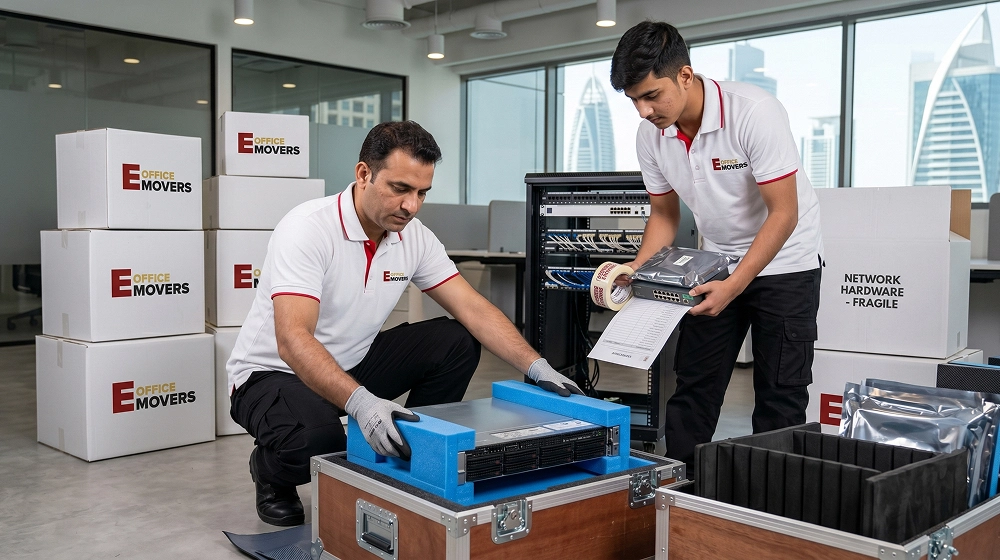
Network equipment is secured during relocation through configuration encryption, controlled access at both sites, vetted crews, and chain of custody tracking, because a firewall or router holds the keys to the entire office network. The settings on these devices are sensitive in a way that physical theft is not the only concern.
Secure network infrastructure transfer in Dubai usually combines:
- Protected configuration backups, stored securely so exported settings cannot be intercepted or misused.
- Controlled access at the old site during decommissioning and at the new site before equipment arrives.
- Vetted, trained technicians handling the active equipment, rather than general movers.
- Chain of custody documentation, tracking each device from removal to reconnection.
- Configured access control on the new server or comms room, whether keycard, biometric, or PIN, in place before the hardware lands.
The comms room or network cabinet at the destination needs the same access discipline as the rest of the move. A firewall sitting in an unlocked room is a risk regardless of how carefully it travelled.
How Much Does Network Infrastructure Relocation Cost in Dubai?
Network infrastructure relocation cost in Dubai depends on the size of the network, the amount of new cabling required, the building access conditions, and the depth of IT support involved, so the active equipment is rarely the largest line on the invoice. The structured cabling installation at the new site often costs more than moving the switches and routers.
The main pricing factors are:
- Network size: A handful of switches in a startup differs sharply from a multi-floor corporate network with dozens of access points.
- New cabling requirements: Installing and certifying structured cabling at the new site is frequently the biggest cost, since the old cabling stays behind.
- Building access: A high-floor office with shared lifts and restricted move hours costs more to work in than a ground-floor space with a dedicated service lift.
- Configuration complexity: A network with complex VLANs, firewall rules, and VPNs takes more skilled time to back up and restore than a flat, simple setup.
- Downtime tolerance: Near-zero downtime requires more planning and after-hours work, which raises the cost.
- IT support depth: Physical transport alone is cheaper than a full service that includes configuration backup, cabling, reconnection, and testing.
A site survey at both locations is the only way to get an accurate figure, because the cabling requirement and access conditions vary so widely between buildings. A network move quoted on device count alone usually misses the cabling, which is where the real cost sits.
Network Relocation Across Dubai’s Business Districts
Network relocation requirements vary across Dubai’s business districts, shaped by building age, cabling standards, and tenant type. The active equipment move is consistent, but the cabling and access picture changes from one area to another.
Business Bay
Business Bay’s newer towers generally come with modern cabling infrastructure, which can reduce the new-cabling cost. Service lift availability remains the scheduling constraint, and the area’s dense mix of SMEs and corporate offices keeps office network relocation work steady here.
DIFC
DIFC’s financial tenants run secure, complex networks with strict firewall and access requirements, so configuration handling and security clearance carry extra weight. Planning lead times run longer because of the additional approvals and the sensitivity of the data the network carries.
JLT (Jumeirah Lake Towers)
JLT, managed under DMCC, requires moves coordinated through building facility management with the service elevator booked ahead. The shared tower facilities make scheduling discipline essential, and evening or weekend moves are standard for network work.
Dubai Marina and the Free Zones
Dubai Marina offices tend to run smaller networks, so moves there centre on a few switches and access points rather than multi-floor systems. The free zones and tech hubs, including Dubai Internet City and Dubai Silicon Oasis, host technology-heavy tenants with larger, more complex networks, where corporate IT relocation in Dubai often involves substantial cabling and configuration work alongside the free zone’s own access rules.
How Do You Choose a Network Relocation Company in Dubai?
Choose a network relocation company in Dubai by checking that it handles configuration backup and structured cabling, not just physical transport, alongside its insurance, references, and district knowledge. A mover that carries the switches but cannot export a firewall configuration leaves you with the hardest part of the job undone.
Useful questions to ask:
- Do you back up and restore device configurations, or only move the hardware?
- Can you install and certify structured cabling at the new site?
- Do you employ network-trained technicians, or subcontract the technical work?
- What insurance do you carry for the equipment and the move?
- Can you provide references from comparable network relocations in Dubai?
- Do you run a site survey at both locations before quoting?
- How do you coordinate the internet circuit provisioning with the move date?
A provider that treats configuration and cabling as core parts of the job, rather than extras, is the one equipped for a real network move. IT network moving specialists handle the logical and physical sides together, which is what the work actually requires.
Common Network Relocation Mistakes to Avoid
Network relocation projects in Dubai tend to go wrong for a few predictable reasons, and most trace back to overlooking the logical side of the network in favour of the physical.
The recurring mistakes include:
- Skipping configuration exports, which leaves switches and firewalls blank at the new site.
- Ordering the internet circuit too late, so a rebuilt network still has no connection.
- Assuming cabling moves with you, when the new site usually needs fresh, certified cabling.
- Failing to map ports, turning reconnection into slow, error-prone cable tracing.
- Using general movers for active equipment, risking lost configurations and mishandled gear.
- Skipping connectivity testing, declaring the move done before confirming every device communicates.
Each mistake is avoidable with proper configuration backups, a documented topology, and a crew that understands networks rather than just transport.
Frequently Asked Questions
What is network infrastructure relocation?
Network infrastructure relocation is the process of moving a company’s connectivity equipment, including switches, routers, firewalls, and patch panels, while preserving the configurations that make the network function. It covers both the physical hardware and the logical settings that define how devices communicate.
Does structured cabling move with the network equipment?
Structured cabling generally does not move, since the cabling inside the old building’s walls stays behind. The new site needs its own cabling installed and certified before move day, while the active equipment such as switches and routers is what physically travels.
How are switch and router settings preserved during a move?
Switch and router settings are preserved by exporting each device’s configuration before powering it down and restoring it after reconnection. These backups hold VLANs, routing tables, and firewall rules that cannot be recovered from the hardware alone, so verifying them before the move is essential.
How long does network relocation take in Dubai?
Network relocation in Dubai typically takes one to two days for the active equipment, though structured cabling installation at the new site can add several days beforehand. Most moves happen outside business hours so testing completes before staff return.
Why does the internet circuit need early planning?
The internet circuit needs early planning because provisioning a new connection from a UAE provider can take weeks. A fully rebuilt network still stays offline if the circuit was ordered too late, so the provisioning timeline is coordinated with the move date from the start.
How is network equipment kept secure during relocation?
Network equipment is kept secure through protected configuration backups, controlled access at both sites, vetted technicians, and chain of custody tracking. Firewalls and routers hold the keys to the entire network, so the comms room access control is configured before the equipment arrives.
Can a regular office mover relocate network equipment?
A regular office mover is generally not equipped to relocate network equipment, because the work requires configuration backup, port mapping, and often structured cabling installation. IT network moving specialists handle the logical configuration and physical transport together.
How much does network infrastructure relocation cost in Dubai?
Network infrastructure relocation cost in Dubai depends on network size, new cabling requirements, building access, and configuration complexity. Structured cabling at the new site is often the largest cost, so an accurate quote requires a site survey at both locations.
Ali Al-Refai is an expert in the moving and logistics industry, with over 12 years of experience in managing both local and international moving operations. He has worked extensively in relocation planning, packing, and logistics, ensuring seamless and efficient transitions for individuals and businesses alike.
His expertise lies in optimizing moving processes, reducing costs, and ensuring the safe handling of items during relocation. Ali regularly shares insights and practical tips on best practices in moving, aiming to help people and companies achieve smoother, cost-effective relocations.