
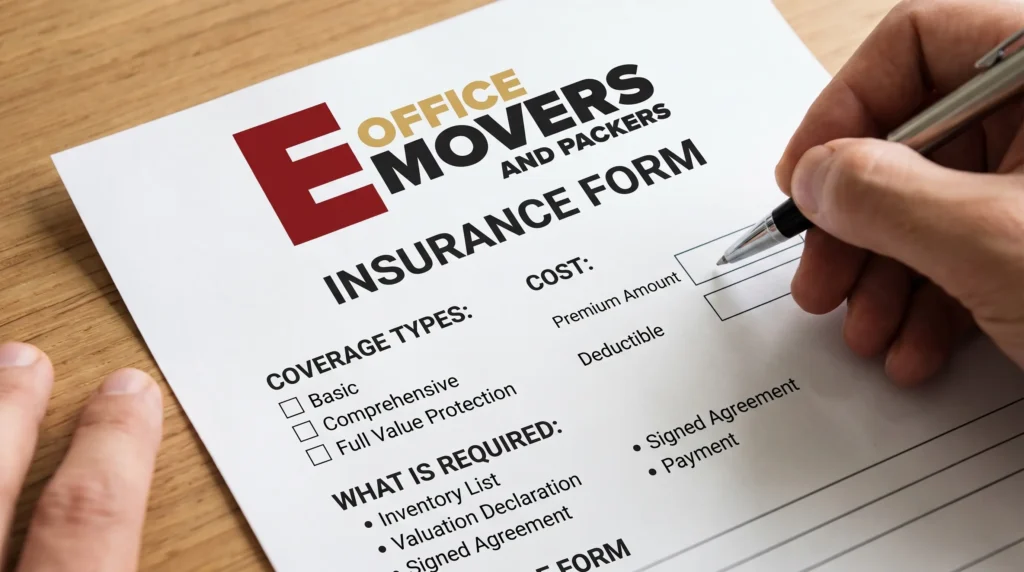
What Is Office Relocation Insurance in Dubai?
Office relocation insurance in Dubai is a policy that protects business assets against damage, loss, or theft while a company moves premises. The cover sits over the entire move window, from packing at the origin office to reinstatement at the destination. A policy attaches to furniture, IT hardware, files, fixtures, and any specialist equipment in transit.
The insurance works on a declared-value basis. A business lists the total worth of the assets being moved, and the policy indemnifies that value against the named risks. A 40-person office declaring AED 1.2 million in furniture, workstations, and IT carries cover for that figure across the move.
Office relocation insurance differs from a mover’s own liability. The mover’s liability sits low and often caps per kilogram, while a dedicated relocation policy covers the full replacement or repair value of the declared assets. The gap between the two figures is the exposure a business carries without a policy.
What Does an Office Mover in Dubai Cover Without Insurance?
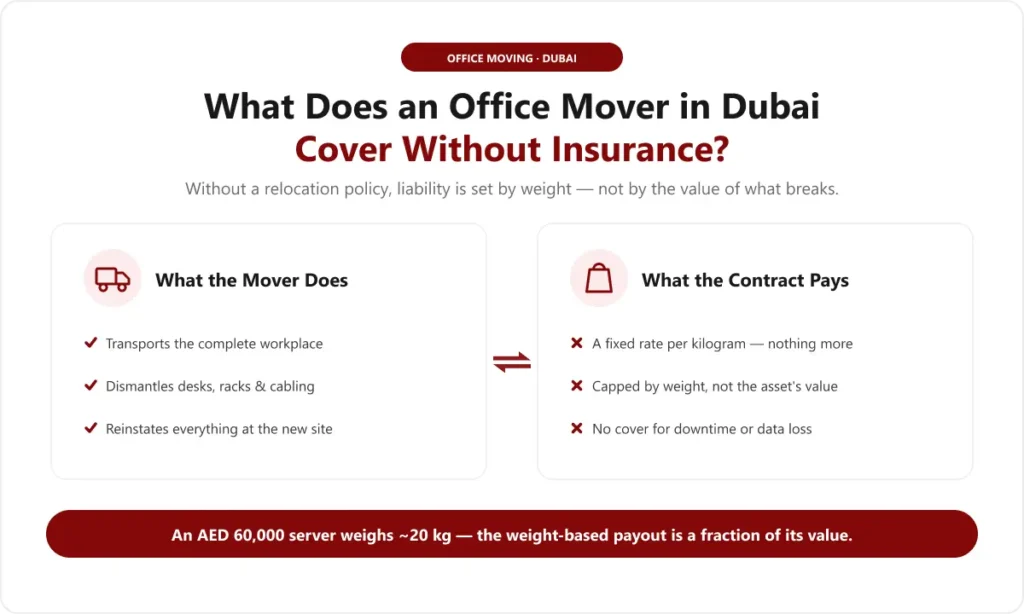
An office mover in Dubai without a relocation policy covers only a limited liability set by weight, not by the value of the asset damaged. A commercial mover transports, dismantles, and reinstates a complete workplace, yet the standard contract limits the mover’s financial responsibility to a fixed rate per kilogram of goods.
A damaged server worth AED 60,000 weighs little. Under a weight-based liability cap, the payout against that loss falls far below the replacement cost. The impact of the shortfalls on the business.
How Relocation Facilities Work in the UAE
The building access plans, free zone protocols, and insurer-declared-value requirements in UAE relocation facilities define the risk transfer process of a relocation. Most Dubai towers route goods through service lifts and loading bays booked in advance, and free zone premises inside DMCC, JAFZA, and DIFC add gate passes and crew clearance.
These access gates matter for insurance. A policy assessor examines how assets were handled, packed, and transported when a claim arises. Moves that follow building protocols, use proper protective packing, and keep a signed asset inventory present cleaner claims. Moves that cut corners on packing or skip the inventory weaken the claim before it reaches the insurer.
Why Do Dubai Businesses Need Office Relocation Insurance?
Dubai businesses need office relocation insurance because the value of office assets in transit exceeds the mover’s standard liability by a wide margin. The policy converts an open exposure into a capped, predictable cost. Four outcomes drive the decision.
- Protection against accidental damage: A dropped monitor, a scratched boardroom table, or a server jolted in transit all sit inside an all-risk policy. The cover repairs or replaces the asset at its declared value rather than at a weight-based fraction.
- Coverage for valuable office assets: IT infrastructure, specialist equipment, and high-value furniture carry replacement costs that a mover’s liability never matches. A dedicated policy closes that gap.
- Reduced financial risk during relocation: A single damaged data cabinet absorbs a five-figure replacement bill. Insurance moves that risk off the company balance sheet for the price of a premium.
- Peace of mind for business owners and managers: Operations and facilities managers coordinate moves under pressure. A policy removes the worst-case financial scenario from the decision set, letting the team focus on continuity.
The case strengthens for businesses with dense IT or sensitive records. A professional services firm moving client files and a redundant server setup carries more concentrated value per crate than a flat-pack startup, and the policy reflects that.
What Risks Affect Office Assets During a Dubai Move?
Office assets face six measurable risks during a Dubai relocation, ranging from physical impact to building access failures. Each risk sits inside a properly structured all-risk policy.
- Impact and handling damage: Workstations, monitors, and partitions chip, crack, or break under improper handling. Heavy boardroom furniture and storage walls carry the highest impact exposure.
- IT and electronic failure in transit: Servers, network cabinets, and data storage suffer from vibration, static, and shock. Hardware that survives the lorry sometimes fails on power-up at the destination.
- Loss and theft: Assets moving through loading bays, service lifts, and multiple lorry trips create handover points where items go missing. Sequential labelling and a signed inventory reduce this exposure.
- Water and environmental damage: Dubai loading bays and open transfer points expose assets to heat and the occasional washdown. Sensitive electronics and documents carry the most environmental risk.
- Document and data loss: Physical records and unbacked-up local data face permanent loss if a crate is damaged or misplaced. Sensitive corporate files raise both a financial and a compliance exposure.
- Building access incidents: A service lift failure or a blocked loading bay forces rushed handling, which raises the chance of damage. Free zone gate delays compress the move window and add pressure on the crew.
The IT and document risks concentrate the most value in the smallest footprint, which is why insurers weigh them heavily when pricing a policy.
What Types of Office Relocation Insurance Coverage Exist?
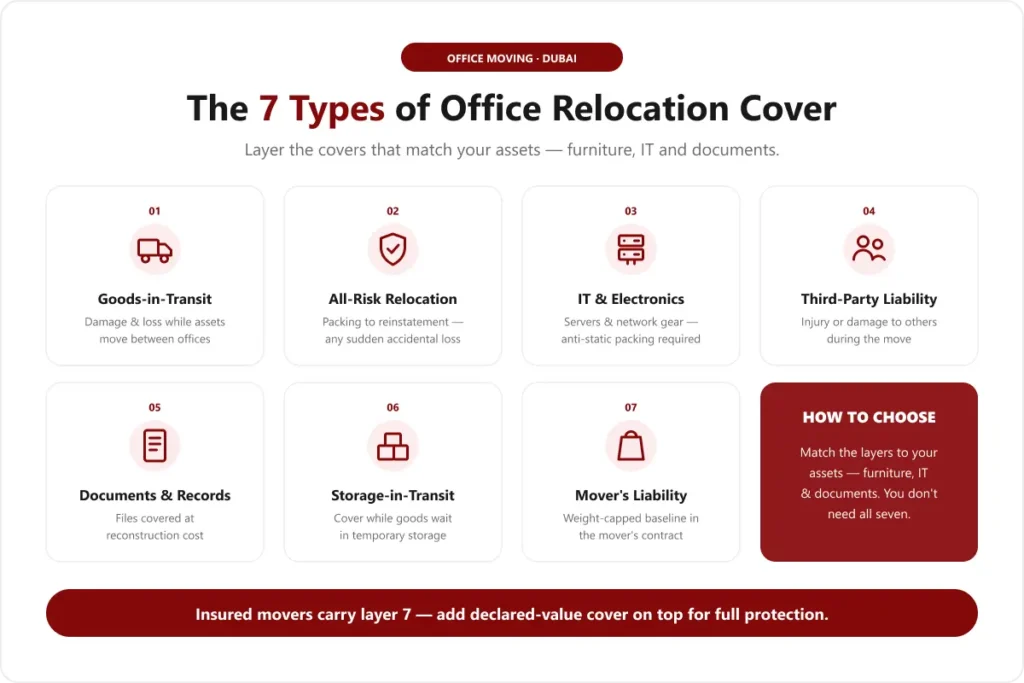
Office relocation insurance in Dubai comes in seven coverage types, layered to match a company’s asset profile. A business selects the combination that fits its furniture, IT, and document exposure rather than buying every layer.
- Goods-in-transit cover: This base layer protects assets while they move between the origin and destination offices. The cover responds to damage and loss during transport.
- All-risk relocation cover: This broader layer extends protection across the full move window, including packing, dismantling, transit, and reinstatement. All-risk responds to any sudden and accidental loss not specifically excluded.
- IT and electronic equipment cover: This specialist layer protects servers, network hardware, and electronics against damage and internal failure caused by the move. The cover often requires anti-static packing and professional handling as a condition.
- Public and third-party liability cover: This layer protects the business against claims for injury or property damage caused to others during the move, including damage to the building or to a third party in a loading bay.
- Document and records cover: This layer protects physical files and records against loss or damage, valued by reconstruction cost rather than market price.
- Storage-in-transit cover: This layer protects assets held in temporary storage when a move runs in phases or the destination office is not yet ready.
- Mover’s combined liability: This baseline sits inside the mover’s own contract and caps by weight. Insured movers carry this layer, yet a business adds declared-value cover on top for full protection.
A startup with cloud IT and flat-pack furniture buys goods-in-transit and all-risk. A corporate office with a server room and physical records adds IT, document, and storage layers.
What Does Office Relocation Insurance Cost in Dubai?
Office relocation insurance in Dubai costs a percentage of the declared asset value, typically between 0.5 and 2 percent, set by the asset mix and the risk profile of the move. A move declaring AED 1 million in assets at a 1 percent rate carries a premium near AED 10,000. The figures below reflect market benchmark ranges, not fixed quotes, since insurers price each move on its declared value and conditions.
The table groups indicative premium ranges by asset profile.
| Asset Profile | Declared Value (AED) | Indicative Premium Rate | Typical Cover Layers |
| Light office, cloud IT | Up to 500,000 | 0.5% to 1% | Goods-in-transit, all-risk |
| Standard SME office | 500,000 to 1.5m | 0.75% to 1.25% | All-risk, IT equipment |
| IT-heavy or document-heavy | 1.5m to 4m | 1% to 1.75% | All-risk, IT, document, liability |
| Corporate, phased move | 4m+ | 1.25% to 2% | Full layered cover, storage-in-transit |
The rate climbs with concentrated IT and document value. A server room and a redundant data setup raise the per-asset risk, so the insurer prices the policy nearer the top of the band. A flat-pack office with cloud-only IT sits at the lower edge.
Fixed premium pricing without a declared value misleads. Two offices of identical size produce different premiums once the asset mix, packing standard, and move conditions enter the calculation.
What Determines Office Relocation Insurance Premiums?
Office relocation insurance premiums are determined by five factors, led by the declared value and the asset mix. Each factor moves the rate the insurer applies to the declared figure.
- Declared asset value: The total worth of the moved assets forms the base figure the premium rate applies to. Higher declared value raises the premium in direct proportion.
- Asset mix and fragility: A move heavy in IT and electronics carries a higher rate than a move of robust furniture, since fragile and high-value assets concentrate the risk.
- Packing and handling standard: Professional packing, crate hire, and anti-static materials lower the rate, since they reduce the chance of a claim. Self-pack arrangements raise it.
- Move complexity and distance: A cross-city or multi-phase move carries more handover points than a single-floor move within one building, and more handovers raise the risk.
- Mover credentials: A move handled by an insured, experienced commercial mover prices lower than one handled by an unvetted contractor, since the insurer weighs the handling standard.
Businesses new to office relocation often skip the declared-value step and underinsure as a result. A policy that declares half the true asset value pays out half the loss, leaving the company to absorb the rest. A full inventory and an honest valuation set the premium correctly and protect the claim.
How Do You File an Office Relocation Insurance Claim?
File an office relocation insurance claim by documenting the loss, notifying the insurer within the policy window, and submitting the inventory with proof of value. A clean claim follows five steps.
- Document the damage at the destination: Photograph the damaged asset, record the date, and note the condition before moving it further.
- Notify the mover and the insurer: Report the loss inside the notification period stated in the policy, since late notice weakens a claim.
- Submit the signed asset inventory: Provide the move inventory and the declared-value list that the policy was written against.
- Provide proof of value and ownership: Supply purchase records, asset registers, or replacement quotes that evidence the declared figure.
- Receive the assessment and settlement: The insurer assesses the claim against the policy terms and settles at the repair or replacement value.
The inventory carries the claim. A move documented with sequential labelling and a signed asset register moves through assessment faster than one with no record of what travelled or what it was worth. Insured movers maintain this paperwork as standard, which is why the choice of mover affects the claim outcome as much as the policy itself.
What Do Insured Office Movers in Dubai Provide?
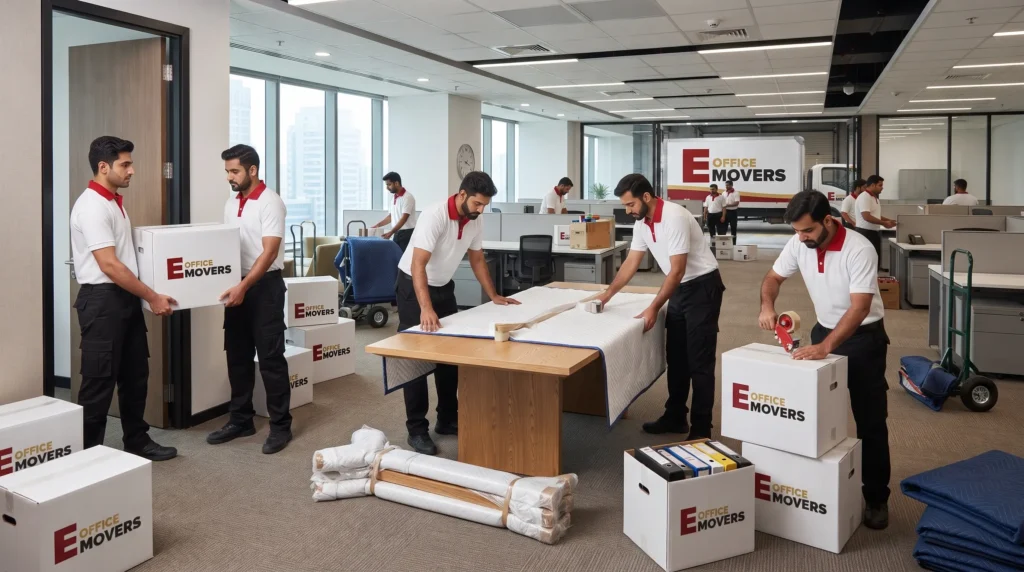
Insured office movers in Dubai provide a documented chain of custody, professional packing, and a liability layer that supports the relocation policy. The mover’s own cover sits underneath the business policy, and the two work together when a claim arises.
The standard scope from an insured mover covers a pre-move survey, a signed asset inventory, sequential labelling, professional packing, and a documented handover at the destination. Anti-static packing for IT and crate hire for fragile items meet the conditions that an IT equipment policy attaches.
Security and Access Systems During an Insured Move
Security and access systems during an insured move require coordinated decommissioning, transport, and recommissioning. Door controllers, biometric readers, CCTV networks, and server room access panels carry both physical value and operational sensitivity. An insured mover handles these alongside the IT scope, often coordinating with the building’s security integrator.
The handling of access systems ties back to the policy. A biometric controller damaged in transit sits inside the IT equipment layer, and a documented decommissioning record supports the claim. A move that pulls security hardware without a record weakens both the recommissioning and any later claim.
Frequently Asked Questions
Is office relocation insurance required for a Dubai office move?
Office relocation insurance is not legally mandatory, yet it is commercially essential for any move with valuable assets. A mover’s standard liability caps by weight, leaving a wide gap against the replacement value of IT, furniture, and equipment. A declared-value policy closes that gap and protects the business balance sheet.
What does office relocation insurance cover in Dubai?
Office relocation insurance covers damage, loss, and theft of business assets across the full move window. The protection extends to furniture, IT hardware, documents, and fixtures from packing through transit to reinstatement. Layered policies add IT equipment cover, document cover, public liability, and storage-in-transit protection based on the asset profile.
How much does office move insurance cost in the UAE?
Office move insurance in the UAE costs between 0.5 and 2 percent of the declared asset value. A move declaring AED 1 million at a 1 percent rate carries a premium near AED 10,000. The rate climbs with concentrated IT and document value, and a declared-value inventory sets the figure accurately.
Does a mover’s liability replace office relocation insurance?
No, a mover’s liability does not replace office relocation insurance. The mover’s cover caps by weight, not by asset value, so a lightweight high-value item like a server pays out far below its replacement cost. A dedicated declared-value policy indemnifies the full worth of the assets in transit.
How do you insure IT equipment during an office move in Dubai?
Ensure IT equipment through a dedicated IT and electronic equipment layer added to the relocation policy. The cover protects servers, network hardware, and electronics against transit damage and internal failure. Insurers often require anti-static packing and professional handling as a condition, so an insured mover supports the policy terms.
What weakens an office relocation insurance claim?
A relocation insurance claim weakens through missing documentation, late notification, and underinsured declared value. Claims without a signed asset inventory, without photographs of the damage, or reported after the policy window face delays or reduction. An accurate declared value and a documented chain of custody support a clean settlement.
Do insured office movers cost more in Dubai?
Insured office movers carry a slightly higher rate than unvetted contractors, offset by lower claim risk. The premium difference reflects professional packing, documented handovers, and a liability layer that supports the business policy. The lower risk of damage and the cleaner claim process recover the cost difference across the move.
Ali Al-Refai is an expert in the moving and logistics industry, with over 12 years of experience in managing both local and international moving operations. He has worked extensively in relocation planning, packing, and logistics, ensuring seamless and efficient transitions for individuals and businesses alike.
His expertise lies in optimizing moving processes, reducing costs, and ensuring the safe handling of items during relocation. Ali regularly shares insights and practical tips on best practices in moving, aiming to help people and companies achieve smoother, cost-effective relocations.