
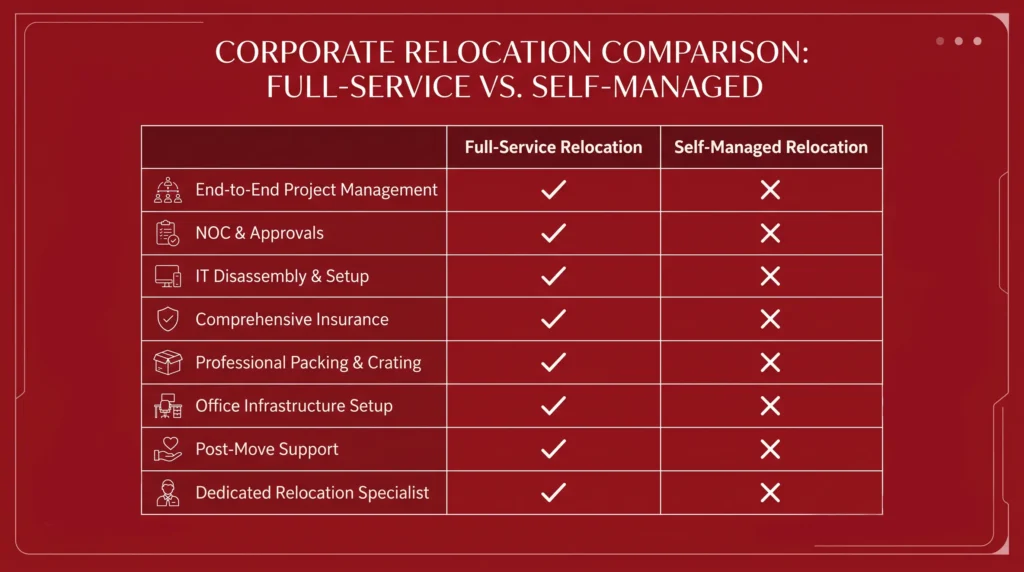
Office moving cost in Dubai depends on the procurement model a business selects: full-service relocation or self-managed relocation. The full-service model assigns packing, transport, IT migration, furniture handling, and project management to one commercial mover. The self-managed model keeps coordination, labour sourcing, equipment hire, and liability inside the business. The two models differ across direct cost, hidden cost, downtime exposure, and risk transfer. The sections below compare service inclusions, cost components, IT and furniture handling, building access and permit requirements, insurance, and the scenarios where each model controls spend. A Business Bay to DIFC relocation serves as the worked example throughout.
What does a full-service office move mean in Dubai?
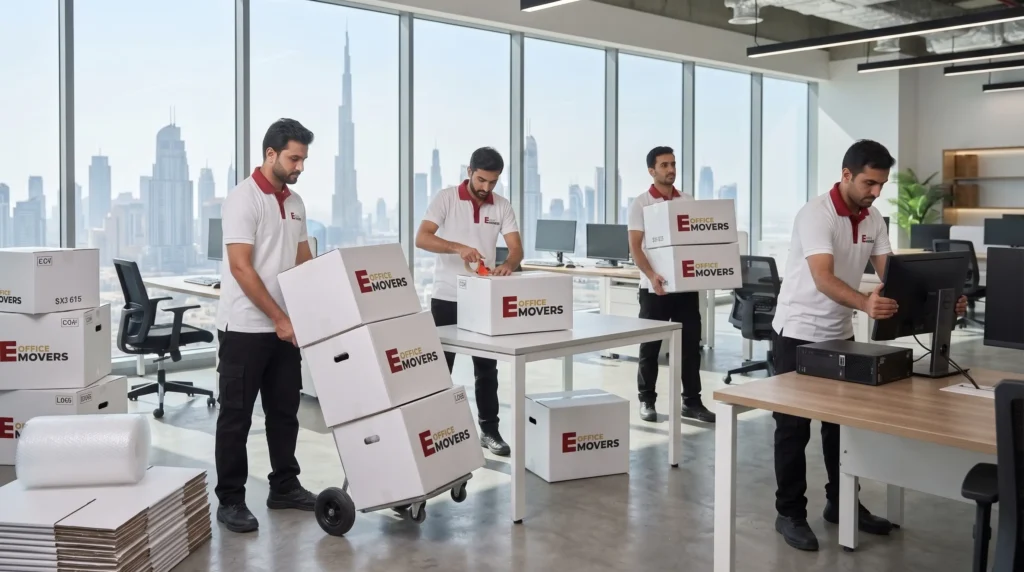
A full-service office move in Dubai is a relocation model where one commercial mover manages packing, transportation, IT disconnection and reconnection, furniture dismantling and reassembly, permits, and project coordination from start to finish. The business assigns one point of contact and one contract. The mover supplies crews, vehicles, packing materials, and equipment. Project managers handle floor plans, sequential labelling, and access scheduling with building management. The model converts a fragmented operation into one accountable workstream. Cost arrives as a single quotation rather than separate items sourced by the business.
What does a self-managed office move involve?

A self-managed office move involves the business coordinating packing, labour, vehicle hire, IT handling, and building access internally, with multiple suppliers contracted separately. Operations staff or an office administrator owns the project. The business sources packing materials, books transport, assigns employees or casual labour, and arranges permits directly with tower management. Each supplier issues a separate invoice. Control stays inside the business, and so does liability for damage, delay, and data loss. The model suits small relocations with light IT and minimal specialist equipment.
What does a full-service office relocation include?
A full-service office relocation in Dubai includes a defined set of logistics, handling, and management services delivered under one contract. The package covers the relocation lifecycle from survey to setup. The following services form a standard full-service scope:
- The site inspection and inventory audit is conducted before the move.
- Packing materials and professional packing crews
- Furniture dismantling, transport, and reassembly
- IT equipment disconnection, transit protection, and reconnection
- Loading, transport, and unloading with trained crews
- Loading bay booking and building access coordination
- Sequential labelling and floor-plan-based placement
- Transit insurance and contractual liability cover
- Project management and a single point of contact
The scope removes supplier coordination from the business and consolidates accountability with the mover.
How do full-service and self-managed office move costs compare?
Full-service and self-managed office move costs compare across direct costs, hidden costs, and risk transfer rather than a single headline figure. The full-service model concentrates spend into one visible quotation. The self-managed model splits spend across suppliers and absorbs hidden costs in employee time, downtime, and rework. The table below maps the main cost components of an office relocation against each model and identifies whether the cost surfaces as a direct or hidden expense.
| Cost component | Full-service move | Self-managed move |
| Packing materials | Included in quotation (direct) | Sourced separately (direct) |
| Labour | Professional crews in quotation (direct) | Casual hire or employee time (direct and hidden) |
| Transport and vehicles | Provided by mover (direct) | Rented per trip (direct) |
| IT relocation | Specialist handling included (direct) | Internal IT or external contractor (direct and risk) |
| Furniture dismantling and reassembly | Included (direct) | Internal labour or skipped (hidden and risk) |
| Permits and building access | Coordinated by mover (direct) | Arranged by business (direct and time) |
| Insurance and liability | Transit cover included (direct) | Often uninsured (risk) |
| Project management | Dedicated manager (direct) | Employee time (hidden) |
| Business downtime | Compressed by scheduling (reduced) | Extended by inexperience (hidden) |
| Rework and damage | Mover liability (covered) | Business absorbs (hidden) |
The headline price of a self-managed move reads lower because hidden costs sit outside the visible invoice.
What direct cost components apply to an office move?
The direct cost components of an office move are labour, transportation, packing materials, and specialist equipment. Labour cost depends on crew size and move duration. Transportation cost depends on vehicle type, trip count, and distance, such as the route from Business Bay to DIFC. Packing cost depends on material grade and item volume, with crates and anti-static wrap costing more than standard cartons. Equipment cost covers trolleys, stair climbers, hydraulic tailgates, and protective floor coverings. After-hours and weekend slots raise labour rates because tower access windows narrow.
What costs do businesses overlook in a self-managed move?
Businesses overlook employee time, operational downtime, rework, and uninsured damage in a self-managed move. Employee hours spent packing and coordinating replace productive work, and that lost output carries a real cost. Downtime extends when crews lack relocation experience, and idle staff at a closed office multiply the loss. Rework follows poor labelling, with boxes opened repeatedly to locate assets. Uninsured damage to monitors, servers, and furniture lands directly on the business. These costs stay invisible until the move ends.
How do IT equipment and server relocation affect the cost?

IT equipment and server relocation raise the cost because the assets require specialist packing, structured shutdown, and tested reconnection. Servers travel in anti-static wrapping and shock-protected crates. Rack-mounted equipment requires rail removal, sequential labelling, and cable mapping before disconnection. Reconnection includes power-up sequencing, network verification, and data integrity checks. A failed server move risks data loss and extended downtime, which outweighs the handling fee. Full-service movers price IT relocation as a specialist line, and self-managed moves shift this risk to internal IT teams.
How do furniture dismantling and reassembly affect the cost?
Furniture dismantling and reassembly add cost through skilled labour and time, particularly for modular workstations and partition systems. Modular desks, bench systems, and glass partitions require trained fitters and correct tools. Incorrect disassembly damages panels and fixings, which forces replacement. Reassembly to the new floor plan extends crew hours at the destination. Full-service movers bundle this labour into the quotation. Self-managed moves either pay a separate fitter or assign untrained staff, which raises the damage rate.
What building access and permit costs apply in Dubai?
Building access and permit costs in Dubai include loading bay bookings, move permits from tower management, security deposits, and access scheduling. Commercial towers in Business Bay and DIFC require advance loading bay reservations and restrict move times to designated windows. Tower management issues move-in and move-out permits and often holds a refundable security deposit against damage to common areas. Lift booking and floor protection apply during the move. DEWA disconnection and reconnection at both sites coordinates with the moving date. Permit charges and deposit amounts vary by tower and free zone.
How do risk, insurance, and liability differ?
Risk, insurance, and liability differ because a full-service mover carries transit insurance and contractual liability, while a self-managed move leaves the business exposed. Full-service contracts define liability for loss and damage and include transit cover for assets in motion. Self-managed moves often proceed without dedicated transit insurance, so damage to IT hardware or furniture becomes an unrecovered loss. Liability for injury during lifting also shifts to the business when employees handle heavy items. Risk transfer forms a core part of the full-service cost.
When does each office move model make financial sense?

A self-managed move makes financial sense for small offices with light IT, short distances, and flexible timelines, and a full-service move makes financial sense for larger offices, dense IT, tight timelines, and high business-continuity requirements. A startup relocating a single floor with laptops and a few desks controls cost through a self-managed move. An SME with server infrastructure and forty staff reduces total cost through a full-service move because downtime and risk dominate the equation. Larger corporations with multi-floor footprints rely on full-service project management to protect continuity. The decision tracks office size, IT density, and the cost of downtime.
What factors influence office move pricing in Dubai?
Office move pricing in Dubai depends on office size, relocation distance, move complexity, IT density, access conditions, and timeline. Office size sets crew count and vehicle requirements through floor area and workstation volume. Distance affects transport, though intra-Dubai routes such as Business Bay to DIFC keep mileage low while access conditions dominate. Complexity rises with servers, modular furniture, and high-rise access. Tight or after-hours timelines raise labour rates. Each factor compounds, so a small office with heavy IT costs more than a large office with a light fit-out.
How do you compare quotes and reduce office relocation costs?
You compare office moving quotes by checking scope, inclusions, insurance, and access handling line by line rather than the headline price. A low quotation that excludes IT handling, permits, or insurance costs more after the gaps surface. The following practices control relocation spend:
- Request itemised quotations with a defined scope
- Confirm insurance and liability terms in writing
- Schedule the move outside peak periods where access allows
- Declutter and dispose of redundant assets before the survey
- Consolidate IT and furniture handling under one provider
- Verify permit and deposit responsibilities before signing
Comparing scope rather than price reveals the true cost difference between providers.
How do you choose between a full-service and self-managed office move?

You choose between a full-service and self-managed office move by weighing office size, IT density, downtime tolerance, and internal capacity against budget. A business with limited IT, a flexible schedule, and available staff controls cost with a self-managed move. A business with server infrastructure, a fixed go-live date, and lean internal teams protects continuity and total cost with a full-service move. The cost comparison resolves once downtime, risk, and employee time enter the calculation alongside the visible invoice.
FAQs
How much does a self-managed office move save in Dubai?
A self-managed office move saves on visible service fees but rarely on total cost once downtime, employee time, and damage risk enter the calculation. Small, low-IT moves achieve real savings. Larger moves often cost more under a self-managed model.
Do office movers in Dubai include permits in the price?
Office movers in Dubai include access coordination in full-service quotations, though tower permit fees and deposits depend on building management. Confirm whether permit charges sit inside the quotation or pass through as a separate cost before signing the contract.
What is the most overlooked office move cost?
The most overlooked office move cost is employee downtime, the productive hours lost while staff pack, coordinate, and wait through a closed office. Downtime cost often exceeds the price difference between a self-managed and a full-service move.
Who is liable for damage during a self-managed office move?
The business carries liability for damage during a self-managed office move, including IT hardware, furniture, and common-area damage. Without transit insurance, the business absorbs replacement costs directly. Full-service contracts transfer this liability to the mover.
How long does an office relocation take in Dubai?
An office relocation in Dubai takes from one day for a small office to several days for a multi-floor corporate move. Building access windows, IT complexity, and crew size set the timeline. Full-service scheduling compresses the active move period.
Ali Al-Refai is an expert in the moving and logistics industry, with over 12 years of experience in managing both local and international moving operations. He has worked extensively in relocation planning, packing, and logistics, ensuring seamless and efficient transitions for individuals and businesses alike.
His expertise lies in optimizing moving processes, reducing costs, and ensuring the safe handling of items during relocation. Ali regularly shares insights and practical tips on best practices in moving, aiming to help people and companies achieve smoother, cost-effective relocations.