
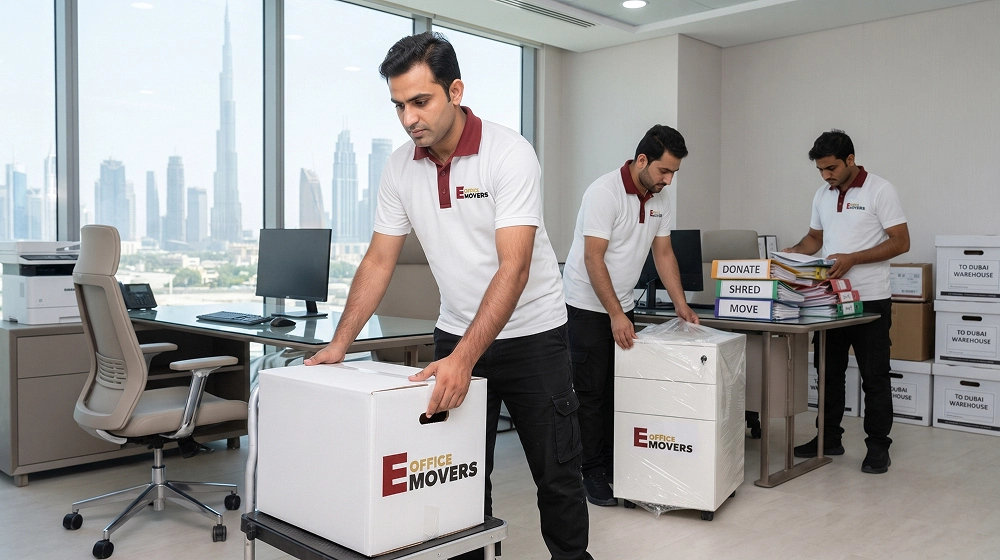
Office decluttering before moving in Dubai is the structured process of reviewing every asset in a workspace and sorting it into keep, relocate, sell, donate, recycle, or dispose before a commercial relocation begins. It happens before packing, not during it, and it shapes how much you pay, how long the move takes, and how quickly your team settles into the new space.
Most businesses underestimate how much they have accumulated until the boxes come out. Filing cabinets nobody has opened in three years. A storeroom of dead monitors. Marketing pull-up banners from a 2019 expo. All of it gets quietly carried to the next office unless someone stops it.
This guide breaks down what to move, what to dispose of, and what to replace, with the Dubai context that actually affects those decisions.
Why Does Office Decluttering Matter Before a Move?
Decluttering matters because office relocation costs in Dubai are driven by volume, and every unnecessary item adds weight, packing time, and truck space you pay for. Movers price commercial jobs around how much there is to handle. A leaner inventory means fewer crates, fewer man-hours, and a smaller vehicle.
The impact runs across three areas:
- Moving cost: Fewer items means less to pack, load, transport, and unload. You are not paying skilled labour to wrap a broken printer.
- Packing time: A decluttered office gets boxed faster, which matters when you are trying to limit business downtime over a weekend.
- New-space efficiency: Walking into a fresh fit-out with only what you use means a faster setup and a cleaner start, instead of unpacking clutter into a smaller footprint.
There is also a hidden cost to skipping this step. Carrying old equipment into a new lease often means renting storage you did not need, or losing usable floor space to furniture nobody wanted in the first place.
What Counts as Common Office Clutter?
Common office clutter falls into five categories: outdated furniture, unused electronics, old paperwork, broken supplies, and excess marketing inventory. Recognising these groups early makes the sorting process far quicker.
Across most Dubai offices, the usual culprits look like this:
- Outdated furniture and workstations: Worn desks, mismatched chairs, partition panels that no longer fit an open-plan layout, and reception units that have aged out of the brand look.
- Unused electronics and IT equipment: Old desktops, dead laptops, tangled cable bins, retired routers, and monitors stacked in a corner “just in case.”
- Old files and archived documents: Years of printed invoices, expired contracts, HR records past their retention period, and binders that were digitised long ago.
- Broken office supplies and storage items: Jammed shredders, damaged label printers, cracked storage boxes, and stationery that has dried out.
- Excess inventory and promotional material: Event banners, branded giveaways, old brochures, and sample stock that has lost relevance.
Two of these categories carry extra weight in Dubai specifically. Paper records sit under data-handling rules, and IT hardware needs proper wiping before it leaves the building. Both are covered further down.
How Do You Declutter an Office Before Relocation?
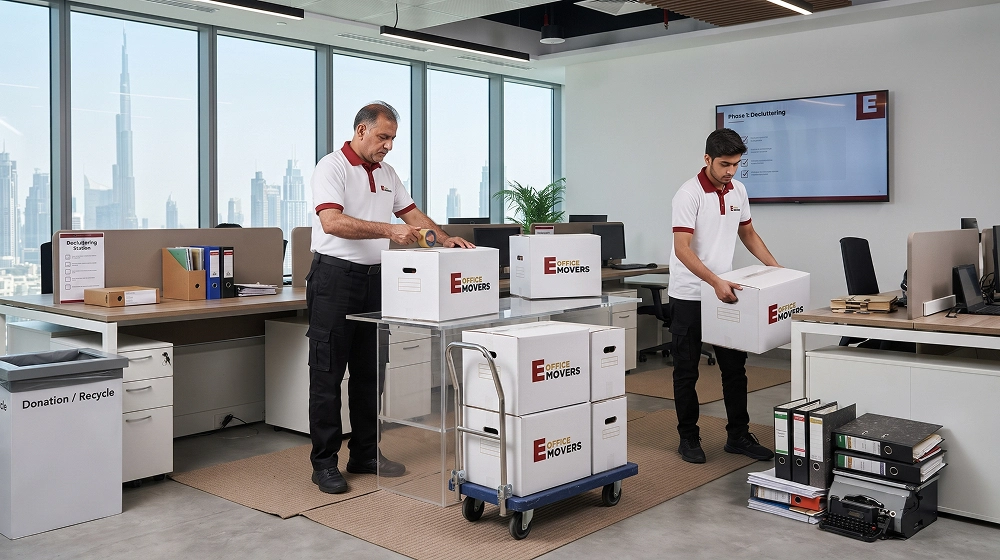
To declutter an office before relocation, assess the full space, categorise every item, assign departmental ownership, set a timeline, and track progress with a checklist. A structured cleanout prevents the last-minute panic where everything gets boxed by default.
Here is a working sequence that holds up for SMEs and larger corporate teams alike.
- Assess the entire office: Walk every zone: desks, meeting rooms, the pantry, the server cupboard, and storage. Photograph problem areas. Build a rough inventory so nothing surfaces as a surprise on moving day.
- Categorise each item: Sort into keep, relocate, sell, donate, recycle, or dispose. Colour-coded stickers or simple tags work well, and they let movers see at a glance what travels and what stays.
- Assign responsibility by department: Finance owns its records. IT owns its hardware. Each team clears its own zone, which spreads the workload and stops one person carrying the whole project.
- Set a decluttering timeline: Start two to three weeks ahead of packing, not the night before. Block specific days for specific zones so progress is visible.
- Track with a checklist: A shared sheet showing what is sorted, pending, or collected keeps everyone honest and gives the move coordinator a single source of truth.
This stage links directly into the wider office move planning process and works best when it runs alongside, not after, the relocation schedule.
How Should You Handle Documents and Records Before Moving?
Documents should be sorted into active records that move, archived records that go to storage, and obsolete records that get securely shredded. Office paperwork is the category most likely to be moved blindly, and it is the one with compliance attached.
Work through it in three passes:
- Active files: Anything in current use moves with you. Label boxes by department and date range so unpacking is logical.
- Archive files: Records you are legally required to retain but rarely touch belong in commercial storage or a digitised archive, not a desk drawer in the new office.
- Disposal files: Expired contracts, duplicate prints, and records past their retention period go to secure shredding.
Document shredding and disposal in Dubai should be handled through a service that provides certified destruction, particularly for anything carrying client data, financial details, or HR information. Loose paper in a skip is a data risk, not a disposal method. Where records contain personal data, the move falls under the same handling principles set out in UAE data-protection practice, which the data security during office relocation guide covers in detail.
A practical move: digitise what you can before the relocation. A real estate firm in Business Bay cut its paper volume by roughly two-thirds simply by scanning closed property files ahead of a move to JLT, which meant fewer cabinets, fewer boxes, and a smaller storage bill afterward.
What Do You Do With IT Equipment and Technology Assets?
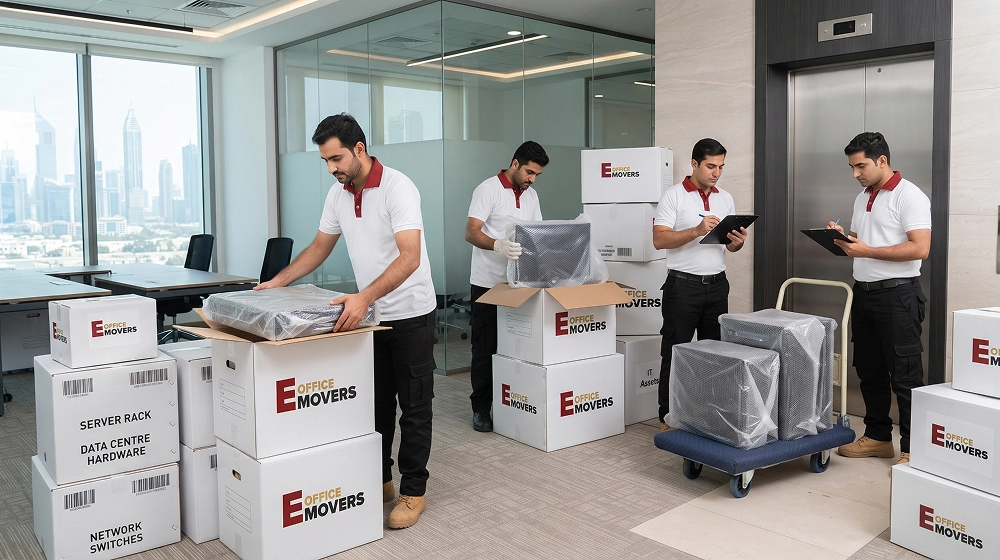
IT equipment should be audited against your asset register, wiped of all data, and split into hardware that relocates, gets resold, or goes to certified e-waste recycling. Technology is the highest-risk and highest-value category in any office cleanout.
Run it in this order:
- Audit against the asset register: Match physical hardware to your records. Anything unlisted or end-of-life is a candidate for removal.
- Wipe before it leaves: Every drive, including retired laptops and copiers with internal storage, needs certified data destruction. This is not optional for business hardware.
- Decide the destination: Working kit relocates. Functional surplus can be resold or donated. Dead hardware goes to e-waste recycling, never general waste.
Server rooms and network hardware sit in their own category because of cabling, racking, and downtime risk, and they are handled through the dedicated server room relocation workflow rather than a general declutter. The decluttering stage simply identifies what is redundant so the IT migration is cleaner.
A short example: a marketing agency moving from Media City found eleven obsolete desktops and four broken monitors during its cleanout. Wiped, sorted, and sent to a certified recycler, they never made it onto the truck, which freed space and removed a data-security headache in one step.
Which Furniture and Equipment Should You Move, Replace, or Dispose Of?
Furniture should be moved if it is in good condition and fits the new layout, replaced if relocation costs more than its value, and disposed of if it is damaged or obsolete. This is the core decision of any decluttering project, and it comes down to a simple value test.
Apply this logic to each item:
- Move it: when the piece is in good shape, suits the new office design, and costs less to transport than to buy again.
- Replace it: when the item is worn, mismatched, or so bulky that moving and reassembling it costs more than a fresh purchase. Heavy legacy storage units often fall here.
- Dispose or recycle it: when the item is broken, unsafe, or simply does not belong in the new space.
Downsizing changes the maths. A company moving into a smaller, more efficient footprint should be ruthless, because square metres in the new lease are the expensive resource. Carrying three unused meeting tables into a compact JLT office defeats the purpose of moving.
For startups scaling up, the opposite applies. Moving into a larger space is the moment to replace the cramped, secondhand furniture that got you started, rather than spreading it thinly across a bigger floor.
Where Can You Recycle or Dispose of Office Items in Dubai?
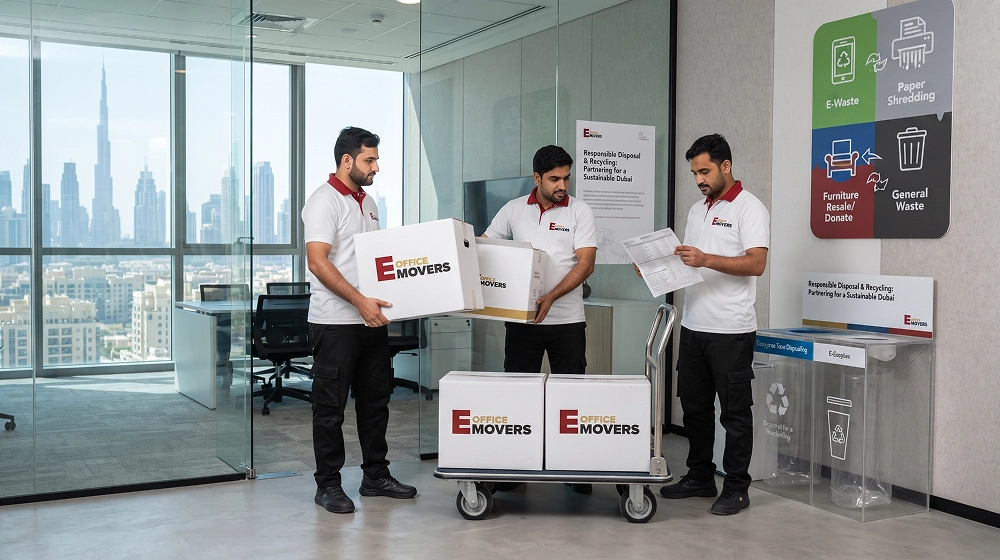
Office items in Dubai can be recycled or disposed of through Dubai Municipality bulky-waste collection, registered e-waste recyclers, furniture resale channels, and donation to community organizations. Disposal is regulated here, and dumping commercial volumes incorrectly carries penalties.
The main routes:
- Bulky furniture and fittings: Dubai Municipality handles bulky-waste collection, and many movers coordinate this as part of a clearance service.
- Electronics and IT hardware: Certified e-waste recyclers in the UAE handle screens, devices, and batteries under proper environmental standards.
- Resale: Functional desks, chairs, and equipment hold value on the local secondhand market, which offsets some moving costs.
- Donation: Usable furniture and supplies can go to smaller businesses, schools, or community groups rather than landfill.
Green relocation is increasingly part of the brief for Dubai businesses tracking sustainability commitments. Sorting for reuse and recycling, instead of clearing everything to waste, is the practical version of that goal.
How Does Decluttering Reduce Office Moving Costs?
Decluttering reduces moving costs by shrinking the volume that movers pack, transport, and unload, which lowers labour hours, truck size, packing materials, and storage fees. Cost in commercial moving tracks volume, so removing dead weight removes line items.
The savings show up in four places:
- Labour: Fewer items to wrap and carry means fewer man-hours billed.
- Transport: A smaller load can mean a smaller vehicle or fewer trips.
- Materials: Less to pack means fewer crates, boxes, and wrapping supplies.
- Storage: Nothing redundant gets carried into paid storage at the other end.
Exact figures depend on office size, item mix, and access at both buildings, which is why a site survey sets accurate pricing. The detailed breakdown of what drives a quote sits in the office relocation cost guide, where pricing factors are covered in full.
How Do Mover Type and Building Security Affect a Decluttered Move?
The type of mover and the access controls at each building determine how a decluttered inventory is scheduled, secured, and cleared. A clean inventory still needs the right team and the right access plan to move smoothly.
On mover type, a full-service commercial mover manages packing, IT handling, and disposal coordination, while a basic transport-only service expects you to prepare everything yourself. Businesses moving for the first time usually benefit from the former, because the decluttering, packing, and clearance are coordinated together rather than juggled in-house. The differences are set out in the how to choose office movers guide.
On security, Dubai office buildings and free zones run access systems that affect move-out logistics: gate passes, lift booking, loading-bay slots, and security clearance for moving crews. Free zones such as DMCC and JLT often require advance permits and approved contractor lists. Factoring this in early prevents a decluttered, packed office from sitting idle because the crew could not get a loading slot.
Frequently Asked Questions
When should office decluttering start before a move?
Office decluttering should start two to three weeks before packing begins. This window gives each department time to sort its own zone, arrange secure shredding, schedule e-waste collection, and resolve disposal without rushing on moving day.
Why should you not move to a new office?
You should not move broken equipment, obsolete IT hardware, expired documents, damaged furniture, or unused promotional stock. Carrying these items raises packing time and transport cost while filling valuable space in the new office.
How do you dispose of confidential documents before relocating to Dubai?
Confidential documents in Dubai should be destroyed through a certified shredding service that issues a destruction certificate. This protects client data, financial records, and HR files, and keeps the disposal compliant with UAE data-handling expectations.
Does decluttering really lower office moving costs?
Yes, decluttering lowers office moving costs. Commercial moves are priced by volume, so removing redundant furniture, equipment, and paperwork reduces labour hours, truck size, packing materials, and any storage fees at the destination.
What is the best way to handle old IT equipment during an office move?
The best way is to audit hardware against your asset register, wipe every storage device with certified data destruction, then relocate working kit and send dead hardware to a registered e-waste recycler in the UAE rather than general waste.
Can old office furniture be recycled or donated in Dubai?
Yes, old office furniture in Dubai can be resold, donated, or recycled. Functional pieces hold resale value or can go to schools and community groups, while damaged items are cleared through Dubai Municipality bulky-waste collection.
Ali Al-Refai is an expert in the moving and logistics industry, with over 12 years of experience in managing both local and international moving operations. He has worked extensively in relocation planning, packing, and logistics, ensuring seamless and efficient transitions for individuals and businesses alike.
His expertise lies in optimizing moving processes, reducing costs, and ensuring the safe handling of items during relocation. Ali regularly shares insights and practical tips on best practices in moving, aiming to help people and companies achieve smoother, cost-effective relocations.