

Data security during office relocation UAE is the practice of protecting personal and confidential information while files, computers, and storage media travel from one workplace to another. A move scatters records across boxes, vehicles, and temporary hands, and that window is exactly where data goes missing or lands in the wrong view. For UAE businesses, the window carries legal weight. Federal Decree-Law No. 45 of 2021, the Personal Data Protection Law (PDPL), holds organizations accountable for personal data at every stage, including the day it crosses Dubai in a truck. This guide explains why data security during a UAE office relocation matters, what the PDPL expects in plain terms, where the risks sit, and how to run a secure move that protects records, devices, business continuity, and client trust.
Why Does Data Security Matter During an Office Relocation?
Data security matters during an office relocation because a move removes the everyday controls that normally protect information, leaving records exposed for hours or days. Inside a working office, files sit behind locked rooms, access cards, and logged systems. The moment a relocation starts, those records leave their controlled environment and pass through packers, drivers, lifts, and storage points.
Several types of information sit at risk during a corporate move, including:
- Customer records with names, contact details, and account data
- Employee files holding salaries, passports, visas, and Emirates ID copies
- Financial documents such as invoices, ledgers, and bank records
- Contracts with clients, suppliers, and partners
- Confidential business information like strategy papers and pricing models
A single misplaced box of HR files exposes the personal data of the entire workforce. Secure office relocation in the UAE protects these records and, with them, the trust that clients and staff place in the business.
What Is the UAE PDPL and How Does It Apply to an Office Move?
The UAE PDPL is Federal Decree-Law No. 45 of 2021, the country’s federal law governing how organisations collect, store, and handle personal data. The law came into force in January 2022 and applies to most private businesses that process the personal data of people inside the UAE. Personal data covers any information that identifies a person, from a name and phone number to biometric records and Emirates ID details.
For an office move, the PDPL matters because relocation counts as processing. Moving, storing, and re-housing files all sit inside the law’s definition of handling personal data. The business stays responsible for that data even while a third party carries it. In practical terms, the law expects an organization to keep personal data secure, control who touches it, and account for where it goes.
This guide covers general data protection practice for relocation, not legal advice. The PDPL executive regulations and enforcement timeline have moved through several updates, so confirm the current position and any sector rules with a qualified UAE data protection advisor before the move.
How Do DIFC and ADGM Differ From Onshore PDPL?
DIFC and ADGM run separate data protection regimes that replace the federal PDPL inside those free zones. The Dubai International Financial Centre operates under its own Data Protection Law, and the Abu Dhabi Global Market under its own Data Protection Regulations. A company moving within or out of DIFC follows the DIFC framework, not the onshore PDPL.
Most other UAE free zones, including DMCC, DAFZA, and the mainland under the Department of Economy and Tourism, fall under the federal PDPL unless a standalone regime applies. A business relocating between zones should map which framework governs each location before move day, since the obligations differ.
What Data Security Risks Arise During Relocation?
Office relocation creates six main data security risks: unauthorized access, misplaced documents, lost or stolen devices, broken chain of custody, exposure in shared spaces, and data loss in transit. Each risk grows because a move increases the number of people and locations that touch the records. These challenges highlight why data security during office relocation UAE remains a critical priority for businesses handling sensitive information.
Physical risks and digital risks run side by side. Paper records face the threat of open boxes, unattended trolleys, and labels that announce their contents to anyone passing in a shared lift lobby. Digital assets, including computers, laptops, servers, storage devices, and network equipment, face theft, data corruption, and unauthorised copying while they sit outside the secured office.
The quietest risk is the unlogged handoff. When nobody records who carried a box from the old server room to the truck, a missing file has no trail. That gap turns a small slip into a reportable data breach.
How Do You Prepare for a Secure Office Relocation?
To prepare for a secure office relocation, organisations build three controls before any box gets packed: a data audit, access permissions, and a document management system.
Run a Pre-Move Data Audit
Catalogue every record and device that holds personal or confidential data before the move begins. A data audit lists what exists, where it sits, who owns it, and how sensitive it is. The audit shows which files need extra protection and which old records qualify for secure destruction instead of relocation. Moving less data lowers the risk automatically.
Set Access Controls and Need-to-Know Permissions
Limit access to sensitive records to the smallest possible group during the move. Assign named staff to oversee HR files, finance records, and server hardware, and keep general packing crews away from those categories. Need-to-know access during a move mirrors the access control the business runs every other day. This approach is a key part of data security during office relocation UAE, helping businesses reduce unnecessary exposure to sensitive information.
Establish a Document Management and Classification System
Classify records by sensitivity, then pack and label them by that class rather than by department alone. Confidential boxes travel in sealed, tamper-evident containers with coded labels that mean nothing to an outsider. A classification system tells the move team which boxes need a chain-of-custody signature and which travel as standard office contents.
How Should Confidential Documents Be Handled Before, During, and After the Move?
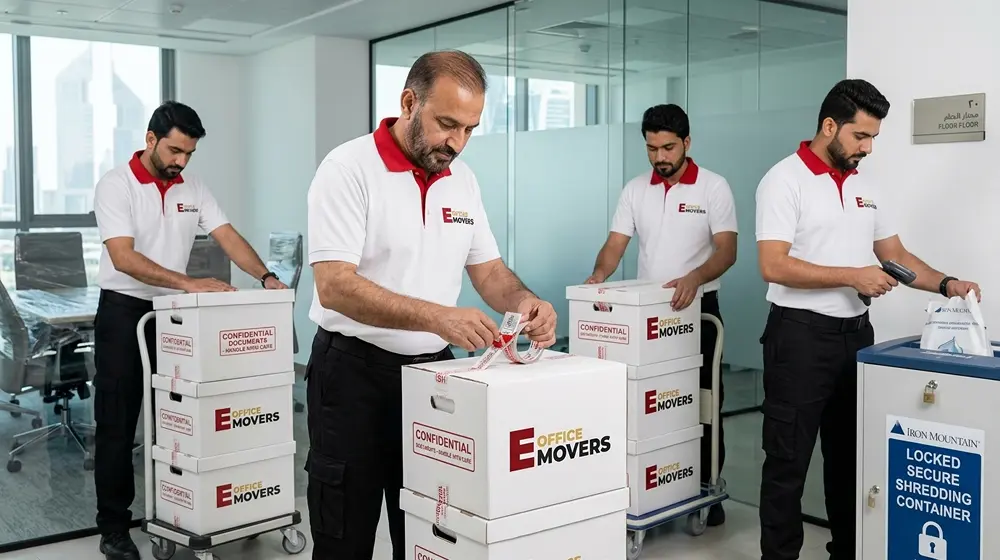
Confidential documents need a controlled handling routine across all three stages of the move.
Before the move: seal sensitive files in lockable crates or tamper-evident boxes, record each crate against the data audit, and assign a custodian. Destroy obsolete records through a certified shredding service rather than carrying dead data to the new office.
During transport: keep confidential crates in a secured, supervised vehicle separate from open furniture loads. Track the consignment from the loading bay to the new site, and never leave sealed records unattended in a lift lobby, loading dock, or vehicle.
After arrival: deliver sealed crates straight to a secured room at the new office, check each one against the manifest, and confirm nothing went missing in transit. Reconnect digital systems and restore access controls before staff start handling live data again.
What Is the Chain of Custody in Office Relocation?
Chain of custody in office relocation is a documented record of every person who handles a confidential item from the old office to the new one. Each transfer point carries a signature, a timestamp, and an item reference. The manifest follows the crate, so accountability never breaks.
Chain-of-custody procedures turn a vague “the files were moved” into a traceable record. If a box goes missing, the log shows the last verified holder and the last confirmed location. That accountability protects the business, supports any breach investigation, and demonstrates the kind of control the PDPL expects an organization to keep over personal data. This level of documentation is essential for data security during office relocation UAE, ensuring that sensitive information remains protected throughout the move and reinforcing the importance of data security during office relocation UAE at every stage of the relocation process.
How Do Access Control and Visitor Management Reduce Relocation Risk?
Access control and visitor management reduce relocation risk by deciding who enters the space while records sit exposed. During a move, both the old and new offices fill with people who are not regular staff. Controlling that flow protects the data on the floor.
- Access control systems restrict entry to packing zones and server rooms through cards or biometric readers
- Visitor management procedures log every external crew member with name, company, and time of entry
- Secure storage solutions hold confidential crates in locked, monitored rooms during any overnight or phased move
- Supervision places a staff custodian wherever sensitive records or hardware sit unpacked
A phased move that spans a weekend creates an overnight gap. Locking confidential crates in a monitored room, rather than leaving them stacked in an open bay, closes that gap.
What Role Do Professional Office Movers Play in Maintaining Data Security?

Professional office movers maintain data security by applying trained handling, vetted crews, and controlled procedures that an untrained team cannot match. A specialist corporate relocation provider treats confidential records and IT assets as a separate workstream, not as ordinary boxes.
Reputable office movers in Dubai support data security through several practices, including:
- Signed confidentiality agreements that bind the moving company and its crew
- Vetted, identified staff rather than anonymous day labour
- Sealed, trackable containers for sensitive records and hardware
- Chain-of-custody documentation handed back to the client after the move
- Coordination with building management for secure access and lift booking
Relocation facilities in the UAE run through the property management of each tower. Moving sensitive assets out of a Dubai commercial building involves move approval, freight-lift booking, loading-bay scheduling, and security clearance for the crew. Security and access systems form part of this work too, since access cards, biometric readers, CCTV recorders, and server-room controllers hold both electronics and the keys to the floor. A professional mover coordinates the disconnection and transfer of these systems so no space sits unsecured during the move.
How Does Data Security Support Business Continuity and Client Trust?
Data security supports business continuity by keeping the records and systems that run the business intact and available through the move. A lost server or a misplaced contract file stops work as surely as a broken lift. Protecting data protects the continuity of operations.
Client trust rides on the same foundation. A law firm, clinic, or accounting practice that loses a client file during a move loses more than a document. It loses the confidence that lets clients hand over sensitive information in the first place. A secure, well-documented relocation signals that the business guards its information with the same care after the move as before it. This commitment to protection is a core part of data security during office relocation UAE, helping businesses maintain confidence, compliance, and operational integrity throughout the relocation process.
Real-World Examples of Secure Office Relocation in the UAE
Three relocation scenarios show how data security shapes a UAE office move.
A Law Firm Relocating Within DIFC
A law firm moved offices inside DIFC while bound by the DIFC data protection regime. The team sealed all client files in tamper-evident crates, ran a full chain-of-custody log, and moved confidential records over a quiet weekend with a partner present as custodian. No file left the supervised chain at any point.
An Accounting Practice Moving to Business Bay
An accounting practice relocating to Business Bay carried years of financial records and client tax files. A pre-move audit flagged obsolete records for certified shredding, which cut the volume of sensitive paper in transit by a third. The remaining files travelled in locked crates matched to a manifest.
A Healthcare Clinic Shifting Within Dubai
A clinic moved within Dubai while holding patient health data, a sensitive category under UAE law. The clinic restricted access to medical records to two named staff, transported them separately under supervision, and restored access controls at the new site before reopening for patients.
What Affects the Cost of a Data-Secure Office Relocation?
The cost of a data-secure office relocation depends on the level of protection the records and systems require, assessed during a site survey. Pricing reflects the work, not a flat rate.
- Volume and sensitivity of records and devices being moved
- Secure packing materials such as lockable and tamper-evident crates
- Chain-of-custody documentation and supervised handling
- Certified destruction of obsolete records before the move
- Building access restrictions at both the old and new sites
- Phased or after-hours scheduling to protect continuity
A professional provider runs a site survey, then prices the move against these factors. Treat any figure given without a survey as a rough estimate rather than a firm quote.
Actionable Steps to Strengthen Data Protection Before Relocation Day
Strengthen data protection before relocation day by completing seven practical steps that close the most common gaps.
- Run a data audit and identify every sensitive record and device
- Destroy obsolete records through a certified shredding service
- Classify and seal confidential files in tamper-evident, coded crates
- Assign custodians for HR, finance, legal, and IT assets
- Set up chain-of-custody logs for every sealed crate
- Confirm building access and secure storage at both sites
- Sign confidentiality terms with the moving company
Completing these steps before move day turns data security from a hope into a process. The business arrives at its new office with its records intact, its systems running, and its compliance position protected. This proactive approach strengthens data security during office relocation UAE and helps organizations maintain compliance, business continuity, and stakeholder confidence throughout the move.
Frequently Asked Questions
Does the UAE PDPL apply to office relocations?
The UAE PDPL applies to office relocations because moving and storing files counts as processing personal data. The business stays responsible for keeping that data secure throughout the move, even when a third-party mover physically handles the records and devices.
What is the biggest data security risk during an office move?
The biggest data security risk during an office move is the unlogged handoff, where nobody records who handled a confidential file or device. Without a chain-of-custody trail, a missing record has no traceable last holder, which can turn a small slip into a reportable data breach.
How do I protect confidential documents while moving offices?
Protect confidential documents by sealing them in lockable, tamper-evident crates, logging each crate in a chain-of-custody record, and transporting them in a supervised vehicle separate from open furniture. Restrict access to named custodians and deliver sealed crates straight to a secured room. These measures are fundamental to data security during office relocation UAE, helping ensure that sensitive information remains protected throughout the relocation process.
Do DIFC and ADGM follow the same data rules as the rest of the UAE?
DIFC and ADGM follow their own separate data protection regimes rather than the federal PDPL. A business relocating within or out of these free zones complies with the zone-specific framework, so the obligations differ from an onshore Dubai or mainland office move.
Should I destroy old records before an office relocation?
Destroying obsolete records before a relocation lowers risk and cost by reducing the volume of sensitive data in transit. Use a certified shredding service for paper and secure wiping for digital storage, and keep a destruction record to support your compliance position.
Ali Al-Refai is an expert in the moving and logistics industry, with over 12 years of experience in managing both local and international moving operations. He has worked extensively in relocation planning, packing, and logistics, ensuring seamless and efficient transitions for individuals and businesses alike.
His expertise lies in optimizing moving processes, reducing costs, and ensuring the safe handling of items during relocation. Ali regularly shares insights and practical tips on best practices in moving, aiming to help people and companies achieve smoother, cost-effective relocations.