

An office relocation inventory management is a systematic record of every asset a business owns before it relocates, capturing each item’s description, condition, location and destination. It is the single most useful document in a move and the one most often skipped. Without it, furniture goes missing, equipment arrives damaged with no proof of its prior state, and finance teams cannot reconcile what left the old office against what reached the new one.
This guide defines the audit, separates it from a simple inventory list, walks through how to run one, and provides a ready-to-use template. It also covers how the audit shapes your moving quote, how assets stay secure in transit, and the practical lessons for businesses moving in Dubai for the first time.
What Is an Office Move Inventory Audit?
An office move inventory audit is a complete, verified record of a company’s physical assets compiled before relocation, listing each item with its condition, value, location and intended destination. It belongs to the asset management discipline and acts as the source of truth for the entire move.
The audit does three jobs at once. It tells the mover exactly what they are handling so the quote is accurate. It gives the business a record to check items against on arrival. And it gives finance and compliance teams the documentation they need for asset reporting and insurance.
A proper audit is more than a headcount of desks. It records the make, model, serial number and condition of equipment, the value of each asset, and a decision on whether the item moves or gets replaced. That last column alone often pays for the effort.
Why Is an Inventory Audit Critical Before an Office Move?
An inventory audit is critical because it protects a business from loss, damage disputes and unnecessary replacement costs during relocation. It turns “I think we had four of those” into a documented fact that holds up against the mover, the insurer and the auditor.
The financial case is direct. Businesses routinely pay to move old furniture and equipment that costs more to transport and reassemble than to replace. An audit forces that decision before move day, not after the bill arrives.
There is a proof case too. If a monitor arrives cracked, an audit with a dated condition note and a photograph settles the question of whether it broke in transit. Without that record, the dispute is your word against the mover’s, and you usually lose.
For finance and compliance teams, the audit is non-negotiable. Company-owned assets need accurate records for reporting, and a relocation is the natural moment to reconcile the asset register against what physically exists.
What Goes Wrong When Assets Are Not Tracked?
Untracked moves fail in expensive, frustrating ways. The pattern repeats across businesses of every size.
- Lost items: Without a checklist to verify against on arrival, missing equipment is noticed weeks later, far too late to claim.
- Damage disputes: No record of an item’s prior condition means no proof it was damaged in transit, so the cost falls on the business.
- Wasted spending: Companies pay to relocate broken or obsolete assets, then replace them anyway after the move.
- Insurance gaps: Goods-in-transit cover relies on documented values, and an unvalued asset is hard to claim for.
- Compliance headaches: Finance teams cannot reconcile the asset register, leaving gaps in reporting and audit trails.
- Slow unpacking: With no destination mapped per item, crews guess where things go, and staff hunt for their equipment.
Each of these traces back to one missing document. The audit.
What Is the Difference Between an Inventory List and a Full Audit?
An office relocation inventory management list counts what you have, while a full audit records, values, verifies and assigns a destination to every asset. The list answers “how many”; the audit answers “what, where, what condition, what value, and what happens to it.”
A basic list might read “20 desks, 25 chairs, 30 monitors.” Useful for a rough count, useless for a dispute. It carries no condition notes, no serial numbers, no values and no move-or-replace decisions.
A comprehensive audit captures all of that and ties each item to a destination in the new office. It supports the moving quote, the insurance claim, the finance reconciliation and the unpacking plan in one document. For anything beyond a tiny office, the audit is the version worth building.
How Do You Conduct an Office Move Inventory Audit?
Running an audit is straightforward when you take it room by room. The order below keeps it efficient.
Categorise the Assets
Start by sorting assets into clear categories so nothing slips through. Group items as furniture, IT equipment, electronics, office supplies, fixtures and high-value or sensitive items. Categories make the audit faster to build and far easier to read later.
Record and Tag Each Item
Record every asset with a unique tag, a description, a quantity and its current location. A simple labelled tag or barcode on each item links the physical asset to its row in the audit, which is what makes verification on arrival possible.
For equipment, capture the make, model and serial number. For furniture, note the type and any distinguishing detail. Precision here prevents arguments later.
Note Condition and Value
Log the condition of each item and its approximate value, with a photograph for anything fragile or expensive. Dated condition notes and photos are your evidence if an item is damaged in transit, and the values feed your goods-in-transit insurance.
Decide Move or Replace
For each asset, decide whether it moves to the new office or gets replaced. Weigh the cost of dismantling, transporting and reassembling against the cost of buying new. Old workstations and bulky storage units often lose this calculation.
Map the Destination
Finally, assign every asset a destination room and desk in the new layout. This single step turns unloading into a checklist and lets the mover place items correctly without supervision at every door.
Office Move Inventory Audit Template
Use the template below as the structure for your audit. Build it in a spreadsheet so it sorts, filters and totals, then share it with the mover and the move team as the single source of truth.
| Asset ID | Item description | Category | Old location | New destination | Quantity | Condition | Value (AED) | Move or replace | Handling notes | | — | — | — | — | — | — | — | — | — | | FUR-001 | Executive desk, oak | Furniture | Room 3 | Room 12, desk 4 | 1 | Good | | Move | Dismantle top | | IT-014 | Dell monitor 27in, SN 4471 | IT equipment | Desk 8 | Desk 22 | 1 | Minor scratch | | Move | Fragile, photo taken | | FUR-022 | Stackable chair | Furniture | Store | Replace | 12 | Worn | | Replace | End of life | | IT-031 | Server unit, rack-mounted | High value | Comms room | New comms room | 1 | Good | | Move | Supervised, anti-static | | ELE-009 | Multifunction printer | Electronics | Reception | Reception, new | 1 | Good | | Move | Drain toner before move |
Fill the value column from your asset register or a current estimate, and keep the handling notes specific. A few practical rules make the template work harder:
- Tag before you type: Physically label each item first, then enter its row, so the tag and record always match.
- Photograph the expensive items: A dated photo against the condition note is your strongest evidence.
- Total the replace column: Seeing the replacement cost in one figure sharpens the move-or-replace decisions.
How Do You Audit IT Equipment Before a Move?

You audit IT equipment by recording every device with its make, model, serial number and condition, then flagging anything that needs special handling. IT assets carry the highest value-per-item and the highest risk, so they get the most detailed rows in the audit.
Capture workstations, monitors, servers, networking hardware and phones individually, with serial numbers for warranty and insurance. Mark sensitive items for supervised transport and anti-static packaging. The audit feeds the technical move plan but does not replace it: the actual server and network cutover sits in the dedicated IT relocation guides.
One habit pays off repeatedly. Reconcile the IT audit against your asset register before the move, so any device that has quietly walked off in the past is found now rather than blamed on the movers.
How Does the Audit Affect Office Move Pricing in Dubai?
A complete audit produces an accurate moving quote, because Dubai movers price on volume, weight, specialist handling and item count. A vague inventory forces movers to estimate how to protect themselves, so a precise audit often lowers the price.
The audit influences several pricing factors directly:
- Volume and count: An exact item list sets crew size and vehicle numbers, removing guesswork padding from the quote.
- Specialist handling: Flagged servers, safes and fragile items let the mover price the right equipment rather than a worst-case assumption.
- Replace decisions: Items marked for replacement do not get moved, cutting volume and cost.
- Storage needs: Assets bound for short-term storage in a phased move are scoped from the audit.
Detailed cost ranges and how each factor is calculated belong in the office relocation cost guide. The point for the audit is simple: the better your inventory, the tighter your quote.
How Are Assets Kept Secure During Relocation?
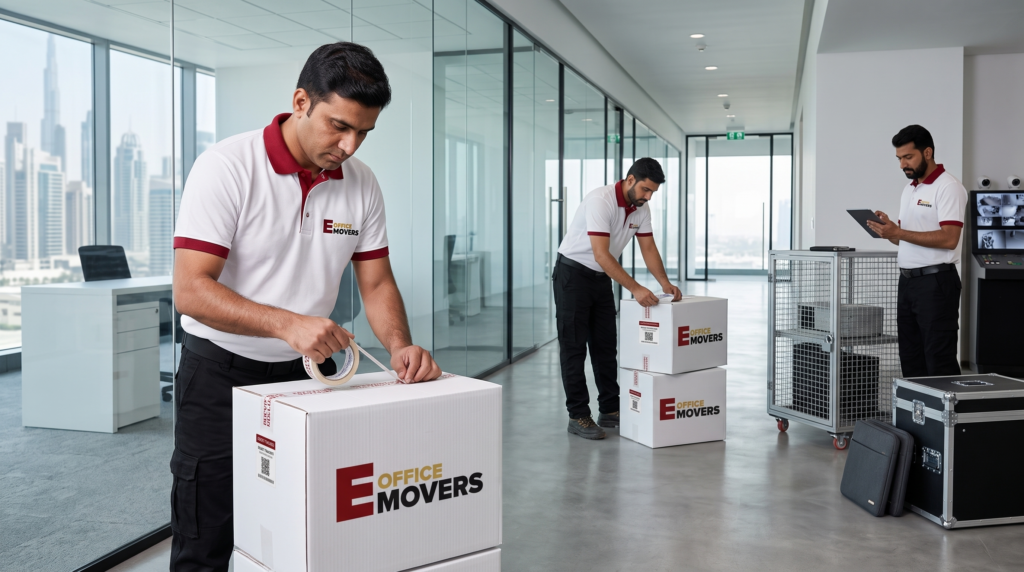
Assets stay secure during relocation through chain-of-custody tracking, supervised transport of high-value items, and controlled access at both premises. The audit is the backbone of that security, because you cannot protect what you have not recorded.
Chain of custody means knowing who handled what and when. Tagged assets checked out of the old office and checked in at the new one leave a clear trail, which matters most for IT equipment and confidential records. Sensitive documents are packed, sealed and tracked rather than moved loose.
Relocation facilities in the UAE support this when a move runs in phases. Secure short-term storage lets a business hold assets safely between premises without leaving them exposed, and reputable Dubai storage facilities run their own access control and inventory systems. Because building access rules and storage terms vary by provider and jurisdiction, confirm the security arrangements for your specific move rather than assuming them.
At the new office, access and security systems are set up before assets arrive, so equipment lands in a building that is already controlled.
A Real Inventory Audit Scenario in Dubai
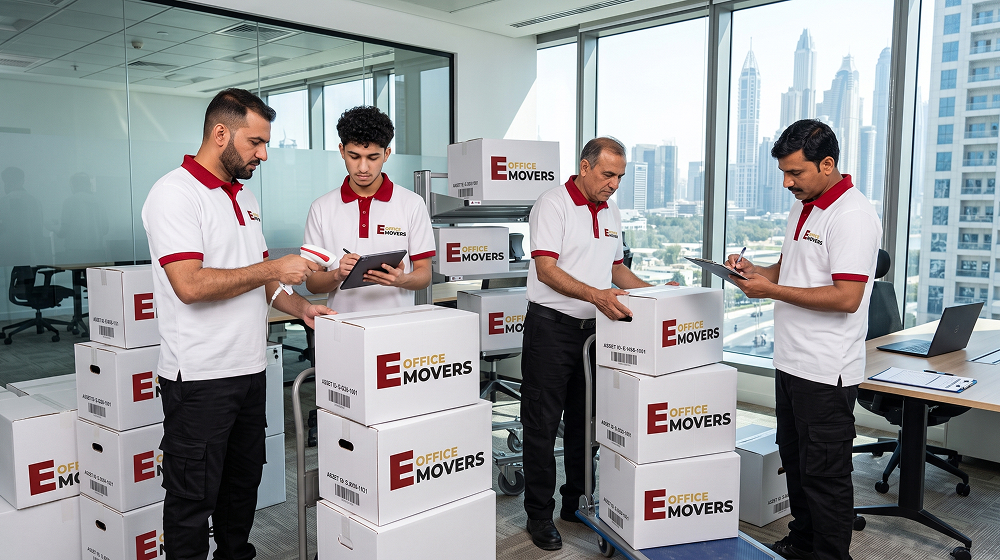
Consider a 40-person marketing firm moving from Business Bay to JLT. Before the move, the office manager ran a full audit and found two things. First, fifteen of the older desks and storage units would cost more to dismantle, move and rebuild than to replace, so they were sold and replaced at the destination. Second, the audit’s serial-number check flagged three laptops missing from the asset register, recovered before the move rather than blamed on the mover afterwards.
On arrival, every tagged item was checked against the audit at the door. One monitor showed transit damage, and the dated condition photo settled the insurance claim in days. The example is illustrative, but the lesson is real: the audit paid for itself twice over, once in avoided moving costs and once in a clean damage claim.
Tips for Businesses New to Office Relocation
First-time movers underestimate the audit and overpay for it later. A few points keep it useful and quick.
- Audit before you quote: Movers price guesswork high, so a precise inventory often lowers the bill.
- Tag everything physically: A label on each item is what makes arrival checks possible.
- Decide move or replace early: The replacement total often surprises businesses into smarter calls.
- Photograph high-value items: Dated photos protect you in damage disputes.
- Build it in a spreadsheet: A sortable, shareable file beats a paper list every time.
- Reconcile with finance: Match the audit to the asset register so reporting stays clean.
Treat the audit as the foundation of the move rather than a chore, and the rest of the relocation runs on solid ground.
Frequently Asked Questions
What is an office move inventory audit?
An office move inventory audit is a verified record of all company assets before relocation, listing each item’s description, condition, value, location and destination. It supports the moving quote, the insurance claim and the finance reconciliation in one document. The audit is the single most useful record in any office move.
Why should you audit assets before an office move?
You should audit assets before a move to prevent loss, settle damage disputes and avoid paying to relocate items worth replacing. The audit gives the mover an accurate scope, gives finance a clean record, and gives you proof of each item’s prior condition. Skipping it usually costs more than running it.
What is the difference between an inventory list and an audit?
An inventory list counts items, while an audit records, values, verifies and assigns a destination to each asset. A list answers how many; an audit answers what, where, what condition, what value and what happens next. For anything beyond a tiny office, the audit is the version that protects the business.
How do you audit IT equipment before relocating?
You audit IT equipment by recording each device with its make, model, serial number and condition, then flagging items needing supervised or anti-static handling. Reconciling the IT audit against the asset register before the move finds any missing devices early. The audit feeds, but does not replace, the technical cutover plan.
Does an inventory audit reduce office moving costs in Dubai?
Yes, a precise audit reduces office moving costs because Dubai movers price on volume, item count and handling, and a vague inventory forces them to quote high. Items marked for replacement are not moved, cutting volume and cost. An accurate audit removes the guesswork padding from the quote.
How are assets kept secure during an office relocation?
Assets are kept secure through chain-of-custody tracking, supervised transport of high-value items, and controlled access at both premises. Tagged items checked out and checked in leave a clear trail, and sensitive documents are sealed and tracked. Secure short-term storage protects assets during phased moves.
Ali Al-Refai is an expert in the moving and logistics industry, with over 12 years of experience in managing both local and international moving operations. He has worked extensively in relocation planning, packing, and logistics, ensuring seamless and efficient transitions for individuals and businesses alike.
His expertise lies in optimizing moving processes, reducing costs, and ensuring the safe handling of items during relocation. Ali regularly shares insights and practical tips on best practices in moving, aiming to help people and companies achieve smoother, cost-effective relocations.