
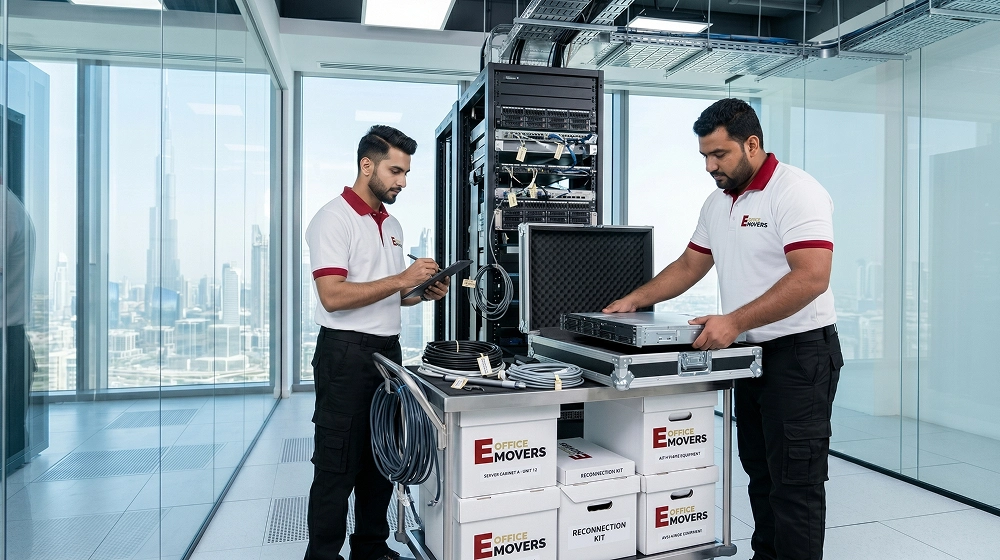
Server room relocation is the structured, sequence-driven process of shutting down, packing, transporting, and rebuilding a company’s server environment at a new premises without losing data or breaking the systems that depend on it. In Dubai, the work follows a strict protocol because the margin for error is thin. A server room is not a collection of separate machines. It is a tightly connected system where the power, the cabling, the cooling, and the boot order all have to come back together in exactly the right way.
Get the protocol right and a business resumes work the next morning as if nothing happened. That is exactly why a best office relocation plan focuses on every technical detail before moving day. Get it wrong and you spend a Monday explaining to staff and clients why the systems are down.
This protocol guide walks through the full sequence a Dubai business should expect during a server room relocation Dubai project, broken into the three phases that define every successful relocation: disconnection, transport, and reconnection. It also covers how the city’s building rules, security expectations, and pricing factors shape the project from start to finish.
What Is Server Room Relocation?
Server room relocation is a specialist form of IT infrastructure relocation that moves an entire server environment, including racks, servers, storage, networking, power, and cabling, as a single coordinated operation. It differs from moving individual computers because the components are interdependent, and the data they hold makes them far more valuable than the physical hardware alone.
A standard office move treats items as separate boxes. Server relocation treats the whole room as one machine that has to be taken apart in order and reassembled in reverse. The discipline runs across three areas at once:
- Physical safety: protecting fragile hardware from shock, vibration, and static.
- Data integrity: ensuring nothing on the drives is lost or corrupted.
- Operational continuity: getting systems back online with the least possible downtime.
Server relocation services in Dubai typically cover everything from a single rack in a startup’s utility room to a full data center relocation involving dozens of racks, redundant power, and dedicated cooling. The scale changes, but the protocol stays the same.
How Does Server Room Relocation Work in Dubai?
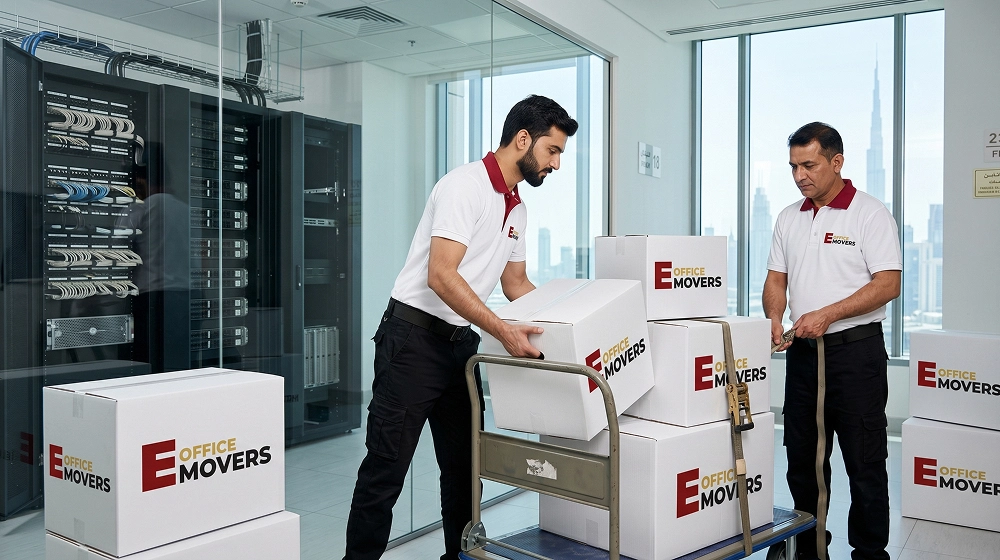
Server room relocation in Dubai works through a planned three-phase protocol, executed almost always outside business hours and shaped by the access rules of the building at each end. The technical sequence is universal, but the practical execution carries a distinctly local layer.
Most server moves in the city happen on a Friday evening or over a weekend. The reason is simple. A live server room cannot be moved while staff are using the systems, so the work waits for a window when the business is closed and the building is quiet. That window becomes the runway for the entire operation.
Before any of the technical work begins, the administrative groundwork has to be in place:
- Move permits from the building’s facility management or the free zone authority.
- Service lift bookings, since most Dubai towers restrict moves to a reserved elevator and a set time slot.
- A certificate of insurance covering the hardware and the move itself.
- Connectivity readiness at the new site, because a server cannot work until its internet circuit and network are live.
In districts like DIFC and JLT, where buildings are managed under their own authorities, this paperwork can take longer to clear than the move itself. Planning the permits and the lift booking weeks ahead is what keeps moving night on schedule.
The Three-Phase Server Relocation Protocol
The server relocation protocol is divided into three phases that always run in the same order: disconnection at the origin, secure transport between sites, and reconnection at the destination. Each phase has its own checklist, and the work in each one only succeeds if the previous phase was done properly.
Phase 1: Disconnection Protocol
The disconnection phase prepares the server room for the move by documenting, backing up, labelling, and gracefully shutting down every system before a single cable is unplugged. Rushing this phase is the most common cause of failed relocations.
The disconnection sequence runs as follows:
- Audit the environment. Record the make, model, serial number, asset tag, and rack position of every device. Photograph the back of each rack so the cable layout is captured exactly.
- Document the logical setup. Note IP addresses, VLANs, server roles, and the dependency order, which is the sequence in which systems rely on each other to function.
- Back up all data. Take a verified, restorable backup, stored offsite or in the cloud so it never travels in the same vehicle as the hardware.
- Label everything. Apply a sequential labelling system. Tag each cable at both ends with what it connects, and label each device with its destination rack and slot.
- Shut down gracefully. Power off applications first, then servers, then storage, then the network core. Never kill power to a running system, because a hard shutdown risks corrupting the data.
- Disconnect and stage. Unplug cabling, remove devices from racks where needed, and stage everything for packing in the order it will load.
A practical note on labelling. A populated rack can hold dozens of identical-looking cables. Without tags, rebuilding it correctly at 2 AM in a new building becomes guesswork, and guesswork at that hour is how networks come up broken.
Phase 2: Secure Transport Protocol
The transport phase moves the hardware between sites using anti-static handling, shock-protected packing, climate control, and a documented chain of custody. The threats during transport are mostly invisible, which is exactly why the protocol is strict.
Anti-static handling: Static discharge damages electronics without leaving a mark. Technicians use anti-static wrist straps and ESD anti-static bubble wrap for exposed boards and drives. Dubai’s air-conditioned, low-humidity offices raise static risk, so this step matters more here, not less.
Shock protection: Servers travel in their rails or in foam-lined crates that hold them still. Movement is the enemy, because a unit that shifts inside its packaging absorbs every bump in the road. Racks move either fully assembled on rack dollies or broken down component by component, depending on weight and lift access.
Climate control: Server hardware does not cope well with Dubai’s summer heat. Equipment left in an uncooled van in July sits in an oven, and heat shortens component life. Climate-controlled vehicles keep hardware within a safe range during the journey, and hydraulic tailgates remove the need to manually lift heavy racks and UPS units.
Chain of custody: Secure server transportation in Dubai is tracked with a signed record showing who handled each asset and when, from the moment it leaves the old rack to the moment it is reconnected. Crates are sealed with tamper-evident tags, and high-value moves often use GPS-tracked vehicles so the route is monitored in real time.
Phase 3: Reconnection Protocol
The reconnection phase rebuilds the server room at the new site by mounting hardware, restoring power and network in sequence, powering up in dependency order, and testing every system before sign-off. This is where the labelling and documentation from Phase 1 prove their worth.
The reconnection sequence runs:
- Mount and rack the hardware according to the sequential labels and the original rack photographs.
- Restore power through the new site’s PDUs and UPS, confirming the electrical setup matches the load. The UAE runs on 230 volts at 50 hertz, so the outlet configuration and circuit count have to be verified, not assumed.
- Patch the network by reconnecting cables to the correct ports using the tags applied during disconnection.
- Power up in dependency order, bringing storage and the network core online before the servers that rely on them.
- Test functionally across applications, file access, email, internet, and phone systems.
- Sign off only after end users confirm their systems work.
The testing step is non-negotiable. A server that powers on is not the same as a server that works. Real functional testing, logging in, opening a shared file, sending an email, running a transaction, is the only proof the move actually succeeded.
Why Does the Boot Order Matter?
The boot order matters because servers depend on each other, and powering them up in the wrong sequence produces errors even when every piece of hardware is perfectly fine. A database server that starts before its storage volume is mounted has nothing to read from, so it logs a failure and stalls.
A short real-world example makes the point. A JLT-based logistics firm relocated its small server room over a weekend and switched everything on the moment it was racked, all at once. The application server came up before the file storage finished mounting, the system threw a string of errors, and Monday started with staff locked out of their shared drives. Nothing was broken. The order was wrong. A short reboot following the correct dependency sequence resolved it, but the team lost the first hour of the week to a problem that the protocol exists to prevent.
This is why the dependency chain documented in Phase 1 carries straight through to Phase 3. The shutdown order reverses into the start-up order, and following it is the difference between a clean Monday and a chaotic one.
How Is Server Room Security Handled During a Move?
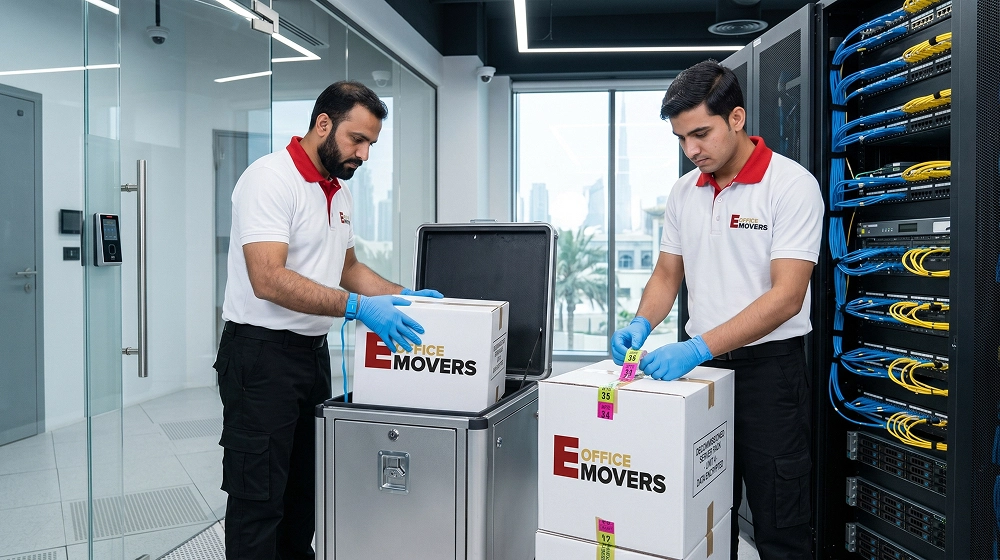
Server room security during a move is handled through controlled access at both sites, vetted personnel, sealed transport, and asset reconciliation, because the data on the hardware is often more sensitive than the hardware itself. For Dubai businesses in finance, legal, and healthcare, the contents of a single storage array can be subject to strict confidentiality and regulation.
The security controls applied during a server relocation include:
- Controlled origin access, so hardware is not removed unsupervised during decommissioning.
- Vetted, trained crews rather than casual labour, particularly where the equipment holds regulated data.
- Tamper-evident sealing on crates and devices so any unauthorised access in transit is visible.
- Asset register reconciliation, matching the destination inventory against the origin audit so any discrepancy is caught immediately.
- Configured destination access, meaning the new server room’s keycard, biometric, or PIN access control is working before the equipment arrives.
Access systems tie the whole thing together. A server room with an unlocked door undoes every other precaution taken during the move, so securing the destination is part of the protocol, not an afterthought.
How Much Does Server Room Relocation Cost in Dubai?
Server room relocation cost in Dubai depends on the number of racks, the sensitivity of the hardware, the access conditions at both buildings, and the level of IT support involved, so a single per-rack price rarely reflects the real job. Two moves with identical hardware can differ significantly because the surrounding factors differ.
The main pricing factors are:
- Rack count and hardware type. A single rack and a full data hall sit at opposite ends of the scale, and storage arrays and UPS systems cost more to handle than basic servers.
- Building access. Ground-floor loading with a dedicated service lift is cheaper than a high-floor server room with shared lifts and restricted move hours.
- Distance and route. A move across the city involves more transport time than a relocation within the same district.
- Downtime tolerance. Near-zero downtime requires more planning, more staff, and a tightly phased after-hours move, all of which raise the cost.
- IT support depth. A basic move covers physical transport, while a full server relocation service includes decommissioning, reconnection, configuration, and testing by IT-trained specialists.
- Specialist requirements. Climate-controlled transport, GPS tracking, enhanced insurance, and tamper-evident sealing add to the figure.
A startup moving a single rack within Business Bay is a modest job. A corporate firm relocating a multi-rack server room with redundant power and a strict weekend window is a project, and the price reflects that gap. This is especially true for a server room relocation Dubai project, where planning, equipment handling, and downtime management can significantly affect costs. The only reliable way to get an accurate figure is a site survey at both locations. A quote given without seeing the racks and the access conditions is a guess.
Server Relocation Across Dubai’s Business Districts
Server relocation requirements shift from district to district in Dubai, because each business hub carries its own building rules, security expectations, and tenant profile. The protocol holds steady, but the practical constraints around it change.
Business Bay
Business Bay’s dense cluster of towers makes service lift availability the deciding factor. Moves are scheduled around lift bookings, and the mix of startups, SMEs, and corporate offices makes it one of the busier areas for server equipment relocation in Dubai.
DIFC
DIFC hosts banks, law firms, and financial services companies, which raises the security bar. Server moves here often involve stricter access clearance and more detailed chain of custody, since the equipment frequently holds regulated financial data. Planning lead times run longer because of the additional approvals.
JLT (Jumeirah Lake Towers)
JLT, managed under DMCC, requires moves to be coordinated through building facility management with the service elevator reserved in advance. The shared facilities across the towers mean scheduling discipline is essential, and evening or weekend moves are the norm.
Dubai Marina and the Free Zones
Dubai Marina’s mix of commercial and residential use tightens move timing to avoid disrupting residents, and offices there tend to run smaller server setups. The free zones and tech hubs, including Dubai Internet City and Dubai Silicon Oasis, host technology-heavy tenants with larger server footprints, where full data center relocation work and the free zone’s own access rules come into play.
How Do You Choose a Server Moving Company in Dubai?
Choose a server moving company in Dubai by checking its IT-specific experience, its insurance, its references, and its grasp of the disconnection and reconnection protocol, rather than picking on price alone. For any server room relocation Dubai project, these factors matter far more than the lowest quote. A general office mover and a team of IT server moving specialists are not the same, and the difference shows up at the worst possible moment.
Worthwhile questions to ask before committing:
- Do you employ IT-trained technicians, or subcontract the technical reconnection elsewhere?
- What insurance do you carry, and does it cover the full replacement value of servers and storage plus data recovery?
- Can you share references from comparable server room moves in Dubai?
- How do you document the chain of custody and reconcile assets at the destination?
- Do you run a site survey at both locations before quoting?
- What is your downtime and boot-order plan?
- Are you familiar with the building rules in my district, whether DIFC, JLT, Business Bay, or a free zone?
A provider that answers these clearly and insists on a site survey before quoting is showing the planning discipline a server move demands. One that quotes a flat rate over the phone without seeing the racks is a risk best avoided.
Common Server Relocation Mistakes to Avoid
Server relocation projects in Dubai tend to fail for a small set of repeated reasons, and nearly all of them come from skipped steps rather than bad luck.
The recurring mistakes include:
- Skipping the verified backup, which turns any rare transit failure into permanent data loss.
- Powering up out of sequence, which produces system errors and delays the return to service.
- Forgetting connectivity, leaving servers racked and powered but offline because the internet circuit was never provisioned.
- Underestimating building rules, so the move stalls at the loading bay for want of a permit or a lift slot.
- Treating servers as ordinary cargo, handing data-carrying hardware to crews with no ESD training.
- Declaring success without testing, before users confirm their systems actually work.
Every one of these is preventable with a documented protocol, a proper audit, and a crew that understands servers rather than just heavy lifting.
Frequently Asked Questions
What is server room relocation?
Server room relocation is the structured process of disconnecting, transporting, and reconnecting a company’s entire server environment, including racks, servers, storage, and networking, during a move. It follows a strict protocol because the systems are interdependent and the data they hold is highly valuable.
How long does server room relocation take in Dubai?
Server room relocation in Dubai typically takes one to three days, depending on the number of racks and the downtime tolerance. Most businesses schedule the move over a weekend so that disconnection, transport, reconnection, and testing finish before staff return on Monday.
How is data protected during a server move?
Data is protected during a server move through a verified backup taken before the move, chain of custody tracking, tamper-evident sealing, and transit insurance. The backup is stored offsite or in the cloud so it never travels with the hardware, ensuring a rare failure does not cause permanent loss.
Why does the boot order matter during reconnection?
Boot order matters because servers depend on each other, and starting them in the wrong sequence causes errors even when the hardware is fine. Storage and network systems are brought online before the servers that rely on them, following the dependency chain documented during disconnection.
Do I need a permit for a server move in Dubai?
Most Dubai towers require a move permit, the moving company’s trade licence, and a certificate of insurance before granting loading bay and lift access. Free zones and managed buildings such as those in DIFC and JLT apply their own access and security rules on top.
How much does server room relocation cost in Dubai?
Server room relocation cost in Dubai depends on rack count, hardware sensitivity, building access, distance, and the depth of IT support required. An accurate quote needs a site survey at both locations, because access conditions affect the price as much as the volume of equipment.
Can a regular office mover relocate a server room?
A regular office mover is generally not suited to server room relocation, because servers and storage need ESD protection, dependency-aware reconnection, and data security controls. IT server moving specialists handle both the physical transport and the technical recommissioning together.
How do you minimize downtime during a server move?
Minimise downtime by scheduling the move outside business hours, provisioning connectivity in advance, labelling all hardware and cables, and reconnecting systems in the correct dependency order. Functional testing before staff return confirms the systems work and prevents a disrupted first day back.
Ali Al-Refai is an expert in the moving and logistics industry, with over 12 years of experience in managing both local and international moving operations. He has worked extensively in relocation planning, packing, and logistics, ensuring seamless and efficient transitions for individuals and businesses alike.
His expertise lies in optimizing moving processes, reducing costs, and ensuring the safe handling of items during relocation. Ali regularly shares insights and practical tips on best practices in moving, aiming to help people and companies achieve smoother, cost-effective relocations.