
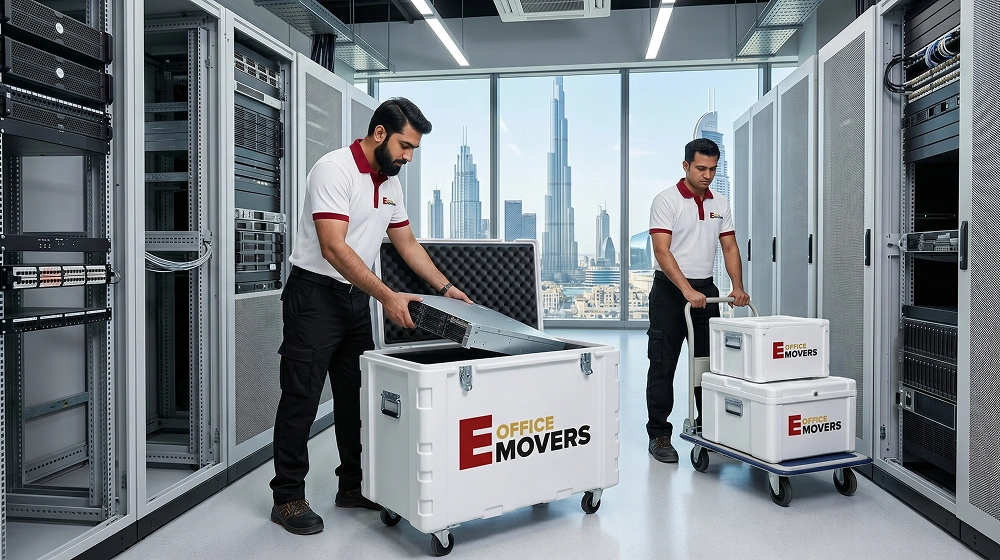
IT equipment relocation is the controlled process of decommissioning, transporting, and recommissioning a company’s technology assets, from servers and network switches to workstations and storage arrays, when a business moves to a new premises. IT equipment relocation in Dubai, this work sits at the intersection of physical logistics and IT operations, because the goal is never just to carry boxes across town. The goal is to lift an entire digital operation out of one building and set it back down in another with the data intact, the hardware undamaged, and the downtime measured in hours rather than days.
For a Dubai business, that distinction matters more than most people expect. A single server rack can hold a company’s accounting system, its CRM, its email, and its file storage. Drop it, expose it to a static discharge, or reconnect it in the wrong order, and you are not looking at a scratched desk. You are looking at lost revenue, missed client deadlines, and a recovery bill that dwarfs the cost of the move itself. This is why many companies rely on professional office movers to handle sensitive IT infrastructure and business-critical equipment during relocation.
This guide covers how IT equipment relocation works in Dubai, the types of hardware that need specialist handling, how server room moves are planned and executed, what drives the price, and how the city’s building rules in districts like Business Bay, DIFC, and JLT shape the whole exercise.
What Is IT Equipment Relocation?
IT equipment relocation is a specialist branch of commercial moving that handles a company’s technology infrastructure as a single, connected system rather than a pile of individual items. It treats a server, the rack it sits in, the cables running to it, and the data living on its drives as one asset that must move together and arrive in working order.
The discipline differs from general office moving in three clear ways. First, the equipment is fragile in ways that are not obvious. A hard drive can survive a bumpy van ride and still fail two weeks later because of a shock it absorbed in transit. Second, the equipment carries data, which means security and chain of custody run alongside physical safety. Third, the equipment is connected, so reconnection follows a strict sequence that mirrors how the systems were originally built.
Most IT relocation projects in Dubai fall into a few recognisable categories:
- Office IT equipment moving: relocating desktops, monitors, laptops, printers, and small network gear during a standard office move.
- Server relocation: physically moving server racks, blade enclosures, and the supporting power and cooling connections.
- Data center relocation: shifting a full data hall or a colocation footprint, often the most complex form of IT infrastructure relocation a company will ever attempt.
- IT asset relocation services: structured moves that include full inventory tracking, asset tagging, and reconciliation against a corporate asset register.
Each category shares the same core principle. The hardware is mapped before it moves, handled according to its sensitivity, and verified after it arrives.
How IT Equipment Relocation Works in the UAE

IT equipment relocation in the UAE follows a sequence of decommissioning, secure transport, and recommissioning, but the practical execution is shaped heavily by where the office sits and who controls the building. Dubai’s commercial property is split across free zones, mainland developments, and managed towers, and each comes with its own rulebook for moving day.
Building Management and Move Permits
Most Grade A towers in Dubai do not let you simply roll up with a van and start loading. Building management offices require a move permit, a copy of the moving company’s trade licence, and a certificate of insurance before they release access to the loading bay or the service lift. In free zone towers, the free zone authority or the master developer often acts as the building manager.
A few examples of how this plays out:
- In JLT, towers fall under DMCC’s jurisdiction, and moves are typically booked through the building’s facility management team with the service elevator reserved in advance.
- In DIFC, the financial centre operates its own access and security protocols, and IT moves involving sensitive systems often require additional clearance.
- In mainland buildings around Deira, Bur Dubai, and Sheikh Zayed Road, the owners’ association or facility manager controls move scheduling.
The practical effect is that a large part of IT relocation in Dubai is administrative. The hardware handling is the visible work. The permits, lift bookings, and insurance certificates are the quiet work that determines whether moving day actually goes ahead.
Moving Hours and RTA Considerations
Dubai’s roads and building rules push most commercial moves into evenings, weekends, or early mornings. Many towers restrict moves to outside normal business hours so that other tenants are not disrupted. Larger vehicles also face access timing rules on certain roads, which means transport routes and timing are planned around the city’s traffic patterns rather than left to chance.
For IT equipment specifically, the off-hours move is a feature, not a hassle. A Friday evening server migration gives the IT team a clear runway to shut systems down, move them, reconnect them, and run testing before staff return. The quieter the building, the cleaner the chain of custody.
Power and Connectivity Standards
The UAE runs on 230 volts at 50 hertz, using the three-pin British-style Type G socket. This matters during IT relocation because power distribution units, UPS systems, and rack PDUs all have to match the new site’s electrical setup. A common reconnection error is assuming the new server room has the same number of dedicated circuits and the same outlet configuration as the old one. It rarely does.
Connectivity is the other half of the equation. A server is useless until it talks to the network and the internet, so the new site’s structured cabling, internet circuit, and patch panels need to be ready before the hardware lands. In practice, the IT relocation timeline and the telecom provisioning timeline have to be coordinated, because a circuit that takes three weeks to activate cannot be ordered the day before the move.
What Types of IT Equipment Need Specialist Relocation?
Several categories of IT equipment require specialist relocation because of their value, their sensitivity, or the data they hold. Treating all of them as generic office furniture is the single most common cause of post-move failures.
The hardware that demands careful handling includes:
- Rack-mounted servers and blade enclosures: heavy, rail-mounted, and full of spinning or solid-state drives that are sensitive to shock and vibration.
- Network infrastructure: core switches, routers, firewalls, and patch panels that define how the entire office connects.
- Storage arrays and NAS units: devices holding the bulk of a company’s data, where a single mishandling event can corrupt volumes.
- UPS systems and batteries: heavy units, sometimes with hazardous battery components, that need careful lifting and sometimes separate transport.
- Telephony and PBX systems: the backbone of business phone lines, increasingly cloud-based but still physical in many Dubai offices.
- Workstations, desktops, and monitors: lower risk individually, but high volume, which makes labelling and tracking the main challenge.
- Printers, scanners, and MFDs: bulky, with toner and moving parts that leak or jam if tipped.
Servers and storage sit at the top of the risk pyramid. A workstation that arrives with a cracked screen is an annoyance. A storage array that arrives with corrupted data is a crisis.
How Do You Plan a Server Room Move?
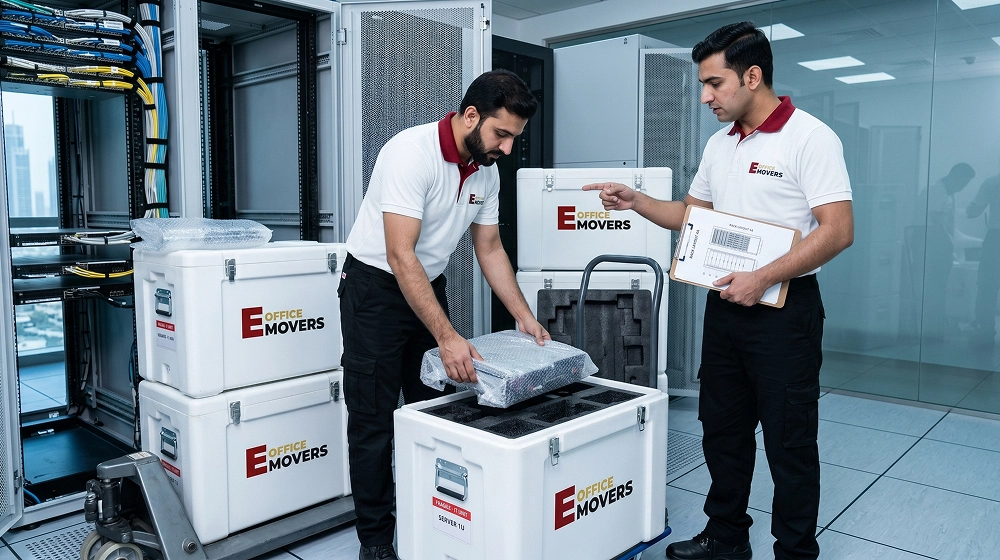
To plan a server room move, you build a complete picture of the existing environment first, then design the new environment, and only then schedule the physical move. The work splits into a clear sequence, and skipping any stage is how moves go wrong.
Step 1: Run a Full Asset Audit
Document every piece of hardware in the server room before anything is touched. A proper audit records the make, model, serial number, asset tag, rack position, and connected cables for each device. This becomes the master reference for the entire move and the basis for the asset register that proves nothing went missing.
Photograph the back of every rack. The cable layout behind a populated rack is effectively a map of the network, and rebuilding it from memory at midnight in a new building is a recipe for errors.
Step 2: Document the Logical Configuration
Capture the software and network side alongside the physical side. Record IP addresses, VLAN assignments, server roles, and the boot order of dependent systems. A database server that comes online before its storage is mounted will throw errors, so the recommissioning sequence has to follow the original dependency chain.
Step 3: Back Up Everything
Take a verified backup of all critical data before the move begins, and confirm the backup is restorable. This is the insurance policy. If a drive fails in transit despite every precaution, a tested backup turns a disaster into an inconvenience. The backup ideally lives offsite or in the cloud so that it is not travelling in the same van as the original hardware.
Step 4: Label with a Sequential System
Apply a sequential labelling system to every device, every cable, and every rack position. Each cable gets a tag at both ends showing what it connects. Each device gets a label matching its destination rack and slot. Sequential labelling removes guesswork at the new site and lets a technician rebuild the rack exactly as it was, in order, without reverse-engineering the layout.
Step 5: Decommission in the Correct Order
Shut systems down gracefully and in dependency order, never by pulling power. Power down applications first, then the servers, then the storage, then the network core. A graceful shutdown protects file systems and prevents the data corruption that hard power-offs cause.
How Is Server Room Equipment Physically Handled and Transported?
Server room equipment is handled using anti-static precautions, custom crating, and shock-protected transport, because the threats to hardware in transit are largely invisible. The two biggest risks are static discharge and physical shock, and both are managed with specific gear rather than goodwill.
Electrostatic Discharge Protection
Static electricity destroys electronics silently. A discharge too small for a person to feel can degrade a circuit board, so technicians handling exposed components wear anti-static wrist straps and use ESD anti-static bubble wrap and bags for boards and drives. Dubai’s air-conditioned, low-humidity indoor environment actually raises static risk, which makes ESD discipline more important here, not less.
Crating, Padding, and Securing
Servers travel best inside their rails or in purpose-built crates with foam inserts that hold them still. Movement is the enemy. A unit that slides inside its packaging absorbs every bump in the road. Heavy items are strapped, and racks are either moved fully assembled on specialist rack-moving dollies or stripped down and packed component by component, depending on weight and the lift access at both buildings.
Climate and Transport
Server hardware does not enjoy Dubai’s summer heat. Equipment loaded into an uncooled van in July is sitting in an oven, and prolonged heat exposure shortens component life. Climate-controlled transport keeps hardware within a safe range during the journey. Vehicles fitted with hydraulic tailgates also remove the need to manually lift heavy racks and UPS units, which protects both the equipment and the crew.
ASHRAE, the body that sets thermal guidelines for data equipment, recommends an operating range of roughly 18 to 27 degrees Celsius for IT hardware. Transport conditions do not need to hit that range exactly, but loading a server into a vehicle that has been baking in a car park all afternoon is asking for trouble.
How Do IT Relocation Services Keep Equipment Secure?
IT relocation services keep equipment secure through chain of custody tracking, sealed transport, asset reconciliation, and insurance, treating data security as seriously as physical safety. For many Dubai businesses, especially those in finance, legal, and healthcare, the data on the hardware is more valuable and more regulated than the hardware itself.
Secure IT equipment transport in Dubai usually combines several controls:
- Chain of custody documentation: a signed record tracking who handled each asset, from the moment it leaves the old rack to the moment it is reconnected.
- Asset register reconciliation: matching the inventory at the destination against the audit taken at the origin, so any discrepancy is caught immediately.
- Tamper-evident sealing: sealing crates and devices so any unauthorized access during transit is visible.
- Vetted personnel: trained crews rather than casual labour, particularly where the equipment holds sensitive data.
- GPS-tracked vehicles: monitoring the transport route in real time for high-value moves.
- Transit insurance: coverage that reflects the true replacement value of the hardware and the cost of data recovery, not just a token figure.
Access systems matter at both ends. The old site needs controlled access during decommissioning so that hardware is not walking out unsupervised, and the new server room needs its access control, whether keycard, biometric, or PIN, configured before the equipment arrives. A server room with an unlocked door defeats every other security measure taken during the move.
How Is Equipment Reconnected and Tested at the New Site?
Equipment is reconnected at the new site by rebuilding the physical layout, restoring power and network in the correct order, and then testing each system before declaring the move complete. This phase is where the labelling and documentation from the planning stage pay off.
The reconnection sequence generally runs:
- Mount and rack hardware according to the sequential labels and the original rack diagrams.
- Restore power through the new site’s PDUs and UPS, confirming the electrical setup matches the load.
- Reconnect the network by patching cables to the correct ports using the cable tags applied during decommissioning.
- Power up in dependency order, bringing storage and network online before the servers that depend on them.
- Run functional testing across applications, file access, email, internet, and phones.
- Sign off only after end users confirm their systems work as expected.
The testing stage is not optional. A server that powers on is not the same as a server that works. Functional testing across real workflows, logging in, opening a file, sending an email, processing a transaction, is what confirms the relocation succeeded.
A real-world example shows why the sequence matters. A Business Bay marketing agency once moved its small server room over a weekend and powered everything on at once the moment it was racked. The file server came up before the storage volume mounted, the system logged a series of errors, and Monday morning began with staff unable to reach shared files. The hardware was fine. The boot order was wrong. A fifteen-minute correction following the proper dependency sequence fixed it, but it cost the team a stressful start to the week that careful planning would have avoided.
How Much Does IT Equipment Relocation Cost in Dubai?
IT equipment relocation costs in Dubai are driven by the volume of hardware, its sensitivity, the access conditions at both sites, and the level of IT support required, so a flat per-item rate rarely tells the real story. Two moves with the same number of servers can differ widely in price because the surrounding factors differ.
The main factors that influence pricing are:
- Hardware volume and type: a single rack and a full data hall sit at opposite ends of the scale, and storage arrays and UPS systems cost more to handle than desktops.
- Building access: ground-floor loading with a dedicated service lift is cheaper than a high-floor office with shared lifts and restricted move hours.
- Distance and route: a cross-city move from Jebel Ali to Deira involves more transport time than a move within the same district.
- Downtime tolerance: businesses that need near-zero downtime require more planning, more staff, and often a phased or after-hours move, all of which raise the cost.
- IT support depth: a basic move handles the physical transport, while a full IT relocation service includes decommissioning, reconnection, configuration, and testing by IT-trained crews.
- Specialist requirements: climate-controlled transport, GPS tracking, enhanced insurance, and tamper-evident sealing add to the figure.
- Insurance value: coverage scaled to the real replacement cost of the equipment and the data, rather than a nominal amount.
A startup moving ten workstations and one small server within JLT is a modest job. A corporate firm relocating a server room, a phone system, and a hundred workstations from DIFC to a new headquarters, with a weekend window and zero tolerance for Monday downtime, is a project. The price reflects the difference.
For an accurate figure, a site survey at both locations is the only reliable route. Any quote given without seeing the hardware, the racks, and the access conditions at both ends is a guess.
IT Relocation Across Dubai’s Business Districts
IT relocation requirements change from district to district in Dubai, because each business hub has its own building rules, access constraints, and tenant profiles. A move that works smoothly in one tower can hit obstacles in another simply because of how the building is managed.
Business Bay
Business Bay’s dense cluster of mid-rise and high-rise towers means service lift availability is the deciding factor. Moves are scheduled around lift bookings, and the area’s mix of startups, SMEs, and corporate offices makes it one of the busiest districts for office IT equipment moving in Dubai.
DIFC
DIFC houses banks, law firms, and financial services companies, which raises the bar on data security. IT relocation here often involves stricter access clearance, more detailed chain of custody, and equipment carrying highly sensitive and regulated data. Planning lead times tend to be longer because of the additional approvals.
JLT (Jumeirah Lake Towers)
JLT, managed under DMCC, requires moves to be coordinated through building facility management with service elevators reserved ahead of time. The cluster of towers and shared facilities means scheduling discipline is essential, and after-hours moves are common.
Dubai Marina
Dubai Marina mixes residential and commercial use, which tightens move timing further to avoid disrupting residents. Smaller offices and creative firms dominate, so IT moves here often centre on workstations, small server setups, and networking gear rather than full data halls.
Free Zones and Tech Hubs
Districts like Dubai Internet City, Dubai Silicon Oasis, and other free zones host technology-heavy tenants with larger server footprints. These moves lean towards server relocation and data center relocation work, and the free zone authority’s own access and security rules apply on top of the building’s.
How Do You Choose an IT Relocation Company in Dubai?
Choose an IT relocation company in Dubai by checking its IT-specific experience, its insurance, its references, and its ability to handle your exact hardware, rather than picking on price alone. A general office mover and an IT relocation specialist are not the same thing, and the difference shows up at the worst possible moment.
Useful questions to ask a prospective provider:
- Do you employ IT-trained technicians, or do you subcontract the technical reconnection to someone else?
- What insurance do you carry, and does it cover the full replacement value of servers and storage plus data recovery?
- Can you provide references from comparable IT or server room moves in Dubai?
- How do you document the chain of custody and reconcile assets at the destination?
- Do you conduct a site survey at both locations before quoting?
- What is your downtime plan, and how do you handle the boot and dependency sequence?
- Are you familiar with the building rules in my district, whether DIFC, JLT, Business Bay, or a free zone?
A company that answers these clearly and offers a site survey before committing to a price is showing the planning discipline that an IT move demands. A company that quotes a flat rate over the phone without seeing the racks is a risk worth avoiding.
Common IT Relocation Mistakes to Avoid
IT relocation projects in Dubai tend to fail for a handful of repeated reasons, and almost all of them trace back to skipped planning rather than bad luck.
The recurring mistakes include:
- Skipping the backup, which turns any hardware failure in transit into permanent data loss.
- Powering on in the wrong order, which throws system errors and delays the return to service.
- Forgetting to provision connectivity, leaving servers racked and powered but unable to reach the internet because the circuit was never ordered.
- Underestimating building rules, so the move stalls at the loading bay for want of a permit or a lift booking.
- Treating servers as furniture, handing high-value, data-carrying hardware to crews with no ESD training or IT knowledge.
- Skipping the destination test, declaring the move complete before users confirm their systems actually work.
Each mistake is preventable with a documented plan, a proper audit, and a crew that understands IT rather than just heavy lifting.
Frequently Asked Questions
What is IT equipment relocation?
IT equipment relocation is the controlled process of decommissioning, transporting, and reconnecting a company’s technology assets, including servers, network gear, storage, and workstations, during an office move. It treats connected hardware and data as one system to protect against damage and downtime.
How long does a server room move take in Dubai?
A server room move in Dubai typically takes one to three days, depending on the volume of hardware and the downtime tolerance. Most businesses schedule the physical move over a weekend or evening so that decommissioning, transport, reconnection, and testing complete before staff return.
Is data safe during IT equipment relocation?
Data is kept safe during IT equipment relocation through verified backups, chain of custody tracking, tamper-evident sealing, and transit insurance. A tested backup stored offsite or in the cloud ensures that even a rare hardware failure in transit does not result in permanent data loss.
Do I need a permit to move office IT equipment in Dubai?
Most Dubai towers require a move permit, the moving company’s trade licence, and a certificate of insurance before granting loading bay and service lift access. Free zones and managed buildings such as those in JLT and DIFC apply their own access rules on top.
How much does IT equipment relocation cost in Dubai?
IT equipment relocation cost in Dubai depends on hardware volume, building access, distance, downtime tolerance, and the depth of IT support required. An accurate quote requires a site survey at both locations, as the access conditions and equipment type affect the price as much as the item count.
Can a regular office mover handle server relocation?
A regular office mover is generally not suited to server relocation, because servers and storage need ESD protection, dependency-aware reconnection, and data security controls. IT relocation services use IT-trained crews who handle the physical move and the technical recommissioning together.
How do you minimize downtime during IT relocation?
Minimize downtime during IT relocation by planning the move outside business hours, provisioning connectivity in advance, labelling all hardware and cables, and reconnecting systems in the correct dependency order. Functional testing before staff return confirms systems work and prevents a disrupted first day back.
What should I prepare before an IT equipment move?
Prepare for an IT equipment move by running a full asset audit, documenting cable and network configurations, taking a verified backup, and confirming the new site has power and connectivity ready. Coordinating these tasks ahead of moving day is what keeps the relocation on schedule.
Ali Al-Refai is an expert in the moving and logistics industry, with over 12 years of experience in managing both local and international moving operations. He has worked extensively in relocation planning, packing, and logistics, ensuring seamless and efficient transitions for individuals and businesses alike.
His expertise lies in optimizing moving processes, reducing costs, and ensuring the safe handling of items during relocation. Ali regularly shares insights and practical tips on best practices in moving, aiming to help people and companies achieve smoother, cost-effective relocations.