

Office moves in Dubai don’t fail because of bad luck. They fail because someone underestimated what was actually involved.
You book a truck, assume the rest will fall into place, and then move day arrives. The building management wants a permit you didn’t know about. The freight elevator is already booked by another company. Your IT team is standing around because nobody planned the disconnection sequence. And your staff can’t work because the workstations are in pieces on the floor of a new office that isn’t ready yet.
That’s not an extreme scenario. That’s what happens when an office move in Dubai isn’t handled properly.
A full-Service Office Movers exists specifically to prevent that. They don’t just show up with a truck and strong arms. They plan the entire relocation from the first site survey to the final walkthrough, handle every building access application, coordinate the IT disconnection and reconnection, disassemble and reinstall your workstations, and make sure your team walks into a functioning office on the other side, not a storage room with desks in it.
If you’re relocating your business in Dubai and want to understand exactly what a full-service office mover covers, what it costs, and what to look for when choosing one, this guide walks through all of it.
What Does a Full-Service Office Mover Actually Do?
Here’s where a lot of businesses get confused. Full service doesn’t just mean someone brings a bigger truck. It means the moving company takes responsibility for every single part of the job, not just the physical part.
They Start with a Proper Survey, Not a Guess
Before anything is quoted or booked, a good full-service office mover sends someone out to walk through your current space. That person isn’t just counting desks. They’re looking at how the workstations are configured, whether the furniture is modular, what IT equipment needs moving, how many filing cabinets and archive boxes you have, and whether anything is fragile, oversized, or unusual.
That visit also flags the building-specific complications that Dubai adds to every office move. Does your current tower require a formal move-out permit? Is the freight elevator shared with ten other companies and only available between 8am and 5pm? Does your new building in Business Bay have a loading bay that fits a 10-tonne truck or just a 3-tonne van? These questions sound small until they cause your move to get blocked at the gate on move day.
Workstation Disassembly Is More Involved Than You’d Think
If your office uses modular furniture, and most in Dubai do, disassembly takes real skill and time. Panels connect in specific sequences. Cable trays, power modules, and partitions all have to come off in the right order without damaging the components. A crew that hasn’t done this before will spend twice as long and still get it wrong.
The labeling that happens alongside disassembly matters just as much. Every panel, every bracket, every carton gets a number that corresponds to a floor plan of the new office. That’s how reinstallation takes hours instead of days. Your team doesn’t arrive at a space full of mystery boxes. They walk into a functioning office.
IT Equipment Gets Its Own Handling Protocol
Monitors, desktop units, servers, network switches, and anything else with a circuit board can’t just be wrapped in a blanket and shoved into a van. Full-service office movers use anti-static packaging, reinforced cartons, and detailed labeling for IT equipment. Servers get photographed before disconnection so reconnection follows the same configuration.
For businesses running on-site infrastructure, the mover works alongside your IT team or IT provider to plan the disconnection and reconnection sequence. The goal is to get critical systems back online at the new location as fast as possible. Every hour offline is a cost.
Documents and Archives Need Their Own System
Physical records don’t always get the attention they deserve during office moves. Box everything together and you’ll spend weeks after the move trying to find one document buried somewhere in 40 identical cartons. A full-service company packs document files in a numbered sequence that matches your existing filing system, uses tamper-evident packaging for anything confidential, and labels each carton with its destination location so nothing ends up in the wrong room.
The Move Itself Is a Coordinated Operation
Loading isn’t random. There’s a sequence to it, heavier items first, fragile items packed to specific positions in the truck, furniture wrapped to prevent scratching during transport. In Dubai, that transport has to account for access timing. Buildings in Deira and Al Quoz have specific hours when large vehicles can park near loading areas. Areas like DIFC and Downtown Dubai often restrict moves to certain windows and require pre-approved truck sizes.
And when the truck arrives at the new location, the job still isn’t finished. Unpacking, reassembly, positioning workstations according to the floor plan, removing all the packing materials, and walking through the space with you are all part of what full service means. The moving company leaves when the office works, not when the last box is unloaded.
For more detail on how the different types of commercial relocation services are structured, the types of office relocation services in Dubai guide is worth reading before you start comparing quotes.
How the Process Runs from First Contact to Final Sign-Off
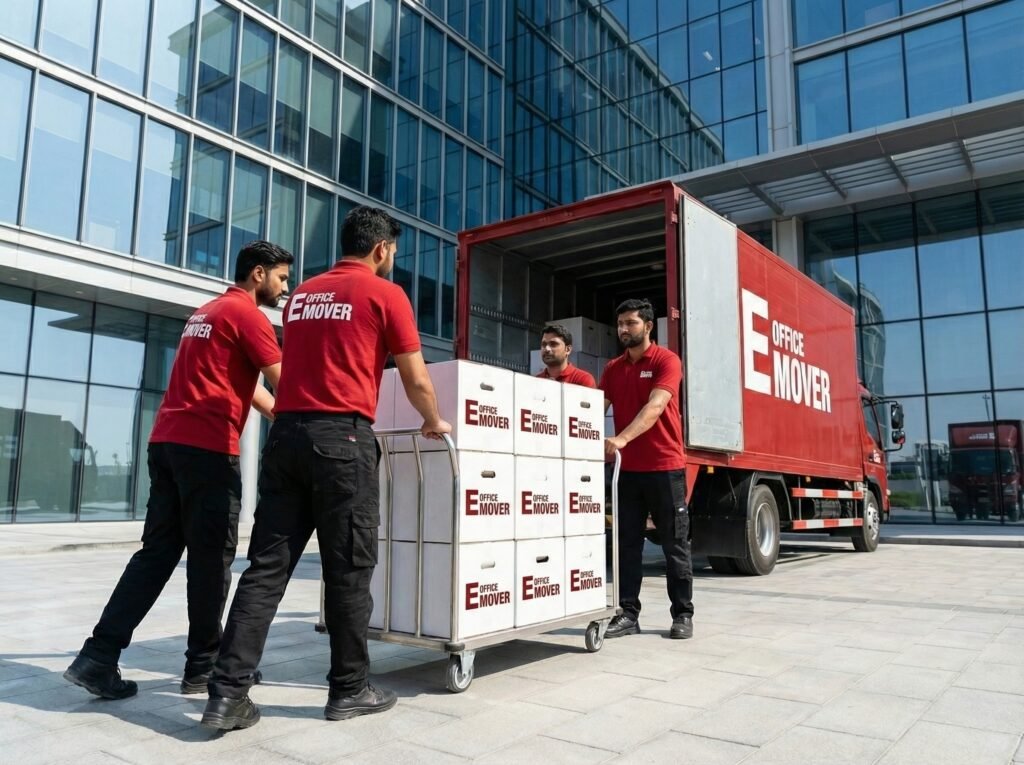
It’s useful to know what to expect at each point, especially if this is your first office move in Dubai.
The first conversation is usually a quick call to describe your situation. Office size, rough timeline, destination, any known complications. A consultant uses that to decide whether a site visit is needed, and for offices bigger than five or six workstations, it almost always is.
After the survey, you receive a written move plan. Not just a price. A plan that covers crew size, truck selection, packing schedule, building access steps, and a move-day timeline with estimated completion. Once you approve it, your date is locked in.
A day or two before the move, a packing crew comes through. They handle everything that doesn’t need to stay active until move day. General supplies, archives, decorative items, storage rooms. Workstations and IT systems stay operational until the last moment to keep disruption minimal for your team.
Move day starts early, usually 7am or 8am, because most buildings have access windows that close by 5pm or 6pm. The full crew works through disassembly, packing, loading, transport, unloading, and reinstallation in sequence. A small office typically wraps in one day. Medium-size offices with 20 to 40 workstations usually need two. Larger operations with server rooms and multi-floor setups can take three to five days.
After reinstallation, a supervisor walks the new space with you to confirm everything is where it should be and functioning correctly. That walkthrough is the handover point.
More detail on the full process is covered on the office relocation in Dubai page if you want a clearer picture of how it all fits together.
What Does This Cost in Dubai?
Costs vary more than most people expect, because two offices with the same number of people can have very different move requirements depending on furniture type, IT volume, building access complexity, and timing.
That said, here are realistic ranges based on typical Dubai office moves. Small offices with five to ten workstations generally come in between AED 1,500 and AED 4,000 for a full-service job. That covers packing materials, labour, transport, and reinstallation.
Mid-size offices in the 20 to 50 workstation range usually fall between AED 5,000 and AED 15,000. The spread within that range reflects the difference between a straightforward open-plan office and one with server rooms, archive systems, and multi-floor access.
Larger corporate relocations, particularly those that are phased or involve significant IT infrastructure, can go from AED 20,000 to well above AED 50,000. Those moves are essentially projects in their own right.
What often catches businesses out are the costs that don’t appear in a headline quote. Building access fees at certain towers. Freight elevator charges at some commercial properties. After-hours or weekend rates if your building only allows moves outside business hours. Short-term storage if you’re vacating your current space before the new one is ready.
Ask for an itemised quote and go through every line. If something isn’t listed and you think it applies to your situation, ask about it before you sign.
Why Does Moving an Office in Dubai Involve So Many More Steps?
Dubai’s commercial buildings operate differently from offices in other cities, and that affects every stage of the move.
Building management in most towers across Business Bay, DIFC, Downtown Dubai, and Dubai Marina requires a formal application before any move can take place. The minimum notice is usually 48 to 72 hours, but plenty of buildings want a week or more. If that application isn’t in, building security turns your moving crew away. That’s a lost day, and depending on your tenancy dates, it might be a day you can’t afford to lose.
Freight elevators are another real constraint. They’re shared, they’re in high demand on popular move days, and they operate on a booking system. If the slot isn’t reserved in advance, your crew ends up waiting. Some buildings limit freight elevator access to specific hours, which compresses the whole move-day timeline.
Then there’s parking. Loading bays in commercial towers across Dubai have vehicle size restrictions. Some don’t have dedicated bays at all. Areas like Deira and parts of Al Garhoud have road access constraints that rule out larger trucks entirely, so crew size and vehicle selection have to be adjusted accordingly.
A full-service office mover who regularly works across Dubai’s commercial zones already knows these constraints and plans around them. A company that doesn’t will learn on your move day, at your expense.
The office move planning guide for Dubai maps out each of these constraints in detail so you can plan around them before you’re in the middle of it.
How Early Do You Actually Need to Book?
Earlier than feels necessary. End-of-month dates go fast because most tenancy agreements roll over at the end of the month. The end of Q1 and Q3 are busy too, because those are common lease renewal periods.
For an office with more than 20 workstations, four to six weeks of lead time is a practical minimum. That window covers the survey, the move plan, building access applications at both locations, IT preparation, and giving your team enough notice to clear personal items and adjust remote work arrangements if needed.
Smaller offices might get two to three weeks’ notice accommodated, but it’s not something to count on for a popular date. If you know your move date, book it.
A week-by-week breakdown of what to prepare and when is available in the office relocation timeline for Dubai.
How to Actually Evaluate an Office Moving Company Before You Commit
There are dozens of moving companies operating across Dubai, and not all of them are equipped for a commercial office move. Some quote low and add charges for things that should have been included. Others have the right price but not the right crew for modular furniture or IT equipment.
A few questions that cut through the sales pitch:
Do they do a site survey before quoting, or do they ask for photos and give a number over the phone? A phone quote is essentially a guess.
Is the quote itemised? If it’s a single lump sum with no breakdown, you don’t know what’s included and you have no basis for comparing it to another quote.
Have they done moves in your building before? Buildings in DIFC and Downtown Dubai have specific access protocols. A mover who hasn’t dealt with them before is figuring it out as they go.
Do they handle the building access applications at both locations? Some companies treat this as your problem. A full-service mover handles it as part of the job.
What does their goods-in-transit insurance actually cover? Ask for the certificate. “We’re insured” is not the same as insurance that covers the replacement cost of your servers and workstations.
Is there a dedicated supervisor on move day who’s responsible for the whole operation? Without one, you’re coordinating the crew yourself.
If you want a structured list of what to check at each stage of preparation, the office relocation checklist for Dubai is a practical reference to work through.
A Quick Word on Dubai’s Main Business Areas
Moving from one part of Dubai to another can feel like two different countries in terms of logistics.
Business Bay and Downtown Dubai are well-organised. Building management is professional, freight elevator systems work properly, and access applications are processed efficiently. The challenge is that everyone else knows this too, so popular move dates fill quickly.
Jumeirah Village Circle and Jumeirah Lake Towers tend to have more flexible access conditions, but parking around JLT during peak hours is genuinely difficult. Movers familiar with the area schedule arrivals before 8am or after 6pm to avoid the worst of it.
Dubai Marina and Jumeirah Beach Residence have high-rise towers with strict freight access windows and very limited loading bay space. These moves almost always need to start at 7am or earlier to use the full access window before restrictions kick in.
Deira and Al Garhoud are different again. Older buildings, smaller freight elevators, no dedicated loading bays in some cases, and narrower roads that rule out certain truck sizes. The right mover adjusts vehicle selection and crew size accordingly rather than showing up with whatever they had available.
Conclusion
Moving an office in Dubai is a project, not just a task. There are permits to sort, elevators to book, IT systems to disconnect and reconnect, and a team of people waiting on the other side to get back to work. When all of that lands on your plate alongside your actual job, things get missed. That’s not a reflection on you. It’s just too many moving parts for one person to manage well.
A full-service office moving company exists to own that entire process. Not to help with it. To own it. The planning, the building access applications, the packing, the transport, the reinstallation, the walkthrough at the end. You stay focused on your business. They stay focused on the move.
What separates a smooth relocation from a stressful one in Dubai isn’t luck. It’s choosing a company that knows the commercial landscape here, knows which buildings in Business Bay.
Frequently Asked Questions
How long does a full-service office move in Dubai take?
It depends heavily on office size. Five to ten workstations usually wrap in one day. Twenty to forty workstations take two days. Larger offices with server rooms or archive systems can take three to five days. Building access windows and freight elevator availability are the factors that most often extend timelines beyond initial estimates.
Do office movers in Dubai handle server equipment?
Yes, though the quality varies between companies. A proper full-service mover uses anti-static packaging, padded cartons, and a coordinated disconnection and reconnection plan developed with your IT team. If a company treats servers the same as office chairs, that’s a red flag.
Can you move to an office on a weekend in Dubai?
Sometimes. It depends entirely on the building management policies at your current and new locations. Some buildings allow weekend moves, others don’t, and a few charge additional access fees for it. Your mover should check both buildings before you commit to a weekend date.
What insurance should I ask for?
Goods-in-transit insurance that covers the actual replacement value of your equipment and furniture, not just a token amount. Ask to see the certificate and confirm that IT equipment and servers are included, because some policies exclude high-value electronics.
What if something gets damaged?
A professional company photographs and documents items before packing and after delivery. If damage occurs, the insurance process kicks in. Before the move starts, ask specifically how claims are handled and what the turnaround is. Getting that in writing costs nothing.
Is a full-service move worth the extra cost compared to doing some of it ourselves?
For most Dubai businesses, yes. The time your team spends packing and disassembling is time they’re not billing clients or running operations. Add the risk of damage from improper packing, and the cost difference usually makes sense. For a very small office with a straightforward setup and available staff, partial service might be fine. But it’s the exception.
How are confidential documents handled during the move?
They’re packed in sealed, numbered cartons with tamper-evident tape. Chain of custody is maintained throughout. If your business has specific compliance requirements around document handling, raise them during the initial survey so the moving company can confirm whether their procedures meet those requirements.
Here’s a proper conclusion for your blog post:
DIFC has tight access windows, knows how to handle servers and modular workstations, and knows how to keep the whole operation moving without pulling you into every decision.
If your business is planning an office relocation, don’t leave it to chance. Contact the team at E Office Mover to arrange a site survey and get a clear, itemised quote. No guesswork, no vague estimates, and no surprises when move day arrives.
Ali Al-Refai is an expert in the moving and logistics industry, with over 12 years of experience in managing both local and international moving operations. He has worked extensively in relocation planning, packing, and logistics, ensuring seamless and efficient transitions for individuals and businesses alike.
His expertise lies in optimizing moving processes, reducing costs, and ensuring the safe handling of items during relocation. Ali regularly shares insights and practical tips on best practices in moving, aiming to help people and companies achieve smoother, cost-effective relocations.