
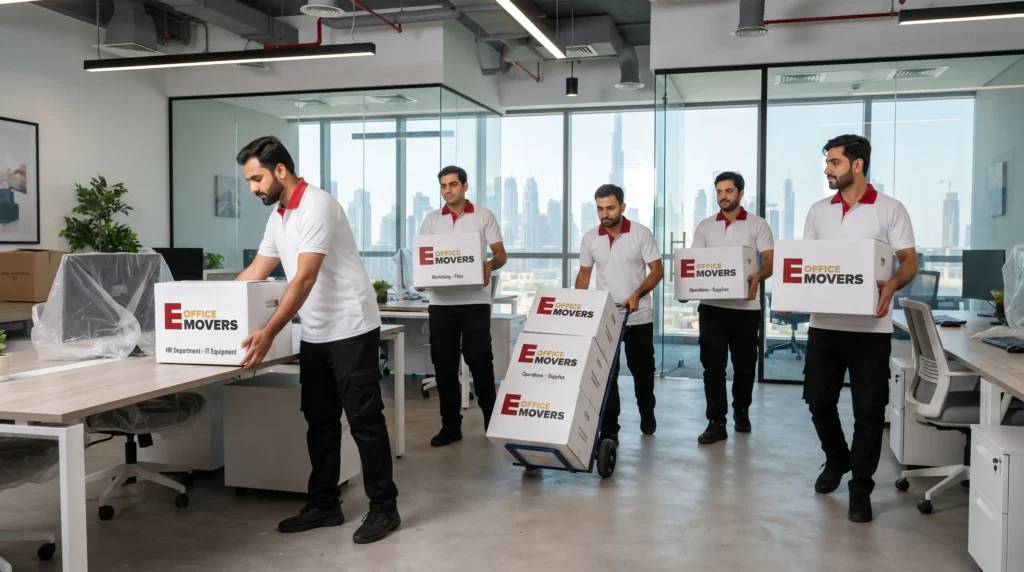
The moving trucks have left, the boxes are stacked in the corners, and your team is standing in an unfamiliar space wondering where to plug in their monitors. This is the moment most relocation plans go quiet, and it is exactly when the real work begins.
A post office move setup checklist is a structured list of verification and setup tasks completed after an office relocation finishes, covering asset checks, IT readiness, workstation setup, and utility confirmation. For businesses relocating across Dubai, this checklist decides whether the team is productive by Monday or stuck troubleshooting for a fortnight.
This guide walks through the first week at your new Dubai office, from the opening inspection to a fully operational workplace.
What Does Office Movers Mean in Dubai?
Office movers in Dubai are licensed commercial relocation companies that handle the disassembly, packing, transport, and reinstallation of business assets between commercial premises across the emirate. Unlike residential movers, they manage server racks, workstation clusters, filing systems, and corporate furniture under tight downtime windows.
Dubai’s commercial moving sector operates within a specific regulatory environment. Most building management offices in towers across Business Bay, DIFC, and JLT require move permits, insurance documentation, and scheduled service-lift bookings before any crew enters the premises. A competent office mover handles this paperwork as part of the engagement rather than leaving it to the facility manager.
The result is that a Dubai office move involves more coordination than the physical lifting itself. Permits, building access rules, and parking allocations often shape the timeline more than the volume of furniture.
How Do Relocation Facilities Work in the UAE?
Relocation facilities in the UAE are warehouse and logistics hubs where movers store, stage, and consolidate office assets before, during, and after a commercial move. These facilities support phased relocations where a business cannot transfer everything in a single day.
Many Dubai relocations run through a staging model. Furniture and equipment leave the old premises, pass through a temporary storage facility, and arrive at the new office in a planned sequence. This approach suits companies whose new lease starts before the old one ends, or whose fit-out is still being completed.
Climate control matters in this market. UAE summer temperatures regularly exceed 45°C, and prolonged exposure damages electronics, leather furniture, and certain documents. Quality relocation facilities offer temperature-regulated storage zones to protect sensitive assets during the transition period.
What Are the Different Types of Office Movers?
There are four main types of office mover operating in the Dubai market, each suited to a different relocation scenario.
- Full-service commercial movers, handle the entire project from planning to reinstallation, including IT disconnection and reconnection. These suit mid-to-large corporate moves.
- Standard furniture movers, transport desks, chairs, and storage units without specialised IT or fit-out services. These work for smaller offices with simple setups.
- Specialist IT relocation movers, focus exclusively on server rooms, data infrastructure, and network equipment, often partnering with general movers on larger projects.
- Storage-led relocation providers, combine moving with warehousing, ideal for phased moves or businesses between leases.
Choosing the right type depends on the complexity of your assets, the gap between leases, and whether your IT setup needs specialist handling.
Why Is a Post Office Move Checklist Important?
A post office move checklist is important because relocation projects fail in the days after the move, not during it, when unverified assets and untested systems quietly stall operations. The physical move is the visible milestone, yet the setup phase determines actual business continuity.
The assumption that work ends when the last box arrives causes most post-move problems. A monitor that survived transport but lost its power cable, a printer that connects to a network that has not been configured, a meeting room with no working display: these small failures compound into days of lost productivity.
Verifying Assets and Systems Protects Continuity
Verification turns assumptions into facts. Confirming that every department received its allocated equipment, that IT systems boot correctly, and that utilities function prevents the slow drip of issues that erode the first week. A facility manager who walks the floor with a checklist catches problems while the moving company is still contactable and accountable.
A Structured Checklist Reduces Downtime
Downtime carries a direct cost. For a 40-person Dubai office, even half a day of stalled operations represents significant lost billable time and salary expense. A structured office move completion checklist sequences the setup so that critical systems come online first, allowing core teams to resume work while secondary areas are still being arranged.
How Do You Start a Post-Move Office Inspection?
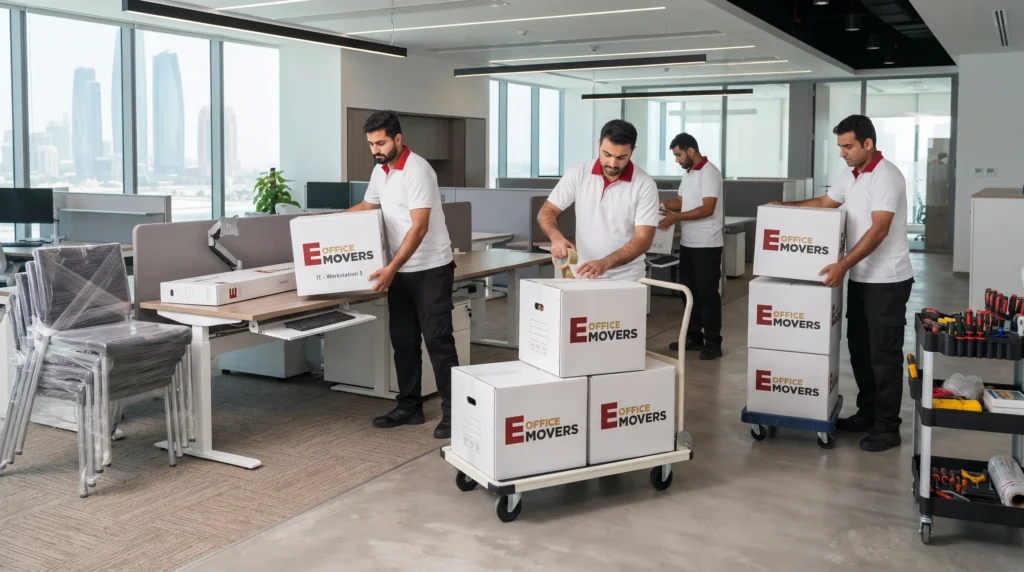
Start a post office move setup checklist inspection by conducting a full walkthrough of the new premises with your inventory list, the building’s floor plan, and a camera for documenting issues. This walkthrough is the foundation of every other setup task.
The inspection happens before the moving crew leaves. Once the trucks depart, resolving missing or damaged items becomes a claims process rather than a same-day fix.
What to Check During the Walkthrough
Move through the office systematically, floor by floor and zone by zone, rather than wandering randomly. Cover these points in order:
- Check every room against the floor plan to confirm furniture landed in its assigned location.
- Inspect items for transit damage, including scratched desks, cracked monitor stands, and dented filing cabinets.
- Identify misplaced items that arrived but sit in the wrong department or zone.
- Photograph any damage immediately, with the date visible, to support insurance or mover claims.
Verify Furniture and Equipment Delivery
Confirm furniture and equipment delivery by matching every received item against the original packing manifest before signing off on the move. Movers in Dubai typically provide an inventory manifest at collection, and this document is your reference point at delivery.
Pay attention to high-value and easily overlooked items. Ergonomic chairs, height-adjustable desks, monitor arms, and server components are the assets most worth confirming individually. A quick count of desks tells you little if the components that make them usable are missing.
Ensure Every Department Received Its Assets
Walk each department’s zone with its team lead present where possible. The person who uses a workstation daily spots a missing dual-monitor setup or a wrong-sized desk faster than a general inspector. This step also gives department heads early ownership of their new space, which smooths the wider settling-in process.
How Do You Verify Inventory and Assets After a Move?
Verify inventory and assets after a move by comparing every delivered item against your asset register and flagging discrepancies within the first 48 hours. This window matters because mover liability and insurance claims weaken as time passes.
Your asset register, the document listing every owned item with its tag number and assigned location, becomes the controlling reference for this stage.
Compare Delivered Items Against Inventory Records
Run a line-by-line comparison rather than a visual estimate. Cross every item off the register as it is confirmed in its correct location. Items that remain unchecked at the end of the pass are your investigation list.
For larger offices, split this task by zone and assign it to multiple people working from copies of the same register. A single person checking 200 assets across three floors invites missed items and fatigue errors.
Confirm Office Furniture and Equipment Arrival
Group your confirmation by category to keep it manageable:
- Workstations: desks, chairs, pedestals, monitor arms, and partition screens.
- Storage: filing cabinets, lockers, and shelving units.
- Shared equipment: printers, scanners, shredders, and coffee machines.
- Meeting rooms: conference tables, display screens, and video-conferencing hardware.
Report Missing Items Promptly
Report any missing item to the moving company the same day it is identified, in writing, with its asset tag and last known location. A verbal mention at a chaotic move site rarely survives. An email or logged ticket creates the record that supports a claim if the item does not surface.
Review Asset Tracking Documentation
Update your asset register with each item’s new location as you verify it. The move is the natural moment to refresh tracking data that has drifted over years in the old office. A clean, current register pays off at the next audit, insurance renewal, or future relocation.
How Do You Handle IT and Technology Checks?
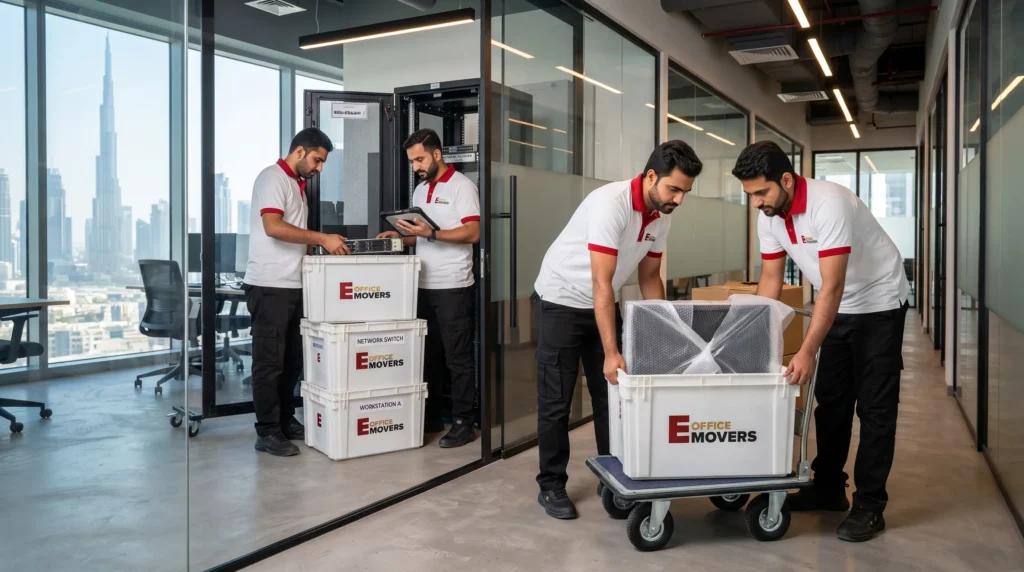
Handle IT and technology checks by testing network connectivity, server functionality, and workstation hardware in priority order, starting with the systems that block the most people from working. IT failures cause the longest post-move delays, which makes this the highest-stakes section of the checklist.
The sequence matters. A network that is not live makes every connected device useless, so connectivity comes first.
Network and Connectivity Checks
Confirm these in order:
- Verify that the internet connection is active and that the contracted bandwidth is delivered.
- Test the office Wi-Fi across all zones, including meeting rooms and corner offices where signal often weakens.
- Confirm that the network switches, routers, and patch panels are powered and reporting correctly.
- Check that the telephone system and any VoIP lines route calls properly.
In Dubai, internet activation at a new premises depends on the provider’s installation schedule, which is best booked weeks before the move rather than discovered on day one. Etisalat and du installations can carry lead times that catch unprepared businesses off guard.
Server and Data Infrastructure Checks
Confirm that servers powered up cleanly, that storage arrays mounted, and that backup systems resumed their scheduled runs. If your move involves specialist IT relocation, the mover’s reconnection report becomes the document you verify against. Test access to shared drives and core business applications before declaring the infrastructure ready.
Workstation Hardware Checks
Power on a sample of workstations across departments and confirm that monitors, docking stations, and peripherals function. A common Dubai-summer issue is equipment that sits in a hot vehicle or storage zone and needs time to acclimatise before powering on reliably.
How Do You Set Up Employee Workstations?

Set up employee workstations by reconnecting each desk’s hardware, restoring login access, and confirming that staff can reach their files and applications before they arrive. A workstation that boots but cannot reach the network is not ready.
Work through these per desk:
- Reconnect monitors, keyboards, mice, docking stations, and any specialist peripherals.
- Confirm that each machine connects to the network and that the employee’s profile loads.
- Verify access to shared drives, email, and the applications that person uses daily.
- Label cables and reconnect power in a tidy arrangement to avoid first-week trip hazards.
Where possible, complete a first pass before employees return. Staff who walk in to a working desk settle faster than those who spend the morning hunting for a missing cable. For phased returns, prioritise the departments whose work cannot pause, such as finance during a reporting period or sales near month-end.
How Do You Confirm Utilities and Office Services?
Confirm utilities and office services by testing electricity, cooling, water, and access systems across the premises during the first inspection. A new Dubai office depends heavily on functioning air conditioning, given the climate, which makes cooling a priority rather than an afterthought.
Check the following:
- Test that power is live at every workstation, meeting room, and common area.
- Confirm that the air conditioning cools effectively across all zones, including server rooms where heat builds fast.
- Verify water supply to kitchens, pantries, and washrooms.
- Test access control, including key cards, biometric readers, and visitor entry systems.
- Confirm that lighting works throughout and that emergency lighting is operational.
In multi-tenant Dubai towers, some utilities run through building management rather than the tenant. Clarify early who controls the AC scheduling, after-hours cooling, and service-lift access, because these directly affect whether your team can work comfortably and whether deliveries can reach your floor.
Frequently Asked Questions
Post-Move Office Setup in Dubai
How long does it take to fully set up a new office in Dubai?
A standard SME office of 20 to 50 people typically reaches full operational readiness within three to five working days after the move. Larger corporate relocations with complex IT infrastructure take one to two weeks. The timeline depends mostly on IT setup and utility activation rather than furniture placement.
What should you check first after an office move?
Check IT and network connectivity first, because these systems block the most employees from working. Confirm the internet is live, servers booted correctly, and core applications are reachable. Furniture and decor matters less if the team cannot access their files and email on the first morning.
Who is responsible for the post-move office inspection?
The facility manager or office manager usually leads the post-move inspection, supported by department heads who verify their own zones. For larger moves, a dedicated relocation project manager oversees the process. The inspection should happen before the moving crew leaves the premises.
What happens if items are damaged during an office move?
Report damaged items to the moving company in writing the same day, with dated photographs and the asset details. Damage discovered during the initial walkthrough, while the crew is still present, is easier to resolve. Most licensed Dubai movers carry transit insurance that covers verified damage claims.
Do you need a permit to move offices in Dubai?
Most commercial buildings in Dubai require a move permit issued by the building management office before relocation. The permit covers service-lift use, scheduled access, and insurance confirmation. Licensed office movers typically arrange these permits as part of the relocation service.
How do you minimize downtime during an office relocation?
Minimize downtime by sequencing the setup so critical systems come online first, completing a workstation pass before staff return, and booking internet activation weeks ahead of the move. A structured post-move checklist lets core teams resume work while secondary areas are still being arranged.
Ali Al-Refai is an expert in the moving and logistics industry, with over 12 years of experience in managing both local and international moving operations. He has worked extensively in relocation planning, packing, and logistics, ensuring seamless and efficient transitions for individuals and businesses alike.
His expertise lies in optimizing moving processes, reducing costs, and ensuring the safe handling of items during relocation. Ali regularly shares insights and practical tips on best practices in moving, aiming to help people and companies achieve smoother, cost-effective relocations.