

You’ve signed the new lease. The move date is six weeks out. And now, standing in your current office, looking at the server room, the reception counter bolted into the floor, and the modular walls your fit-out contractor spent three days installing, you’re wondering exactly how all of this is going to end up somewhere else without your business grinding to a halt.
Office relocation in Dubai is the process of transferring every physical element of your business furniture, IT hardware, documents, and fit-out components from one commercial address to another while managing building permits, free zone access rules, IT reconnection, and staff continuity at the same time. It sounds manageable until you hit the first obstacle: the building won’t let your trucks in until 8 PM.
This guide covers how it actually works in Dubai the permits, the costs, the IT headaches, the decisions that derail moves, and what separates a relocation that finishes over a weekend from one that costs you a week of downtime.
What Does Office Relocation in Dubai Really Mean?
Most people think of it as moving furniture. It isn’t.
When a business relocates an office in Dubai, it’s simultaneously managing four separate workstreams physical logistics, IT infrastructure, regulatory paperwork, and internal communications all on the same deadline. Drop any one of them and the others back up behind it.
The physical side is obvious: dismantling workstations, wrapping equipment, loading trucks, reassembling everything at the new site. But that’s maybe 40 percent of what a well-run relocation actually involves.
The rest? Your building management won’t release a move-out NOC if your service charge is outstanding. Your new landlord’s facility team needs the moving company’s trade license, insurance certificate, and truck registration before anyone enters the loading bay. The new office needs an active fiber connection before your servers arrive not after. And your trade license address has to match your physical premises for DED or free zone compliance purposes.
Miss any of these, and moving day turns into a standoff in a parking lot.
That’s why businesses in Dubai hire office relocation specialists rather than residential movers. The physical work overlaps. The knowledge doesn’t.
Why Are Businesses Relocating Their Offices in Dubai Right Now?
New Grade A towers are delivering in Business Bay, Dubai Hills Business Park, and Jumeirah Lake Towers every year. Older buildings in Deira and Bur Dubai are losing tenants to better-spec stock. Free zone consolidations are pushing companies to re-register in different jurisdictions. And post-pandemic hybrid work models have companies downsizing floor plates they no longer need at full capacity.
Growth is still the most common reason. A 12-person startup in a DIFC serviced office grows to 35 people and needs a floor of its own. A regional distributor adds a logistics division and needs warehouse-adjacent office space in Al Quoz or Dubai Investment Park neither of which is close to their current address in Downtown.
Lease expiry comes second. When a landlord renews at 20 to 30 percent above the current rate, the conversation shifts quickly to alternatives. Jumeirah Lake Towers, for instance, offers comparable connectivity and address quality to Business Bay at noticeably lower per-square-foot costs for many unit sizes.
Then there are regulatory triggers. Change your license activity, restructure ownership, or shift from a free zone entity to a mainland LLC and your registered address has to change with it. The building doesn’t move. Your paperwork does, and so does your phone number, your Google listing, your DEWA account, and your bank’s correspondence file.
How Does Office Relocation Work in Dubai The Full Process
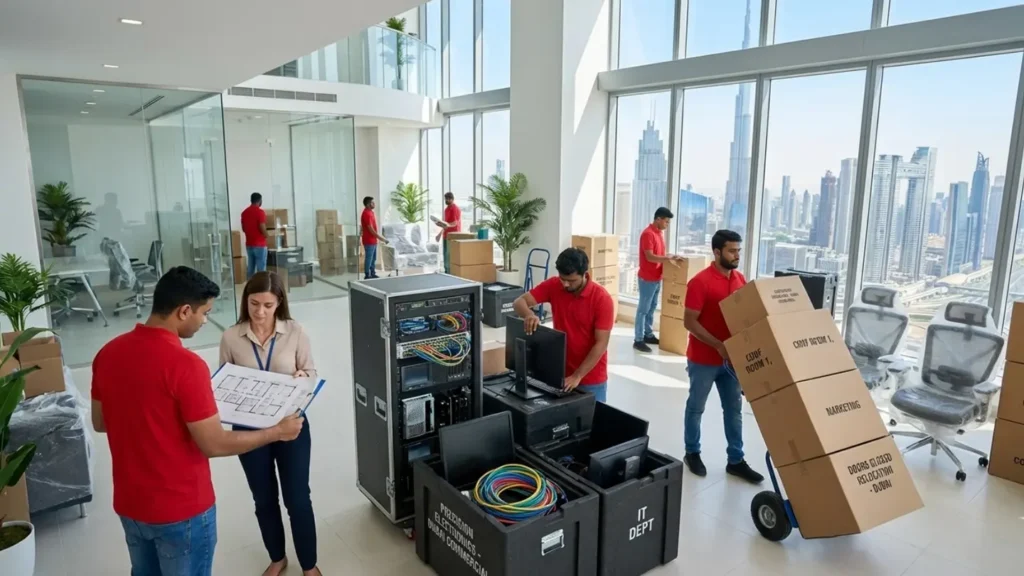
Let’s walk through it from the day you confirm a new lease to the morning your staff arrive at the new address. There are ten stages. They don’t always run sequentially several run in parallel, which is part of why this process catches businesses off guard.
1. Scope the move properly. Before you call a single mover, walk every room and decide what’s coming. Not everything should move. Broken chairs, obsolete desktop towers, archived print jobs from 2018 these cost money to transport and create clutter at the new site. A proper inventory takes a few hours and saves more time than it costs.
2. Confirm the new space against your existing furniture. Get the floor plan of your new premises not the marketing brochure, the actual architectural drawing with column positions and door widths. A 20-person open plan in a 150 sq ft elevator lobby doesn’t guarantee your 2.4-metre boardroom table makes it through the door.
3. Set your timeline with two anchors. The day you must vacate your current space and the earliest date you can access the new one. Everything else schedules around those two dates. Build at least two weeks of buffer before vacate for permit processing alone more if you’re in a free zone with its own administrative system.
4. Tell your stakeholders before you think you need to. Staff need four to six weeks’ notice for personal logistics. Clients need your new address before you move, not after. Couriers, suppliers, banks, and insurance companies all carry your address on file. Updating them after the move creates weeks of misdirected deliveries and administrative friction.
5. Book pre-move site surveys with shortlisted movers. A surveyor visits both locations not just your current office. They’re checking elevator dimensions against your largest items, loading bay access hours, truck parking regulations in that specific area, floor protection requirements, and whether the new building’s service corridor is wide enough for your server rack transport cases.
6. Apply for permits immediately. Building NOCs and free zone access permits take five to ten working days when your paperwork is complete. If it’s incomplete, add another week. If it lands during Eid Al Adha, National Day, or Ramadan working-hour adjustments, add more. Apply the moment your move date is confirmed, not the week before.
7. Build your IT relocation plan. This runs parallel to everything else, starting from week one. Fiber connectivity at the new office needs to be provisioned and tested before any hardware moves du and Etisalat activation takes five to ten working days, and that’s assuming the building already has structured cabling installed. If it doesn’t, add the fitout lead time on top.
8. Pack what’s non-operational first. Archive rooms, storage cupboards, training areas, kitchen supplies these can be boxed up two to three weeks before the move without touching anything your team uses daily. This reduces moving day volume significantly and makes the final packing phase faster.
9. Execute the move. On the day itself, your job is to have one person at each site someone with authority to make decisions and to stay out of the crew’s way. Professional movers work faster when they’re not waiting for approvals on every item.
10. Update every registered address immediately. Trade license, free zone records, Google Business Profile, company website, DEWA account, bank correspondence address, invoicing templates, email signatures. This is the step companies postpone and then forget. A business operating from a new address with an old one on its DED license is technically non-compliant.
What Building Rules Affect Office Moves in Dubai?
This is where most moves get complicated. Dubai’s commercial buildings don’t operate on your schedule they operate on their own.
Grade A towers in Business Bay, DIFC, and Downtown Dubai typically restrict moves to after-hours windows: 7 PM to 6 AM on weekdays, with broader access on Fridays and Saturdays. These aren’t suggestions. Show up with a truck at 10 AM on a Tuesday and building security will turn you away NOC or no NOC.
The reason is operational. High-rise commercial buildings with dozens of tenants can’t have moving crews blocking service elevators, parking lorries in the loading bay, and dragging trolleys through lobbies during peak business hours. The restriction protects everyone else in the building.
Free zones have their own systems entirely.
DIFC runs its move-in and move-out permits through the DIFC Authority’s tenant services portal. You’ll need a security deposit, third-party liability insurance from the moving company, a signed indemnity, and the DIFC Authority’s approval before any crew steps off the service elevator with a trolley.
TECOM Group which manages Dubai Internet City, Dubai Media City, and a handful of other zones processes move permits through its own facility management system. Trucks above a certain axle load need pre-approval because of weight limits on internal access roads. Not every moving company knows this.
JAFZA is entirely different again. Unauthorized vehicles don’t enter the free zone. Moving trucks need pre-registered gate passes through JAFZA’s logistics access system before they reach the perimeter.
Standard non-free-zone commercial buildings managed by companies like Emrill, Transguard, or Farnek process NOCs internally in three to five working days when documentation is complete. The documentation typically includes the moving company’s trade license, their insurance certificate, truck registration details, the tenant’s settled account confirmation, and the proposed move schedule.
One thing catches businesses consistently: the move-out NOC and the move-in permit are two separate documents from two separate organizations. Both take time. Apply for both at the same time the moment you confirm your move date.
What Do Professional Office Relocation Companies in Dubai Actually Do?
More than you’d expect. Less than you’d assume if you don’t ask specifically.
A full-service commercial relocation in Dubai covers eight operational areas. A transport-only contract covers one. The difference in price is real. So is the difference in outcome.
Pre-move planning and survey. Trained surveyors assess both sites and produce a written move plan: crew count, vehicle sizes, packing material quantities, timed sequence for each area of the office, access notes for both buildings. This plan is the document your internal team works from not a verbal agreement.
Workstation and furniture dismantling. Modular benching systems, sit-stand frames, acoustic screens, cable management trays, and glass partition panels all disassemble differently. A crew that regularly works with this equipment brings the right tools Allen keys, impact drivers, hex socket sets and labels every component for identical reassembly. A crew that doesn’t will improvise, and your furniture will show it.
IT and server room handling. Servers go into padded transport cradles rated for the weight and size of the unit. UPS units which are heavy and have internal batteries that can’t be laid on their sides transport upright in custom cases. Network switches, patch panels, and cable runs get labeled at both ends before a single connection is broken. Anti-static packaging on workstations and desktop units protects against the electrostatic discharge that residential bubble wrap doesn’t address.
Document management. Archive boxes get numbered, sealed, and tracked under a chain-of-custody log. Every box has a label showing originating department, content type, and destination zone in the new office. Legal, financial, and HR records move with documented handoff at every stage.
Packing materials and floor protection. Double-walled cartons, stretch film, edge guards for glass and marble surfaces, sofa covers, and protective floor sheeting in corridors. The sheeting matters more than people think a single trolley wheel scratch on polished concrete in a new office creates a dispute with the building that you don’t want to have.
Transportation. The right vehicle size eliminates return trips. A return trip on a move with a restricted access window say, a building that only allows moves between 8 PM and 2 AM means waiting 18 hours for the next available window. Volume estimation during the site survey is what prevents this.
Reassembly and setup. Furniture goes to the positions shown on the floor plan you provided during the survey. IT equipment goes to the server room or network cupboard, oriented according to the rack layout your IT team confirmed. The crew doesn’t leave until everything is in position.
Storage. When your vacate date and your new access date don’t align a gap of days or weeks short-term commercial storage bridges the difference. Rates vary by unit size, climate control, and whether you need access during the storage period.
How Much Does Office Relocation Cost in Dubai in 2026?
It depends on four things: how much is moving, what service level you’re buying, when the move happens, and how complicated building access is at both sites.
Here’s a practical breakdown:
| Office Size | Full-Service Cost Range (AED) |
|---|---|
| 5–10 employees | 8,000 – 15,000 |
| 15–30 employees | 20,000 – 45,000 |
| 40–80 employees | 50,000 – 90,000 |
| 100+ employees | 90,000 – 150,000+ |
These figures assume full service: packing, dismantling, transport, and reassembly. A transport-only contract where your team does the packing and unpacking costs less but transfers the breakage risk to you.
The after-hours premium is real. Moves between 7 PM and 6 AM, or on public holidays, carry a crew surcharge usually 20 to 35 percent above the standard rate. You often can’t avoid this if your building restricts daytime access, so factor it into your budget from the start rather than treating it as a surprise.
The second-trip problem is expensive. If the volume estimate is wrong and the truck can’t carry everything in one run, a second trip means additional transport time, additional labor hours, and if the building access window closes before the second run finishes an overnight storage and a rescheduled access window. Get the site survey done properly and you won’t face this.
Storage charges accumulate. If the old lease expires before the new office is ready, daily or weekly commercial storage adds up fast. Commercial storage in Dubai is charged by unit size and climate control specification an air-conditioned unit large enough for a 20-person office’s furniture runs into real money beyond a couple of weeks.
Always ask for an itemized written quote. Not a per-employee estimate or a per-square-metre figure an itemized quote that breaks out labor, transport, packing materials, insurance, any after-hours premium, and permit liaison as separate line items. That’s the only basis on which you can accurately compare three quotes from three companies.
What Common Mistakes Cost Businesses the Most During an Office Move in Dubai?
The mistakes that hurt aren’t unusual. They show up in move after move.
Applying for permits too late. Two to three weeks ahead is minimum. Less than that, and you’re at the mercy of administrative turnaround times you can’t control especially around UAE public holidays when government and facility management offices run on reduced hours.
Hiring a residential mover for a commercial job. The physical labor overlaps. The knowledge doesn’t. A mover who handles villa moves doesn’t routinely encounter server room decommissioning, DIFC permit portals, or modular workstation reassembly. Ask specifically: how many office relocations did they complete in the last 12 months? Request two references from similar-scale commercial moves.
Skipping the site survey and accepting a phone quote. A phone quote based on employee headcount produces a number. A site survey produces an accurate plan. The difference between them shows up on moving day as extra trucks, extra hours, or items that won’t fit through doors no one measured.
Assuming IT connectivity will be ready. It won’t be unless someone confirmed it. Fiber or leased-line activation in Dubai takes five to ten working days. If you’re assuming the new building has live connectivity because it’s a modern tower, you’re assuming something nobody verified. One call to du or Etisalat, two weeks before the move, eliminates this entire category of problem.
Moving without auditing first. A relocation is the only natural moment your business has to clear out what doesn’t belong. Broken chairs, decade-old filing cabinets, obsolete desktop towers, and branded materials for products you discontinued three years ago don’t need to arrive at the new address. They just cost money to move and space to store.
Forgetting the address update list. The move finishes. Everyone’s busy with setup. The address update list goes to the bottom of the to-do pile. Three weeks later, couriers still can’t find you, your Google listing sends clients to an empty office, and your bank is still posting statements to an address where someone else now pays the rent.
What Should You Look for in an Office Relocation Company in Dubai?
Not a long list. A short one applied rigorously.
A valid trade license for commercial moving activity. Verify it on the DED portal or the relevant free zone business registry. This is a two-minute check that eliminates unlicensed operators entirely.
Commercial transit insurance with a meaningful coverage limit. Ask for the policy document not a summary, the actual certificate. Confirm that the coverage limit reflects the replacement value of your IT hardware and furniture. Understand the claims process before you need it.
Documented experience in office relocations, specifically. Not villa moves, not household packing. Office relocations with IT equipment, modular furniture, building permit management, and free zone access experience. Ask which buildings and free zones they’ve worked in recently. A company that’s completed moves in DIFC, JLT, and Business Bay has navigated the access systems you’ll need navigated.
An itemized written quotation following a physical site survey. Not an estimate. Not a per-employee rate. A quote produced after a surveyor has visited both locations and documented what’s actually moving.
A dedicated contact for the project. One person who answers when you call, who knows the status of your permit applications, who coordinates with building management on your behalf, and who shows up on moving day. A general dispatch line is not the same thing.
Conclusion
Office relocation in Dubai isn’t complicated once you understand the moving parts. The building access rules are fixed learn them for your specific buildings and plan around them. The IT sequence is predictable start it four weeks out and it won’t be a crisis on moving day. The permit process has a known timeline apply early and it’s a formality, not a roadblock.
Frequently asked questions (FAQs)
How far in advance should I start planning an office relocation in Dubai?
For a 10 to 25-person office, eight to ten weeks of planning time is realistic. For a 30 to 80-person operation, twelve weeks minimum. Enterprise moves across multiple floors, with phased execution and complex IT infrastructure, need four to six months not because the physical move takes that long, but because permits, IT provisioning, and lease timing decisions need that runway to avoid conflicts.
Do I need a permit to move out of my current commercial building in Dubai?
Yes, in almost every case. Building facility management companies whether managing a private tower or operating within a free zone require a move-out NOC before allowing any moving crew to use the service elevator and loading bay. The NOC confirms your account is settled and specifies the approved access window for the move. Free zones like DIFC, TECOM zones, and JAFZA have their own permit systems running alongside the building NOC.
Can an office move be done during business hours in Dubai?
In some buildings, yes. Many older commercial buildings in Deira, Bur Dubai, and Al Quoz industrial areas don’t impose strict move-hour restrictions. But most Grade A commercial towers particularly in Business Bay, Downtown Dubai, and DIFC restrict moves to after-hours windows, usually 7 PM to 6 AM on weekdays. Check with building management at both sites before scheduling anything.
How do professional movers handle servers and IT equipment during a commercial relocation?
Servers shut down through proper shutdown sequences not hard power cuts. They’re mounted in purpose-built transport cradles rated for their weight and size. UPS units travel upright. Every cable leaves its port labeled with both the origin device and destination port, based on documentation built before disconnection. Anti-static packaging protects sensitive hardware from electrostatic damage during transport.
What’s the most common reason office moves in Dubai go over budget?
Underestimated volume is the most frequent culprit leading to second trips, extra labor hours, or storage costs when trucks can’t carry everything in a single run. After-hours premiums catch companies that didn’t budget for them. And permit delays that push the move date force double-rent periods when both the old and new leases run simultaneously. All three are avoidable with proper planning.
Does relocating an office in Dubai affect the trade license?
Yes. Your trade license issued by DED or your registration with whichever free zone authority governs your entity must reflect your actual physical address. When you move, you’re required to update your registered address in the relevant system. Failing to do so creates a mismatch between your operational address and your official record, which affects regulatory standing and shows up during due diligence processes.
What trips businesses up is treating the move as a logistics problem when it’s actually a project management problem. The truck is the easy part. The coordination is what needs attention.
If your move is coming up and you want a quote built on an actual survey of your premises not a headcount estimate or a per-square-metre figure reach out to the team at E Office Mover. We work specifically in commercial relocations across Dubai, and we’ll give you an accurate plan before you commit to a date.
Ali Al-Refai is an expert in the moving and logistics industry, with over 12 years of experience in managing both local and international moving operations. He has worked extensively in relocation planning, packing, and logistics, ensuring seamless and efficient transitions for individuals and businesses alike.
His expertise lies in optimizing moving processes, reducing costs, and ensuring the safe handling of items during relocation. Ali regularly shares insights and practical tips on best practices in moving, aiming to help people and companies achieve smoother, cost-effective relocations.