
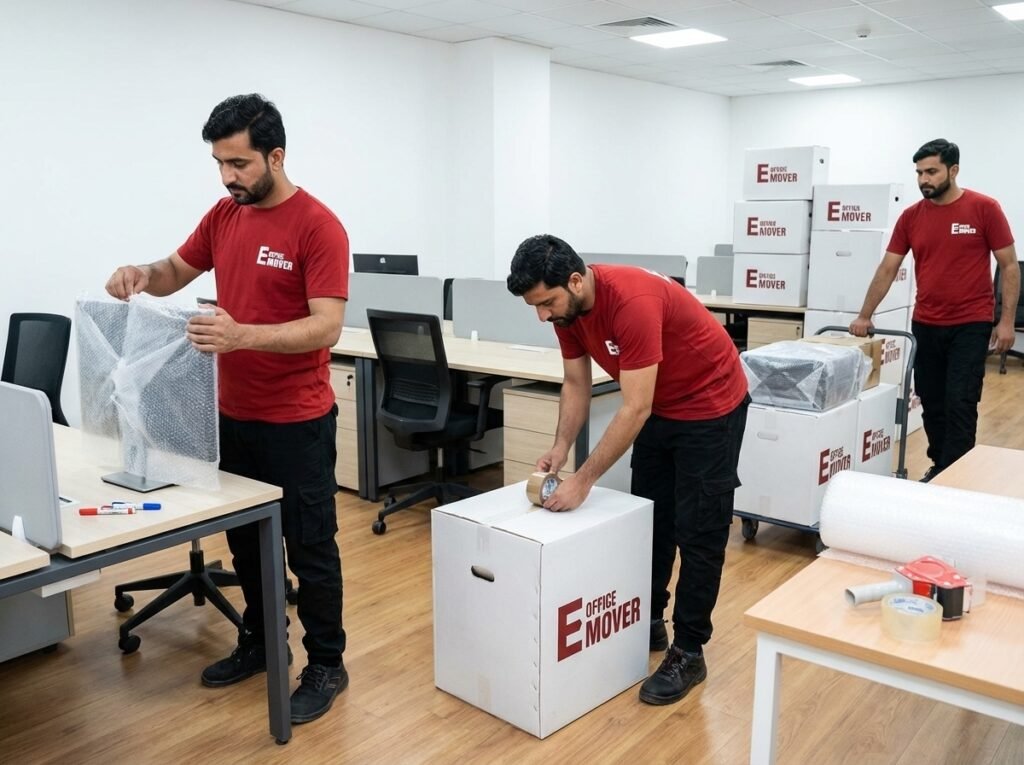
Planning an office move in Dubai requires more than booking a truck and picking a date. For small and medium-sized businesses, a structured office move planning guide is the difference between a clean two-day transition and a week of missed client calls, misplaced equipment, and double rent. The process involves permits, building access windows, IT sequencing, and regulatory updates that all need to run in parallel and none of them wait for you to figure them out on the day. Start with a clear timeline, assign ownership to each task, and treat this as a project rather than a task.
Dubai’s commercial property market adds layers that don’t exist in most other cities. Buildings in Business Bay, Downtown Dubai, and Jumeirah Lake Towers each operate under their own access rules, service elevator booking windows, and NOC requirements. Free zones like DIFC, Dubai Internet City, and Dubai Media City run their own permit systems on top of that. Knowing these constraints before you set your move date is what keeps a well-funded relocation from turning into a weekend standoff in a loading bay.
This guide walks Dubai SMEs through every stage of office move planning from the initial scope session to the final address update with realistic timelines, AED cost ranges, and the specific local details that most planning resources quietly skip over.
How Early Should You Start Planning an Office Move in Dubai?
For most SMEs, the planning window needs to open eight to twelve weeks before the physical move date. That’s not how long packing takes. That’s how long the non-physical work takes when it’s done correctly.
Permit applications for building NOCs and free zone approvals take five to ten working days when documentation is complete. Fiber or leased-line connectivity activation through du or Etisalat takes five to ten working days on its own. If the new office needs structured cabling installed first, add the fit-out lead time on top of that. A reputable moving company in Dubai typically needs three to four weeks of lead time for a mid-sized SME move, particularly during Q1 and Q4, when commercial lease cycles drive peak demand.
If you’re moving from or into a free zone, add a buffer. DIFC, JAFZA, and TECOM-managed zones process permits through their own systems on their own schedules. A public holiday that shortens a working week by two days can turn a five-day NOC into a twelve-day one.
The calendar rule for Dubai SMEs: set your target move date, count back twelve weeks, and begin planning that day.
Step 1: Scope the Move Before You Call Anyone
The first task isn’t finding movers. It’s understanding exactly what’s moving.
Walk every room in your current office with a notepad or a shared spreadsheet. Document each category: workstations, chairs, storage cabinets, server equipment, monitors, meeting room furniture, kitchen appliances, reception furniture, and any items your fit-out contractor installed that technically belong to the landlord. That distinction matters when you’re settling your exit inspection.
This inventory serves three purposes. It gives movers the information they need to produce an accurate quote rather than a headcount estimate. It forces the decision on what to discard rather than transport. And it identifies which items require specialist handling servers, UPS units, glass partitions, or any fragile equipment that shouldn’t go into a standard carton.
What to document per item category:
- Workstations: quantity, whether modular or standalone, cable management included
- IT equipment: server count, UPS units, switch and patch panel quantity, any racked equipment
- Storage: filing cabinet count, document volume in archived files, any confidential records requiring chain-of-custody handling
- Furniture: dimensions of any oversized items (boardroom tables, reception counters, L-shaped desks)
- Fit-out components: glass panels, partition walls, custom shelving that’s fixed to walls
Once you have this inventory, compare it against the floor plan of your new space. Get the actual architectural drawings with column positions, door widths, and service corridor dimensions not the marketing layout. A boardroom table that fits your current elevator may not fit the next one.
Step 2: Set a Two-Anchor Timeline
Every office move planning timeline in Dubai needs two fixed points before anything else is scheduled.
The first anchor is your vacate date the day you’re contractually required to hand back your current space. The second is your earliest access date and the first day you can bring furniture and equipment into the new premises. Everything else slots in between these two dates.
In an ideal scenario, there’s enough gap between access date and vacate date to run a phased move over several nights. In most SME scenarios, the gap is tight, and the move needs to happen over a single weekend or across two consecutive overnight windows.
Build your timeline backward from the vacate date:
- Week 12 before vacate: scope the move, produce inventory, shortlist movers
- Week 10 before vacate: site surveys with shortlisted movers, quotes received
- Week 8 before vacate: confirm mover, apply for permits and building NOCs immediately
- Week 6 before vacate: confirm fiber connectivity order at new office, begin IT planning
- Week 4 before vacate: begin packing non-operational items (archives, storage, kitchen)
- Week 2 before vacate: confirm elevator bookings at both buildings, confirm permit approvals
- Move week: execute the physical move in confirmed access windows
This timeline assumes you’re in a standard commercial tower. If you’re moving out of a free zone, add two weeks to the permit phase. If you’re moving during October to February, when commercial moves peak in Dubai, add another two weeks to your mover booking lead time.
Step 3: Understand Dubai’s Building Access Rules Before Booking Anything
This is the step that catches the most Dubai SMEs off guard, and it’s the one that most planning guides gloss over.
Grade A Towers: After-Hours Only
Most Grade A commercial towers in Business Bay, Downtown Dubai, Dubai Marina, and DIFC restrict moving activity to after-hours windows typically 7 PM to 6 AM on weekdays. Some buildings allow Saturday daytime moves. Friday moves are off the table in almost any building adjacent to residential units. These aren’t suggestions you can negotiate around. Building security enforces them.
The elevator booking sits alongside the time window restriction. Service elevators in high-rise commercial towers need to be reserved 48 to 72 hours in advance. If a building has one service lift, that single elevator sets the pace for the entire move regardless of crew size. An 8-person crew can’t work faster than one elevator load at a time.
Free Zone Permit Systems
Free zones operate permit systems that run separately from and in addition to the building management NOC.
DIFC processes move-in and move-out permits through its own tenant services portal. The documentation required includes a security deposit, third-party liability insurance from the moving company, a signed indemnity form, and written DIFC Authority approval. Plan for five to seven working days minimum once documentation is submitted.
TECOM-managed zones which include Dubai Internet City, Dubai Media City, and several others have weight restrictions on internal access roads. Moving trucks above certain axle loads require pre-approval because of road loading limits. Not every moving company is aware of this, and trucks turned away at the zone gate create a crisis on move night.
JAFZA operates its own logistics access system. All vehicles entering the free zone need pre-registered gate passes. An unauthorized truck doesn’t reach the building; it doesn’t get past the perimeter. Apply for gate pass registration at least two weeks before the move date.
Jumeirah Beach Residence and Dubai Marina Vehicle Access
Parts of Jumeirah Beach Residence and Dubai Marina restrict vehicle length. Certain truck configurations can’t enter the development without an RTA permit. This is one of those local constraints that doesn’t appear in generic moving guides. If your current or new office is in either location, confirm truck access with building management before finalizing your mover’s vehicle plan.
Older Commercial Areas: Fewer Restrictions, Different Challenges
Buildings in Deira, Bur Dubai, and Al Quoz industrial areas typically impose fewer time restrictions on moves. Daytime access is often possible with a standard building NOC. The trade-off is that parking loading bays in older commercial areas can be tight, and in Deira particularly, street congestion during business hours slows loading significantly. Al Quoz and Dubai Investment Park are the easiest areas in Dubai for logistics, with wider roads, accessible truck parking, and fewer access restrictions.
Step 4: Plan Your IT Relocation as a Separate Workstream
IT planning needs to start the same week you confirm your move date, not the week before you move.
Connectivity activation is the hardest constraint to compress. Fiber or leased-line provisioning through du or Etisalat takes five to ten working days when the building already has structured cabling installed and the application is complete. If the new office needs cabling work first, you’re looking at an additional lead time that depends on your fit-out contractor’s schedule. There is no shortcut to this. Assuming connectivity will be ready because the building is modern is the single most common IT mistake in Dubai office moves.
What Proper IT Relocation Covers
A structured IT relocation plan documents every connection before anything is touched. Cable runs between servers, switches, patch panels, and workstations get labeled at both ends, not just one. Server shutdown sequences follow a defined protocol rather than a hard power cut. Equipment moves in anti-static packaging, not standard bubble wrap, because residential packing materials don’t protect against electrostatic discharge.
UPS units are particularly tricky. They’re heavy, the internal batteries can’t be laid on their sides during transport, and they travel upright in cases designed for the purpose. A moving crew that doesn’t know this either improvises or tells you it’s fine. It isn’t.
Reconnection at the destination follows the documented configuration, not whoever gets there first. Systems are tested before the first employee walks in on Monday morning not during business hours when a failure means downtime.
For SMEs with a server room or more than ten networked workstations, budget AED 1,500 to AED 8,000 for dedicated IT relocation handling on top of standard moving costs. That’s the range from a simple workstation disconnect-and-reconnect service through to full server room decommissioning, transport, and reinstallation.
Step 5: Get Quotes the Right Way
Most SMEs approach quoting backwards. They call three companies, give a rough headcount, and collect three numbers. Those numbers are meaningless.
An accurate quote for an office move in Dubai can only be produced after a trained surveyor has visited both locations. Not just the current office in both locations. The surveyor is checking elevator dimensions against your largest items, truck parking access at the delivery address, floor protection requirements in the new building’s corridors, and whether the service corridor is wide enough for server rack transport cases.
What an itemized quote should break out separately:
- Labor: crew size and number of hours
- Transport: vehicle type, number, and distance
- Packing materials: carton count, wrapping materials, floor protection
- IT handling: if applicable, as a separate line item
- After-hours premium: if access restrictions require night or weekend work, this should appear explicitly not buried in a total figure
- Permit liaison: whether the company handles building NOC applications on your behalf or whether you’re expected to manage that yourself
Never accept a per-employee estimate or a per-square-metre figure. Both produce a number. Neither produces an accurate plan. The difference between a real survey-based quote and a headcount estimate shows up on moving days as extra trucks, extra hours, or items that won’t fit through doors no one measured.
For a 10 to 20-person SME doing a full-service move in Dubai packing, dismantling, transport, and reassembly expect costs in the range of AED 8,000 to AED 22,000. After-hours requirements add a crew surcharge of 20 to 35 percent. Overnight moves to buildings with tight access windows sit toward the top of that range.
Step 6: Communicate the Move Internally and Externally
Moving day surprises are mostly communication failures. Most of them happen weeks before the move.
Staff need four to six weeks’ notice. Not because the physical move affects them most won’t touch a single box but because personal logistics take time. Commute routes change. Some staff need to update childcare arrangements. A team that finds out about a Business Bay to Jumeirah Village Circle move two weeks before it happens doesn’t have enough time to plan.
Clients need your new address before you move, not the day of. Couriers, logistics partners, and regular suppliers all carry your address in their systems. A client who sends a signed contract to your old address the week after you moved needs you to track it down and explain the mix-up. That’s a friction cost that compounds across dozens of relationships.
The external update list to build before move day:
- Trade license registered address (DED or relevant free zone authority)
- Google Business Profile
- Company website contact page, footer, sitemap
- DEWA account
- Bank correspondence address
- Insurance policy registered address
- Invoicing templates and email signatures
- Any directories or listing sites relevant to your industry
- Courier accounts (Aramex, DHL, FedEx business accounts)
Most businesses postpone this list until after the move because they’re busy with the physical work. Three weeks later, couriers are delivering to an empty office, Google is sending clients to an address where someone else now works, and the bank is posting statements to the wrong place. Build the list before the move, and execute it on the first morning you’re operational at the new address.
Step 7: Execute a Phased Packing Approach
Not everything in an office is operational every day. The parts that aren’t operational can be packed weeks before the move without disrupting the business.
Archive rooms and document storage are typically the first to go. File boxes, archived records, reference materials that haven’t been touched in a year can be packed, labeled, and staged for transport three weeks before move day without affecting anyone’s work. This also creates an early opportunity to audit the archive. A relocation is the natural moment to destroy records past their retention period and clear out what doesn’t need to follow you.
Kitchen supplies, branded materials, training equipment, and conference room items not in daily use follow a week later. These areas pack out quickly and removing them from the equation makes the final packing phase of the live workstations and active equipment faster and less chaotic.
The live desks pack last. Each employee packs their own personal effects. The moving crew packs the hardware, cables, monitors, and desk items. Labeling by department and desk number at the source means no sorting at the destination.
Labeling system that actually works:
Use a three-part label: department code, floor or zone in the new office, and individual item number. A monitor labeled “OPS-A2-04” goes to the Operations team, Zone A2, item four. A crew can place it without asking anyone. That system, multiplied across 200 items, saves two to three hours on the day of setup.
Step 8: Handle the Legal and Regulatory Updates
This is the step with the longest tail, and it’s the one most SMEs underestimate because it doesn’t happen on a moving day, it happens over the two weeks that follow.
Trade License Address Update
Your DED trade license or free zone registration must reflect your actual physical address. Operating from a new address while your license still shows the old one creates a mismatch between your operational status and your registered record. This comes up during bank KYC reviews, during contract due diligence by enterprise clients, and during any government interaction that references your trade license.
The update process differs by entity type. DED mainland companies apply for an address amendment through the DED portal or a registered typing center. Free zone entities update through the specific free zone authority DIFC, DMCC, JAFZA, or whichever governs your license. Timelines range from same-day for some mainland amendments to five to seven working days in some free zones.
DEWA Account Transfer
Businesses are responsible for transferring their DEWA commercial account to the new premises. This involves closing the account at the old address ensuring final meter readings and settling any outstanding balance and opening a new account at the new address. If the new landlord hasn’t transferred the DEWA account for the unit to your name before you take occupancy, coordinate this directly with the building management or the landlord before move day. Arriving at a new office without confirmed DEWA access creates a problem that’s difficult to solve quickly.
Post-Move Checklist for Compliance
- Trade license address amendment: submitted within two weeks of move
- Free zone authority notification: same timeline if applicable
- Google Business Profile: update within 24 hours of moving
- Bank KYC update: notify your relationship manager before the move
- DEWA transfer: confirmed before move day, not after
For a full breakdown of every regulatory step and a complete compliance checklist structured by move phase, the office relocation checklist for Dubai businesses covers each item in sequence.
What Are the Hidden Costs in an Office Move in Dubai?
Most SMEs budget for the moving company quote and underestimate everything else. These are the costs that appear after the quote is signed.
Building deposit for elevator use. Many commercial towers in Business Bay and Downtown Dubai require the moving company to pay a refundable deposit to use the service elevator. This gets passed through to the client. Amounts vary by building AED 500 to AED 3,000 is a common range. Confirm whether this applies at both buildings before finalizing your budget.
After-hours premium. If your current or new building restricts daytime access, your move happens at night. Night and weekend work carries a crew surcharge, typically 20 to 35 percent above the standard rate. Budget for it from the start rather than treating it as an unexpected addition.
RTA permits for restricted zones. If trucks need an RTA permit to access parts of Dubai Marina or Jumeirah Beach Residence, that cost comes back to the client. It’s not large, typically AED 300 to AED 700 but it’s a cost that won’t appear in the original quote unless you’ve asked specifically about vehicle access at both addresses.
Double rent. When the new lease starts before the vacate date on the old one, both rents run simultaneously. For SMEs with tight cash flow, even two weeks of double rent is meaningful. Negotiate with your new landlord to align access dates with your vacate date where possible. If you can’t, factor the overlap into your total relocation budget.
IT downtime. This isn’t a cash cost, but it’s a real cost. A server that goes offline because connectivity wasn’t provisioned in time, or because reconnection happened in the wrong sequence, produces a revenue impact that dwarfs the cost of the move itself. Budget the time for IT planning properly. It costs nothing to plan correctly and everything when you don’t.
For a detailed breakdown of service types and what they cost in Dubai, the types of office relocation services in the Dubai guide covers each category with AED ranges and what drives the variation.
Dubai SME Office Move: Area-by-Area Practical Notes

Some Dubai locations consistently add planning complexity. Others are more straightforward. Here’s what each area typically involves.
Business Bay has a dense concentration of Grade A towers with strict after-hours access rules, single service elevators in many buildings, and limited truck parking near the canal during business hours. Building management teams in Business Bay are thorough with documentation requirements and expect to submit the mover’s trade license, insurance certificate, and truck registration a minimum of five working days before the move.
Downtown Dubai operates similarly to Business Bay for access restrictions. The additional complexity is road access; several loading zones near Emaar-managed buildings operate under specific access sequences, and trucks above a certain length can’t use certain entrance points. Confirm truck access with building management before your mover finalizes the vehicle plan.
Jumeirah Village Circle is significantly more accessible than central Dubai locations. Buildings are newer, service elevators are generally larger, and truck parking near loading areas is easier to coordinate. Most buildings allow weekday evening moves with standard building NOC documentation.
Jumeirah Lake Towers is mixed. The interconnected development has good access for most buildings, but some of the older towers in the cluster have small service elevators and limited loading bay space. Confirm elevator dimensions before the site survey so the mover can plan around any constraints.
Dubai Internet City and Dubai Media City both fall under TECOM Group management. As noted above, truck weight limits on internal access roads require pre-approval for heavier vehicles. These zones have dedicated logistics access processes work with a mover who has done moves in TECOM zones before, not one learning the system on your job.
Al Quoz and Dubai Investment Park are the most logistics-friendly areas in Dubai for office moves. Wide roads, accessible loading areas, fewer time restrictions, and straightforward building access make these locations significantly easier to plan. The trade-off is distance from central Dubai, which adds transport time for phased moves or storage runs.
How to Choose an Office Relocation Company for Your Dubai SME
The selection criteria matter more than the price comparison.
Valid trade license for commercial moving activity. Check the DED portal or the relevant free zone business registry. A two-minute verification eliminates unlicensed operators who can’t be held accountable when something goes wrong.
Commercial transit insurance with a meaningful coverage limit. Ask for the actual insurance certificate not a summary. Confirm that the coverage limit reflects the replacement value of your IT hardware and high-value furniture. Understand the claims process before you need to use it.
Documented office relocation experience, specifically. Not villa moves. Not household packing. Office relocations that involved IT equipment, modular workstations, building permit management, and access coordination in the specific areas where your move will happen. Ask which buildings and free zones they’ve completed moves in recently.
Site survey before any quote. A mover who won’t visit before quoting is a mover who will quote wrong. The quote that starts low and grows once work is underway comes from a company that didn’t survey properly.
Permit liaison included in the service. A commercial mover in Dubai who leaves NOC applications to you is transferring the burden and the risk of delays to your side. Confirm whether they handle building permit coordination on your behalf, or whether you’re managing that alongside your own workload.
For questions about how office relocation works in Dubai the full process from lease signing to staff move-in the complete office relocation guide covers every stage with process detail and cost context.
Conclusion
An office move in Dubai is a project management exercise as much as a logistics one. The physical work packing, loading, transport, reassembly is the part that takes the least time. The planning work that runs before it permits, IT provisioning, stakeholder communication, and regulatory updates is what determines whether the move finishes on schedule or creates weeks of operational friction.
For Dubai SMEs, the two most common planning failures are starting too late and underestimating the permit timelines for specific buildings and free zones. Both are avoidable with a clear twelve-week timeline and a moving partner who manages the administrative side on your behalf rather than leaving it in your inbox.
Every stage in this guide scope, timeline, building access, IT planning, quoting, communication, packing, and regulatory updates connects directly to the next one. Skip one and the following stage becomes harder. Follow the sequence and the move becomes a managed transition rather than a reactive scramble.
If your office move is on the horizon and you want a quote built on a real site survey, not a headcount estimate, contact the E Office Mover team. We work exclusively in commercial relocations across Dubai and will give you an accurate written plan before you commit to a date.
Request a free moving survey and let us build your move plan from the ground up.
Frequently Asked Questions:
How many weeks before the move should a Dubai SME start planning?
Eight weeks is the minimum for a straightforward move from a standard commercial tower. Twelve weeks is the realistic target for SMEs in free zones, for moves during Q1 or Q4 peak periods, or for any business with a server room or significant IT infrastructure. The planning phase is where delays accumulate permits, connectivity provisioning, and mover availability all have lead times that can’t be compressed at short notice.
Can we move our office in Dubai during the day?
In some buildings, yes. Older commercial buildings in Deira, Bur Dubai, Al Quoz, and Dubai Investment Park generally allow daytime moves with a standard building NOC. Most Grade A commercial towers in Business Bay, Downtown Dubai, Dubai Marina, and DIFC restrict moves to after-hours windows, typically 7 PM to 6 AM on weekdays. Confirm the access rules with building management at both locations before scheduling the move.
What permits are required for an office move in Dubai?
At minimum, a move-out NOC from the building management at your current premises and a move-in permit from the building management at your new address. Free zone relocations require an additional NOC from the relevant free zone authority DIFC, TECOM, JAFZA, or others which runs on its own timeline independently of the building NOC. Both applications need complete documentation: the mover’s trade license, insurance certificate, truck registration, and your account settlement confirmation.
What happens if we don’t update our trade license address after moving?
Your DED trade license or free zone registration needs to reflect your actual physical address. Operating with a mismatched address creates compliance issues that surface during bank KYC reviews, enterprise client due diligence processes, and any government interaction referencing your trade license. The amendment process is straightforward; the risk is in forgetting to do it during the busy post-move period.
How much does a full-service office move cost for a 15-person SME in Dubai?
For a 15-person SME doing a full-service move packing, dismantling, transport, and reassembly the typical range in Dubai is AED 10,000 to AED 20,000 depending on volume, IT requirements, and whether after-hours access restrictions apply. Moves with a server room, modular workstations requiring specialist dismantling, or buildings with strict overnight-only access windows sit toward the top of that range.
Does the office move affect our Google Business Profile listing?
Yes. Google Business Profile carries your registered address, and an outdated listing sends clients and couriers to your old location. Update your Google Business Profile within 24 hours of moving; it’s a five-minute task that prevents weeks of misdirected foot traffic and deliveries. The same applies to your website, invoicing templates, and email signatures.
Can we do an office move in phases rather than all at once?
Phased moves work well for SMEs that can’t absorb a single-weekend disruption. Archive rooms, storage areas, and non-operational equipment move first over two to three weeks before the primary move. The live workstations and IT infrastructure move last, usually over a single overnight window. A phased approach requires more building access bookings and coordinator effort, but it reduces moving-day pressure significantly and spreads the disruption across the team.
Ali Al-Refai is an expert in the moving and logistics industry, with over 12 years of experience in managing both local and international moving operations. He has worked extensively in relocation planning, packing, and logistics, ensuring seamless and efficient transitions for individuals and businesses alike.
His expertise lies in optimizing moving processes, reducing costs, and ensuring the safe handling of items during relocation. Ali regularly shares insights and practical tips on best practices in moving, aiming to help people and companies achieve smoother, cost-effective relocations.