

An office move planning guide for a Dubai SME is a structured plan that takes a small or medium business from the decision to relocate through to a fully working new office. For an SME, the move carries more weight than it does for a large corporation. A small team has less slack, a tighter budget, and no spare floor to fall back on if a server stays offline. Good planning closes that gap. This guide walks through why planning matters, the stages of a relocation, how to build a timeline and budget, how to choose a location, how to prepare furniture and IT, how to coordinate movers and building management in Dubai, the mistakes that cost SMEs money, and how to settle into the new workspace without losing productivity.
Why Does Office Move Planning Matter for Dubai SMEs?
Office move planning matters for Dubai SMEs because a small business absorbs the cost of a bad move directly, with no large reserve to cushion the disruption. A delayed internet connection or a misplaced furniture order stalls the whole team, not one department. Planning turns a high-risk event into a managed project.
Dubai adds its own layer of rules that an SME owner cannot skip. A new office needs an Ejari tenancy registration, a DEWA connection in the company name, and building management approval before any move begins. Free zone offices in DMCC, Dubai Internet City, or JLT follow the access rules of their authority, while mainland offices under the Department of Economy and Tourism follow theirs. SME office relocation in Dubai works best when the owner maps these requirements early rather than discovering them on move week.
Three outcomes separate a planned move from a rushed one:
- Lower downtime, because systems come back online in a tested sequence
- Controlled cost, because the budget covers the full scope before quotes arrive
- Steady productivity, because staff know what happens and when
What Are the Stages of an Office Move Planning Process?
An office move planning process runs through five stages: decide, plan, prepare, execute, and settle. Each stage feeds the next, and skipping one pushes the problem downstream.
Stage 1: Decide and Define the Move
Confirm the reason for the move and define what the new office must deliver. A growing team, a lease ending, or a need for a better address each shapes the brief differently. Write down the non-negotiables, the headcount the space must hold, and the target move date before viewing a single property.
Stage 2: Plan and Budget
Build the timeline, set the budget, and assign responsibilities. This stage produces the project plan that every later decision references. An SME that locks its budget and timeline here avoids the scramble that defines most failed moves.
Stage 3: Prepare and Pack
Sort, label, and pack while keeping the office running. Run the data audit, declutter old furniture and records, and brief the moving company. Preparation is where the move is won or lost, since a well-prepared office moves fast and a chaotic one drags.
Stage 4: Move Day Execution
Transport, install, and reconnect on the scheduled day or weekend. A move coordinator runs the day against the plan, checks deliveries against the inventory, and keeps the moving crew, building staff, and IT team in sync.
Stage 5: Settle In and Review
Test systems, onboard staff to the new space, and clear the snag list. The move is not finished when the last box arrives. It finishes when the team works at full speed in the new office.
How Do You Build a Realistic Office Relocation Timeline?
Build a realistic office relocation timeline by working backwards from the move date and allowing the longest lead item to set the schedule. For most Dubai SMEs, that long-lead item is the internet and telecom connection, which providers install on their own schedule, not yours.
A practical SME timeline spans eight to twelve weeks for a standard office. Larger or IT-heavy moves need more. The timeline breaks into early planning, vendor selection, packing and preparation, move week, and post-move setup. A detailed week-by-week relocation timeline lays out each task in order, and an SME benefits from following one rather than guessing the sequence.
Leave buffer time. A timeline with no slack breaks at the first delay, and delays happen. Booking the freight lift, securing building approvals, and confirming the internet line all sit outside your direct control, so build margin around them.
How Should an SME Budget for an Office Move in Dubai?
An SME budgets for an office move by costing every category of the move, not just the moving truck. The transport fee is often the smallest line in a full relocation budget. The hidden lines catch unprepared businesses.
A complete office move budget covers several categories, including:
- Moving and relocation services, including labour and transport
- Packing materials, from boxes to anti-static and protective wrapping
- IT relocation, covering disconnection, transport, and reinstallation
- Furniture transportation and any new or replacement pieces
- New office setup, including Ejari, DEWA, internet activation, and signage
- Downtime cost, the value of hours lost during the transition
- Deposits and approvals required by building management
Pricing for a move depends on volume, distance, building access, IT complexity, and the level of service. A professional provider assesses these factors during a site survey before quoting, so treat any number given without a survey as a rough estimate. A dedicated breakdown of office relocation cost factors helps an SME plan the budget in detail.
How Do You Assess Office Needs and Choose the Right Location?
Assess office needs by measuring how the current space fails and what the business needs in three years, not just today. An SME that rents purely for current headcount outgrows the space before the lease ends, then pays to move again.
List the requirements that the new office must meet:
- Headcount and growth, including desks for planned hires
- Layout, covering meeting rooms, quiet zones, and collaboration space
- Location and access, for staff commutes and client visits
- Connectivity and infrastructure, including fibre availability and power load
- Cost and lease terms, balanced against the budget
Dubai offers distinct options for an SME. Business districts such as Business Bay, JLT, and Barsha Heights suit firms that want a commercial address. Serviced offices in towers across the city suit startups that need a quick, low-commitment setup. Free zones like DMCC, Dubai Internet City, and Dubai Media City suit businesses tied to a specific liscence or community. Choosing the location that supports growth is a decision worth its own detailed comparison, since the wrong choice repeats the whole move within two years.
What Approvals and Documents Does a Dubai Office Relocation Require?
A Dubai office relocation requires several approvals and documents tied to the new address, most of which carry their own processing time. An SME that treats these as move-week paperwork meets delays no moving crew can fix.
The core requirements for a new office include:
- Ejari registration of the new tenancy contract
- DEWA setup for power and water in the company name
- Trade licence address update with the relevant authority
- Building management NOC and move approval at both sites
- Freight-lift and loading-bay booking for the move date
Mainland firms update the licence address through the Department of Economy and Tourism, while free zone businesses work through their own authority, such as DMCC or Dubai Internet City. A detailed guide to office relocation permits and approvals covers each document in full, and an SME confirms which apply to its licence type before booking the move.
How Do You Create an Office Move Checklist and Assign Responsibilities?
Create an office move checklist by turning the project plan into dated tasks, then assigning a named owner to each one. A task with no owner is a task that slips. A checklist without dates is a wish list.
Most SMEs run the move through a small relocation committee rather than one overloaded person. A typical structure assigns:
- A move coordinator who owns the overall plan and timeline
- An IT lead for servers, network, and equipment
- An admin or facilities owner for furniture, supplies, and building liaison
- A finance contact for the budget and vendor payments
- A communications owner for staff updates
A full office moving checklist for Dubai breaks every stage into actionable items, and an SME saves hours by working from a ready structure instead of building one from scratch.
How Should You Communicate the Move to Your Team?

Communicate the move to your team early and in stages, so staff plan around it rather than react to it. Silence breeds rumour, and rumour drains productivity faster than the move itself.
Tell the team the basics as soon as the move is confirmed: the new location, the rough timeline, and the reason behind it. As move week approaches, share the practical details, including the new commute, the seating plan, the move-day schedule, and what each person packs from their own desk. A short FAQ for staff answers the questions that otherwise fill inboxes. Keeping employees informed throughout the relocation protects morale and keeps work moving while the office changes around them.
How Do You Plan Furniture, Workstations, and Shared Spaces?
Plan furniture and shared spaces by mapping the new floor before move day and deciding what travels, what gets replaced, and what gets retired. An SME often discovers that old furniture does not fit the new layout, and finding out on move day wastes a truck and a crew.
Cover each zone of the new office in the plan:
- Workstations, sized to the team with room for growth
- Meeting rooms, fitted for the technology and group sizes the business uses
- Storage areas, planned for records, supplies, and equipment
- Common spaces, including reception, kitchen, and breakout zones
Produce a simple floor plan with each desk and room numbered. The moving crew then places furniture by the plan instead of asking where each piece belongs. A clear layout turns chaotic unpacking into a placement exercise.
How Do You Decide What to Move, Replace, or Dispose Of?
Decide what to move by sorting every asset into keep, replace, or retire before packing, since moving unwanted items wastes money twice. An SME pays to transport old furniture, then pays again to dispose of it after it fails to fit the new floor.
Run a simple sort across the office:
- Keep: items that fit the new layout and remain in good condition
- Replace: worn furniture or equipment the new space outgrows
- Retire: broken, obsolete, or duplicate items through resale, donation, or disposal
- Store: items the business needs but cannot house yet
Decluttering before a move cuts the volume, lowers the moving cost, and gives the new office a clean start. Where the business owns more than the new space holds, commercial storage bridges the gap. The decisions made here feed straight into the budget and the furniture plan.
How Do You Prepare IT Infrastructure Before Moving Day?
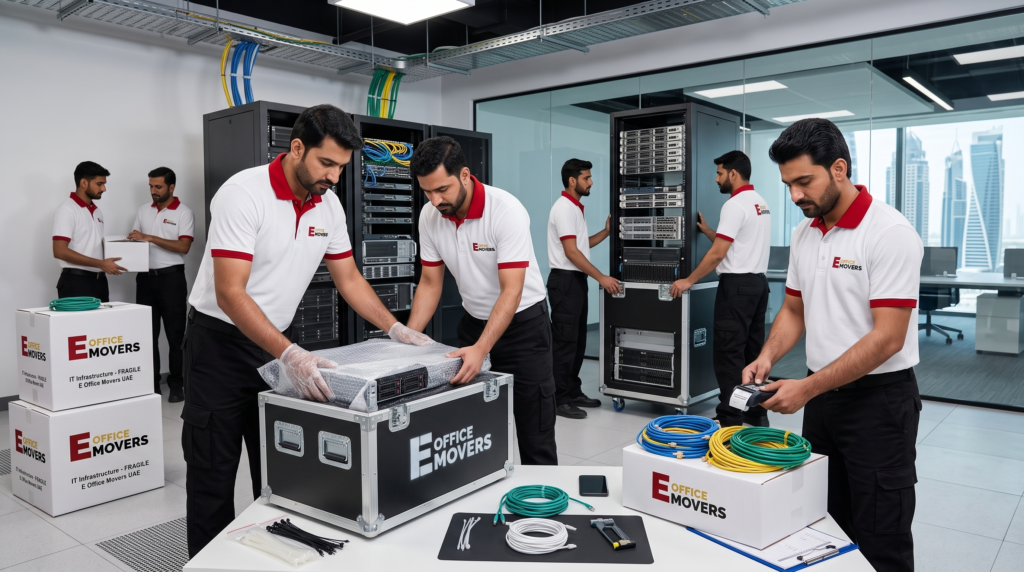
Prepare IT infrastructure by confirming the new connection and backing up every system well before the move, since IT failures cause the longest downtime. A desk arrives and works instantly. A network does not.
Order the internet and telecom line early. Providers in Dubai, including Etisalat and du, install business connections on a lead time that runs into weeks, so an unconfirmed line is the single most common cause of a delayed opening. Back up all servers and workstations, label every cable, and document the network setup before disconnection. Moving servers, switches, routers, and sensitive electronics calls for proper handling and anti-static protection, and IT equipment relocation deserves a dedicated plan within the wider move. Where the business handles personal or confidential data, the relocation also sits under UAE data protection rules, which shape how files and devices travel.
How Do You Coordinate Movers, Building Management, and Service Partners?
Coordinate the move by treating every external partner as a dependency with its own lead time and approval. A move fails when one partner shows up unbooked or unapproved.
Office movers in Dubai are companies that handle commercial relocation as a managed service, from packing and transport to furniture installation and IT reconnection. They range from full-service corporate movers that run the entire project to lighter providers that handle transport alone. An SME chooses the type that matches its complexity and internal capacity.
Relocation facilities in the UAE run through the property management of each building. Moving in or out of a Dubai tower involves move approval, a freight-lift booking window, loading-bay access, and security clearance for the crew. Security and access systems form part of this work, since access cards, biometric readers, and CCTV often need reconfiguring at both ends so neither office sits unsecured during the transition.
Coordinate these partners in parallel:
- The moving company, booked and briefed against the inventory
- Building management at both sites, for approvals and lift booking
- Internet and telecom providers, for line activation timed to move day
- DEWA, for power connection in the company name
- Furniture and fit-out suppliers, scheduled around the move
What Common Mistakes Do SMEs Make When Relocating?
SMEs new to office relocation make several recurring mistakes, almost all traceable to starting too late. A first move feels simpler than it is until the dependencies stack up.
- Booking the internet line too late, then opening with no connectivity
- Underestimating building approvals, missing the freight-lift window
- Skipping the budget detail, then meeting hidden costs on move week
- Moving old furniture that does not fit the new layout
- No single owner, so tasks fall through the gaps between people
- Reopening before testing, then troubleshooting in front of clients
Each mistake has a simple fix, and the fix is always earlier planning. An SME that starts eight weeks out, with a named coordinator and a clear budget, avoids the failures that catch a rushed move.
How Do You Keep the Business Running on Move Day?
Keep the business running by moving in a low-impact window and bringing critical systems back online first. Most Dubai SMEs move over a weekend or after hours, when freight lifts sit free and the working week stays productive.
Run move day against the plan, not improvisation. The move coordinator checks each delivery against the inventory, the IT lead reconnects and tests the network, and each department confirms its area is ready before staff return. A phased move suits a business that cannot stop, since non-essential equipment relocates first while core systems stay live until the last possible moment. Minimising disruption protects both revenue and client confidence through the transition.
What Should You Do After the Move?
After the move, test everything, settle the team, and close the snag list before calling the relocation complete. The first day in a new office is the most fragile, and a few checks prevent a week of frustration.
Work through the post-move tasks in order:
- Test all systems, including internet, servers, phones, printers, and security
- Confirm the workspace setup, with each desk and room ready for use
- Onboard the team, walking staff through access cards, facilities, and emergency exits
- Log outstanding issues, from a wobbly desk to a dead network port
- Review the move, capturing lessons for the next relocation or branch
A short settling-in period, with the move coordinator still on call, clears the small problems quickly. The relocation finishes when the team works at full pace, not when the truck leaves.
Real-World Office Relocation Challenges for Dubai SMEs
Three scenarios show the challenges a Dubai SME meets and how planning answers them.
A Software Startup Outgrowing a Serviced Office
A software startup outgrew its serviced office and moved into a leased JLT unit. The founders ordered the fibre line six weeks ahead, which arrived two days before move day after a provider delay. The early order saved the launch. A late order would have left the team offline through their first week.
A Marketing Agency Moving Within Business Bay
A marketing agency relocated within Business Bay and assumed old desks would fit the new floor. A pre-move floor plan revealed they would not, so the agency ordered replacements in time. Without the plan, the agency would have paid to move furniture it could not use.
An Accounting Firm Relocating to Barsha Heights
An accounting firm moved to Barsha Heights while protecting client financial records. The firm ran a phased weekend move, backed up every system, and tested the network before Monday. Staff opened the week working, with no downtime and no lost files.
A Consulting Firm Splitting a Move Across Two Floors
A consulting firm moved into a two-floor DIFC unit and underestimated the freight-lift booking. With one lift window per day, the crew split the move across two days. Booking both days in advance kept the schedule intact and stopped the move stalling halfway.
Frequently Asked Questions
How far in advance should a Dubai SME plan an office move?
A Dubai SME plans an office move eight to twelve weeks in advance for a standard office. IT-heavy or larger moves need longer. The internet and telecom connection sets the longest lead time, so confirm that line early and build the rest of the timeline around it.
What is the most important first step in office move planning?
The most important first step is appointing a single move coordinator who owns the plan, timeline, and budget. A named owner stops tasks falling between people, keeps every partner accountable, and gives the team one clear point of contact throughout the relocation.
How long does an SME office relocation take in Dubai?
An SME office relocation in Dubai takes a weekend to a few days of physical moving, within an overall project of eight to twelve weeks. The physical move is short, while planning, approvals, internet activation, and setup occupy most of the schedule.
What does an office move cost for a small business in Dubai?
An office move cost depends on volume, distance, building access, IT complexity, and service level, so a fixed figure needs a site survey. Budget beyond the transport fee to cover packing, IT relocation, new-office setup, deposits, and downtime for a realistic total.
How can an SME avoid downtime during an office move?
An SME avoids downtime by moving in a low-impact window, backing up all systems first, and reconnecting critical infrastructure before staff return. A phased move keeps core services live, and testing every system before reopening prevents troubleshooting during business hours.
Ali Al-Refai is an expert in the moving and logistics industry, with over 12 years of experience in managing both local and international moving operations. He has worked extensively in relocation planning, packing, and logistics, ensuring seamless and efficient transitions for individuals and businesses alike.
His expertise lies in optimizing moving processes, reducing costs, and ensuring the safe handling of items during relocation. Ali regularly shares insights and practical tips on best practices in moving, aiming to help people and companies achieve smoother, cost-effective relocations.