
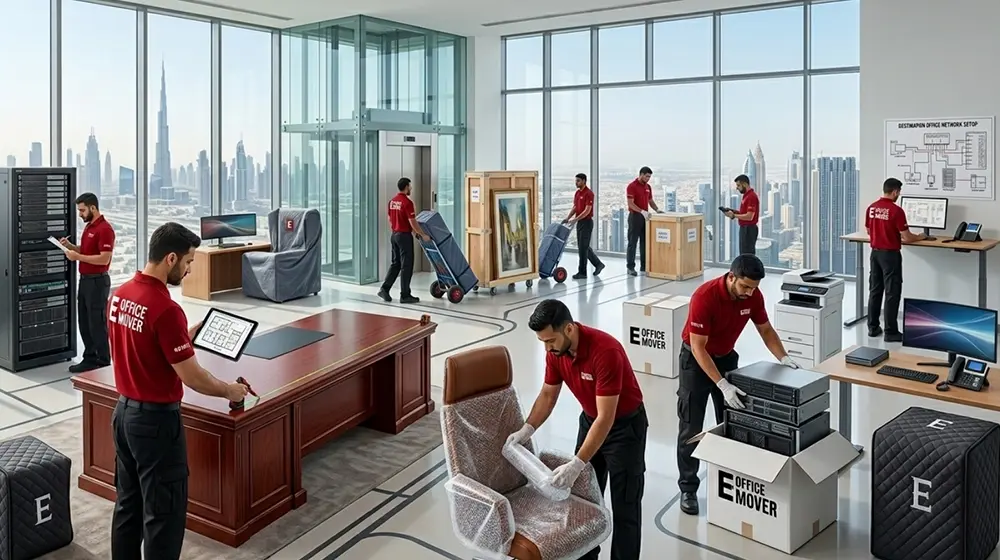
Moving an office in Dubai is not something you figure out as you go. Get the workflow wrong and you’re looking at elevator access denied on move day, a server room that takes two weeks to reconnect, or a landlord holding your deposit because the handover inspection wasn’t booked in time. The office move workflow in Dubai has real stages, real permit requirements, and real costs that vary depending on whether you’re in a free zone or a standard commercial tower. This guide breaks all of it down, in order, so nothing catches you off guard.
If you’d rather have someone handle the coordination for you, our office relocation services in Dubai cover the full process from the initial survey through to final handover.
Why Dubai Office Moves Can’t Be Improvised
Most cities let you hire a van and move over a weekend. Dubai doesn’t work like that, at least not for commercial moves.
Building management in most towers here controls elevator access, loading bay use, and lobby protection. You can’t just show up with a truck. Free zones like DMCC, DIFC, and Dubai Media City each run their own approval systems on top of the standard building management process. Miss a step in that chain and your move gets blocked, sometimes at 7 AM on the Saturday you’ve booked your team to be off work.
There’s also the lease clock. Exit clauses in many Business Bay and JLT commercial leases don’t leave much room. The space needs to be cleared, restored, and handed back within a fixed window. If the move runs late, the penalty starts.
That’s why the workflow matters. It’s not bureaucracy for its own sake. It’s the sequence that stops a manageable move from turning into an expensive mess.
Stage 1: Pre-Move Assessment
Everything starts here, four to twelve weeks out depending on how large the office is.
A pre-move assessment isn’t just counting desks. It’s about understanding what you’re actually dealing with before you commit to a date. How dense is the server room? Are there custom modular workstations that need professional disassembly? Is there heavy equipment like industrial printers, AV systems, or archive storage that requires specialist handling?
The assessment should also look at both locations, not just the one you’re leaving. Floor plans at the new premises need to be measured against what you’re bringing. You’d be surprised how often companies discover mid-move that a piece of furniture doesn’t fit through the new office’s corridor.
During this phase, the person leading the move should:
- Get actual measurements from both premises, not estimates
- Photograph server room cabling and workstation layouts before anything is touched
- Confirm the lease exit conditions in writing with the current building management
- Check whether the destination building has any restrictions on move-in timing or vehicle size
For towers in Downtown Dubai or Business Bay, written notice of a planned move is usually required two to three weeks before the date. That notice is what triggers elevator scheduling. Skip it and the elevator simply won’t be available.
What a Realistic Timeline Looks Like
For a medium office, call it 20 to 50 people, plan for six to ten weeks from assessment to move day. Here’s roughly how that breaks down:
- Weeks 1 and 2: Survey, scope confirmation, and quote sign-off
- Weeks 3 and 4: NOC applications, building access scheduling, IT vendor loop-in
- Weeks 5 and 6: Packing starts on non-essential items, furniture labeling, crate ordering
- Week 7: Final IT disconnection, equipment crating
- Move day: Transport, offloading, IT reconnection at the new premises
- Post-move: Snagging, layout adjustments, move-out documentation returned
Offices above 100 workstations usually don’t move in a single push. Departments relocate in batches over consecutive weekends. It’s slower on paper, but it keeps the business running while the move happens, which is the whole point.
Stage 2: Building the Budget
Office moves in Dubai cost more than people expect when they first get into the numbers. Not because movers are overcharging, but because there are cost categories that don’t show up in an initial quote.
The visible costs are straightforward enough: the packing crew, transport vehicles, packing materials, and any furniture assembly or disassembly required. What catches businesses is everything else.
Parking permissions for moving trucks in restricted commercial zones can involve applications, fees, and waiting periods. Some building management offices charge for elevator use. Overtime rates kick in if the move runs beyond the agreed window. If the new premises aren’t ready on time and items go into temporary storage, that’s an additional weekly cost.
To give you a rough sense of what full-service moves cost in Dubai right now:
- A small office of 10 to 15 desks in JVC or Jumeirah: roughly AED 2,500 to AED 5,000
- A mid-size office of 30 to 50 workstations in Deira or Al Quoz: AED 6,000 to AED 14,000
- A larger commercial relocation in DIFC or Business Bay, particularly with server room work: AED 25,000 and above, depending on scope and whether after-hours access is needed
The IT side is often underbudgeted. If your IT vendor charges separately for disconnection and reconnection, factor that in from the start. Network reconfiguration costs vary a lot depending on how different the cable layouts are between your old and new premises.
Our office move planning guide for Dubai goes deeper on cost categories by office size if you want a more detailed breakdown.
Stage 3: Permits, NOCs, and Approvals
This is the stage that trips up the most businesses, and it’s the one that has the least margin for error.
Every commercial building in Dubai requires prior notification before a move can happen. The specific requirements depend on whether you’re in a standard commercial tower or inside a free zone.
Standard Commercial Towers
For offices in towers across Business Bay, Sheikh Zayed Road, Al Barsha, or Deira, you’ll typically need to submit:
- A formal move notification letter to building management
- A security deposit or cheque covering elevator and lobby use during the move
- The confirmed move date and time window, since most buildings restrict moves to weekends or off-peak hours
- Proof of insurance from the moving company
That’s the baseline. Some buildings add their own requirements on top, so it’s worth calling the facilities manager directly rather than assuming.
Free Zone Approvals
This is where things get more layered.
In DIFC, the no-objection certificate comes from the tower developer, not the landlord. Dubai Civil Defense inspection is also required for any significant fit-out change at the vacated premises. That inspection takes three to four working days to clear.
In DMCC, which covers most of the JLT towers, the drawing proposals go first to the tower developer. Then approval is needed from DMCC directly and from Concordia, who carry out a Certificate of Conformity inspection. The ceiling must stay accessible until Concordia has completed their check, which matters if you’re planning any reinstallation of ceiling-mounted cable trays or lighting.
Dubai Media City runs a slightly different process. Civil defense approval typically takes two to three working days, and the final handover package needs a completion certificate, updated drawings, and an inspection request letter all submitted together.
If you’re moving between a free zone and a mainland location, you’re dealing with both sets of requirements at the same time. Exit documentation from the free zone authority and entry permits at the mainland building need to land on the same timeline. Plan for this early because delays on either side can hold up the whole move.
Stage 4: IT and Infrastructure Planning
Nobody talks about this stage enough. IT planning is what determines whether your team can actually work in the new office on the first Monday after move day, or whether they’re sitting around waiting for the internet to come back on.
The core problem is that IT reconnection always takes longer than expected when it hasn’t been planned properly. Cable connections that weren’t photographed before disconnection take hours to reverse-engineer. Server configurations that looked simple turn complicated when the network layout at the new premises differs from the old one.
A solid IT disconnection plan covers:
- Photographing every cable connection before anything is unplugged
- Labeling each cable, port, and switch individually
- Looping in the ISP early to arrange a parallel setup at the new premises before the old connection is cut
- Scheduling the disconnect and reconnect within a single overnight window where possible
- Completing a full data backup before servers are physically moved
For offices in Dubai Marina, JBR, or Al Barsha that run business-critical systems, it’s worth paying for a two to three day parallel running period. Both premises stay active during the transition. It costs more, but it’s cheaper than a full day of staff downtime because the email server hasn’t reconnected.
Your IT vendor and your moving company both need to know what the other is doing. When those two teams aren’t coordinated, things fall through the gap. If you want a checklist that covers the IT side by role, our office relocation checklist for Dubai has a dedicated section for it.
Stage 5: Packing and Inventory Control
Packing an office isn’t like packing a flat. The risks are different, the materials are different, and the organization system you use will directly affect how fast the new office gets set up.
Documents and business records need sealed, labeled boxes with a proper chain of custody. Sensitive files don’t go into generic cardboard without identification. Monitors need antistatic padding. CPUs and hard drives go into antistatic bags before they touch any foam or bubble wrap. Furniture that can’t be cleanly disassembled gets wrapped in heavy blankets before loading, not after it’s already on the truck.
The packing sequence that works best for most offices goes something like this:
- Archive rooms and filing cabinets first. These are usually the least disruptive to pack early and they take time to do properly.
- Common areas, the kitchen, the reception counter, and any informal seating
- Meeting rooms, including projectors, AV units, and whiteboards
- Individual workstations, monitors, keyboards, desk storage, and personal items
- The server room and all comms hardware, done last on move day itself
Every box needs a numbered label that maps to a specific zone in the new office. Not a room name. A numbered zone. When the truck arrives at the new premises, each box goes straight to its zone. Nothing gets staged in the corridor while someone figures out where it should go.
Modular desks, partition walls, and storage systems need to be photographed before disassembly. Each component gets a label. Reassembly goes much faster when there’s a reference to work from rather than trial and error on-site.
Stage 6: Transport and Access Coordination
The logistics of actually moving the items are more constrained in Dubai than people realize, especially in high-density commercial areas.
Loading bay dimensions vary between towers. A truck that works at your current building might not clear the ceiling at the destination. That’s not a hypothetical. It happens often enough that it’s worth confirming dimensions before the vehicle is booked.
Elevator access at both buildings has to be booked separately. The windows don’t always align, so you may need to stage items at the destination lobby while waiting for the service elevator to become available. That’s manageable if it’s planned. If it’s not, it creates a bottleneck that slows the whole operation.
Restricted commercial zones like DIFC and Downtown Dubai have rules around truck parking that require advance applications. Showing up and expecting to park a 10-ton vehicle outside the lobby isn’t realistic in those areas.
Most buildings in Dubai limit commercial moves to weekends or evenings. Saturday is the most common move day, usually with an access window from 8 AM to around 6 PM. Some buildings only allow Saturday, not Friday. Checking this before you finalize your move date sounds obvious, but it’s regularly overlooked.
For high-volume moves, a two-truck relay reduces total move time significantly. One truck loads at the origin while the other offloads at the destination. They alternate rather than waiting for round trips. It’s more expensive upfront but it often saves enough time to avoid overtime charges.
Stage 7: Offloading, Setup, and the Walk-Through
Arriving at the new premises doesn’t mean the move is done. This stage is where disorganized moves show their real cost.
Offloading needs to follow the same zone logic as the packing sequence. If the boxes were labeled correctly, they go directly from the truck to the right area of the new office. If they weren’t, everyone on-site spends time sorting and relocating boxes before any setup can begin.
Setup happens in this order for most offices:
- Workstations reassemble first so the space becomes usable as quickly as possible
- IT equipment reconnects according to the documented cable layouts
- Meeting room furniture and AV systems go in next
- Reception and common areas last
Once setup is complete, the walk-through compares the condition of every item against the pre-move inventory. Any damage gets photographed immediately and referenced against the inventory number. Don’t wait until the next day. Evidence collected on the same day as the move is what supports any insurance or liability claim.
Post-move snagging takes one to two days for a medium office. Chair adjustments, monitor heights, cable management, and minor furniture repositioning. It’s not glamorous work but it’s what makes the new space actually functional rather than just full of stuff.
Stage 8: Handover at the Previous Premises
This is the stage people rush, and it’s the one that causes the longest-running headaches.
The original office needs to be fully cleared, which sounds straightforward until someone discovers three archive boxes in a storage room that was forgotten, or a wall-mounted monitor bracket that was never removed. Building management in Dubai documents everything during the exit inspection. Anything left behind or any damage that wasn’t there at the start of the lease comes out of the deposit.
Restoring the premises varies by lease type. Some commercial leases require a full white-wall reinstatement. Others just require the space to be cleared and clean. Confirm the scope in writing before the move so there are no surprises at inspection.
The handover package typically includes returning all access cards, parking tokens, and building passes. In free zones, there’s often an additional regulatory check before the exit certificate is issued. In DIFC, the fire safety and civil defense compliance status of the vacated space has to be confirmed first.
Keep every document from the move process. Permits, inspection reports, NOCs, and the final handover certificate. They protect you against future disputes, and in Dubai’s commercial property environment, those disputes do happen.
Our team manages the full office relocation process in Dubai right through to this final handover step.
How Office Size Changes the Workflow
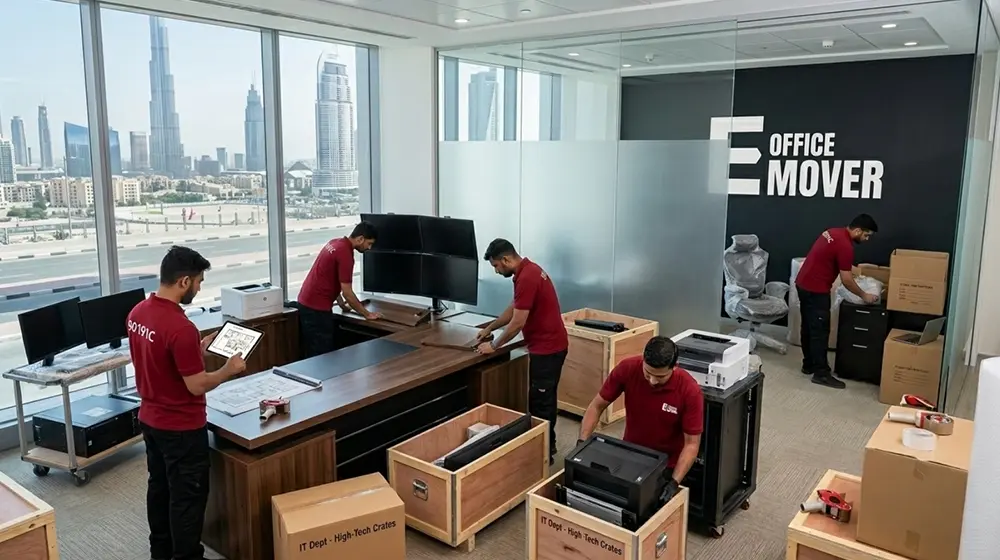
Not every move needs twelve weeks of planning. The workflow scales to the size and complexity of the office.
| Office Size | Recommended Lead Time | Key Complexity Factors |
| Small (1 to 15 staff) | 3 to 4 weeks | Access permits, IT cabling, basic furniture |
| Medium (16 to 50 staff) | 6 to 8 weeks | Zone packing, NOC coordination, IT planning |
| Large (51 to 150 staff) | 10 to 16 weeks | Phased relocation, parallel IT, department scheduling |
| Enterprise (150 plus staff) | 16 to 24 weeks | Full project management and dedicated coordinator |
A small office in JVC or Deira with straightforward IT and no free zone requirements can absolutely complete a move in one solid weekend given three to four weeks of preparation. A 120-person operation in Business Bay or One Central needs a fundamentally different approach, one that keeps departments functional while the move progresses in stages.
The Mistakes That Derail Office Moves in Dubai
There are four failures that come up repeatedly.
Skipping the building permit is the most common. Trucks arrive, the loading bay is locked, the security team won’t activate the service elevator, and the entire operation stalls while someone tries to reach building management on a Saturday morning. It’s entirely preventable.
Bringing in the IT vendor too late is the second. When the IT team finds out about the move two weeks before it happens, there’s no time to arrange a parallel ISP setup, document the existing network, or plan the reconnection sequence. The result is staff arriving at the new office to find no internet, no phones, and no networked printers.
No inventory labeling system is the third failure. When boxes aren’t numbered and mapped to zones, offloading turns into a sorting operation. Everything piles up in corridors, and setup takes twice as long as it should.
Underestimating packing time is the fourth. A 30-workstation office needs six to eight hours of professional packing before the first piece of furniture is moved. If that work is rushed or left to staff the evening before, it shows up as damaged equipment and missing items.
Before your planning phase begins, take a look at our office relocation checklist for Dubai. It covers the common failure points with specific action items.
Free Zone Moves vs. Mainland Commercial Buildings
This comparison matters because the approval timelines are genuinely different, and confusing them is expensive.
For a standard mainland commercial building, the approval process is relatively contained. Submit the notification letter, provide insurance documentation, pay the elevator deposit, get the move window confirmed. From application to approval you’re usually looking at two to five working days.
Free zone moves involve the building management process plus an additional layer from the zone authority. In DMCC that means the tower developer, then DMCC, then Concordia. In DIFC it’s the tower developer plus Dubai Civil Defense. In Dubai Media City it’s the landlord and civil defense running in parallel. The full clearance timeline in a free zone ranges from seven to fifteen working days depending on the zone and the complexity of the scope.
Moving from a free zone to a mainland location, or the reverse, means both approval processes run simultaneously. The exit clearance from the zone authority and the entry permit from the mainland building need to align. Plan an extra buffer week for this specific scenario because delays on one side can hold up both.
Conclusion
Most office moves in Dubai don’t go wrong on move day. They go wrong three or four weeks before it, when someone assumed the building permit would sort itself out, or the IT vendor was looped in too late, or the packing was left to the last two days.
The workflow laid out in this guide isn’t complicated. It’s eight stages, each one building on the last. What makes it work is doing them in order and giving each one the time it actually needs, not the time it would need in an ideal situation.
If you’re moving to a small office in JVC or Jumeirah, three to four weeks of solid preparation gets you there cleanly. If you’re relocating a 60-person operation from one Business Bay tower to another, six to eight weeks and a phased approach is what keeps your team productive throughout. And if you’re navigating a DIFC or DMCC free zone exit on top of everything else, build in an extra buffer for the regulatory approvals because those timelines don’t flex easily.
The one thing that consistently separates smooth office relocations from disruptive ones in Dubai isn’t budget size or team size. It’s how early the planning started and how clearly the responsibilities were divided across each stage.
If you’re not sure where to begin, start with a pre-move survey. It gives you a realistic picture of what the move actually involves before you commit to a date, a budget, or a building permit application. From there, everything else in the workflow has something concrete to build on.
Frequently asked questions (FAQs)
How long does an office move in Dubai actually take?
For a small office of 10 to 15 people, the physical move takes one to two days once packing is done. But the preparation, permits, and coordination should start three to four weeks before that. For medium and large offices, the planning phase runs six to sixteen weeks depending on free zone requirements and IT complexity.
Is a permit required to move an office in Dubai?
Yes, and it’s not optional. Every commercial building requires formal notification and an approved move permit from building management before any moving activity can take place. Free zone offices need approvals from the zone authority on top of that. Trying to move without a permit typically results in access being denied on the day.
What does an office move cost in Dubai?
It depends on office size, the distance between locations, IT scope, and whether you need after-hours or weekend access. Small offices in areas like JVC tend to fall between AED 2,500 and AED 5,000. Mid-size offices in Deira or Al Quoz typically run AED 6,000 to AED 14,000. Larger moves in DIFC or Business Bay with server room work can go well beyond AED 25,000.
Can an office move be completed in a single day?
For small offices, yes, if packing and permits are handled in the days before. For anything above 30 or 40 staff, a single-day move is usually rushed and carries real risk of damage and downtime. A phased approach across two or three weekends is more practical and less disruptive.
What happens if building management isn’t notified before the move?
The building can deny truck access at the loading bay, refuse to activate elevator service, and hold the security deposit until a formal handover inspection is arranged. In some free zones, unauthorized moves can also create issues with the business license renewal process.
Do office movers in Dubai handle IT equipment?
Professional office movers pack IT equipment using antistatic materials and labeled cable systems. The actual disconnection and reconnection of servers and network infrastructure is typically handled by your IT vendor or an IT relocation specialist. Some full-service office moving companies coordinate directly with IT vendors as part of their scope.
What is a phased office relocation?
A phased relocation moves departments in batches across multiple weekends rather than shifting the entire company at once. It’s the right approach for offices above 50 people, businesses running critical systems that can’t all go offline at the same time, and moves where the destination premises are still being fitted out in sections.
Ali Al-Refai is an expert in the moving and logistics industry, with over 12 years of experience in managing both local and international moving operations. He has worked extensively in relocation planning, packing, and logistics, ensuring seamless and efficient transitions for individuals and businesses alike.
His expertise lies in optimizing moving processes, reducing costs, and ensuring the safe handling of items during relocation. Ali regularly shares insights and practical tips on best practices in moving, aiming to help people and companies achieve smoother, cost-effective relocations.