

Office relocation in Dubai is the managed process of moving a company’s entire workplace staff, furniture, IT infrastructure, files, and equipment from one commercial premises to another, usually under a fixed project plan and a building handover deadline. It sits in the wider category of commercial logistics, not residential moving, and that distinction matters more than most business owners expect.
A home move tolerates a few boxes left in the hallway overnight. An office move does not. Servers have to be back online by Monday, the landlord wants the old unit returned to its original condition, and forty people need working desks the moment they walk in. That pressure is exactly why the office moving sector in Dubai operates the way it does.
This guide covers what office movers in Dubai actually do, how the relocation process runs from survey to handover, the different types of movers available, what the job really costs in dirhams, the permits and free zone approvals involved, and the security systems that protect your assets along the way. It is written for business owners, startup founders, SME operators, and corporate teams planning a move in the UAE.
What Does Office Relocation in Dubai Actually Involve?
- Office relocation in Dubai involves five core activities: pre-move surveying, packing and protection, dismantling and transport, IT migration, and reinstallation at the new site. Each one is a separate workstream, and a competent mover runs them in parallel rather than one after another.
- The scope changes depending on what your business actually owns. A 12-person marketing agency in Business Bay moves desks, monitors, a few cabinets, and a small network rack. A 200-seat insurance firm in DIFC moves a server room, an access-controlled archive, modular workstations, and a reception fit-out that took three months to build. Both are “office relocations.” They are not the same job.
- What ties every commercial move together is accountability. The mover takes responsibility for getting your operation from Point A to Point B with minimal downtime and no lost or damaged assets. In a business context, downtime is the real cost far more than the moving invoice itself.
- Three things separate office relocation from ordinary moving:
- Business continuity. The goal is for your team to keep working, not just to shift boxes. Phased moves and weekend execution exist for this reason.
- Asset traceability. Companies carry inventories, depreciation schedules, and IT asset registers. Items have to arrive accounted for, not just “mostly there.”
- Regulatory and building compliance. Free zones, building management, and Dubai Municipality all have rules that touch a commercial move. Skipping them creates fines and access disputes.
What Do Office Movers in Dubai Do?
Office movers in Dubai plan, pack, transport, and reinstall a company’s workplace as a single coordinated project, and the good ones also manage the parts most clients forget permits, lift bookings, IT reconnection, and the condition handover of the old unit.
Here is how that breaks down in practice.
Site Survey and Project Scoping
A reputable mover starts with a physical survey, not a phone quote. A surveyor visits both the current and the new premises and records what is being moved, how heavy and fragile each item is, how it leaves the building, and how it enters the new one. Lift dimensions, loading bay access, stair widths, and parking permits all get logged here. This survey is what makes a quote accurate. A quote given without one is a guess.
Packing and Asset Protection
Office movers supply and apply professional-grade packing materials. This goes well beyond cardboard. The standard kit for a Dubai office move includes:
- Plastic moving crates with security seals (reusable, stackable, and far sturdier than boxes)
- Anti-static (ESD) bubble wrap for monitors, drives, and electronics
- Corner protectors and edge guards for glass partitions and tabletops
- Sequential labelling systems that match each crate to a destination room
- Cable bags and labelled IT pouches so nothing gets reconnected by guesswork
The labelling system is the quiet hero of any move. When 300 crates land at the new floor, a colour-coded and numbered system is the difference between a smooth unpack and a full day of chaos.
Dismantling and Transport
Movers dismantle workstations, partition systems, shelving, and heavy furniture, then transport everything in box trucks fitted for the job. In Dubai, vehicles with hydraulic tailgates matter because most commercial buildings have a loading bay with a fixed height, and manual lifting of heavy cabinets is both slow and risky. Climate-controlled transport is worth asking about too, since electronics and certain documents do not enjoy a closed truck baking in the August sun.
IT and Network Migration
This is the workstream that decides whether your Monday morning is calm or catastrophic. Office movers with an IT capability shut down, label, pack, transport, rerack, and reconnect your servers, switches, and workstations. Specialist IT relocation in Dubai often runs as a separate scheduled phase, frequently over a weekend, so the network is tested and live before staff return.
Reinstallation and Handover
At the new site, movers reassemble furniture, position equipment per the floor plan, and reconnect workstations. A thorough mover also helps return the old unit in handover-ready condition, because most Dubai commercial leases require the tenant to restore the space patched walls, removed signage, original flooring before the deposit is released.
How Does the Office Relocation Process Work in the UAE?
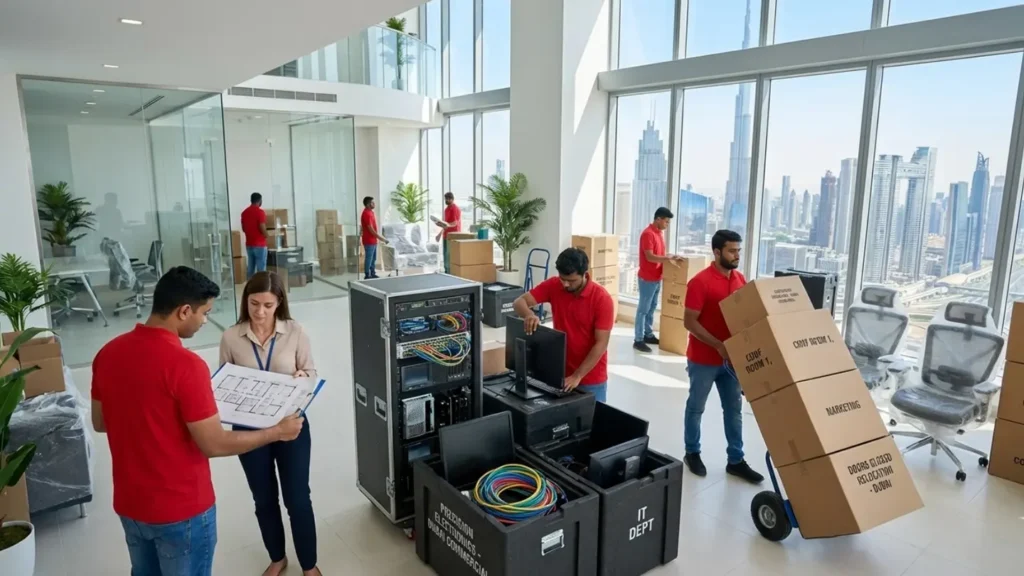
The office relocation process in the UAE runs through six phases: survey, planning, approvals, packing, the move itself, and post-move setup. A mid-sized move typically spans two to six weeks from first survey to the final desk being switched on.
The phases below are the spine of nearly every commercial move in Dubai.
Phase 1: Survey and Inventory
A surveyor documents every asset and every access constraint at both sites. The output is an inventory list and a move scope. For larger firms, this is also where the IT asset register gets cross-checked, so finance and operations agree on exactly what is moving..
Phase 2: Planning and Scheduling
The mover builds a move plan with a timeline, a crew size, a vehicle count, and a sequence. The sequence is where experience shows. Moving the server room and the legal archive first, on a Friday night, keeps the rest of the move calm. Booking the building’s service lift in advance prevents a crew from standing idle while another tenant’s furniture blocks the only freight elevator.
Phase 3: Permits and Approvals
Before a single crate leaves, the paperwork has to be in order. In Dubai this commonly includes a No Objection Certificate from both buildings, free zone approvals if either address sits inside one, and a move slot agreed with building management. More on this below, because it trips up first-time movers more than any other step.
Phase 4: Packing and Labelling
The crew packs in reverse priority. Items needed last get packed first; daily essentials get packed last and unpacked first. Everything is sealed, labelled, and recorded. Workstations are dismantled and their fixings bagged and taped to the desk they belong to.
Phase 5: The Move
Transport happens in the agreed window, usually outside business hours to avoid traffic and minimise disruption. A move coordinator works both ends, one team loading at the old site, another receiving and directing at the new floor according to the labelled plan.
Phase 6: Post-Move Setup and Sign-Off
The crew reassembles furniture, the IT team brings the network up and tests it, and a final walkthrough checks the inventory against what arrived. Any snags get logged and resolved. Then the old unit is handed back to the landlord in lease-compliant condition.
What Are the Different Types of Office Movers in Dubai?
Dubai has six main types of office movers, each suited to a different business size and complexity: full-service movers, IT relocation specialists, furniture and fit-out movers, storage-integrated movers, free zone specialists, and SME or small-office movers.
Picking the wrong type is a common and expensive mistake. A startup hiring a heavy corporate relocator overpays for capability it never uses. A 150-person firm hiring a man-and-van crew loses three days of productivity. Match the mover to the job.
Full-Service Office Movers
Full-service movers handle the entire project end to end survey, packing, IT, furniture, transport, reinstallation, and old-unit handover. They suit medium and large companies that want a single point of accountability and have no internal logistics team. The premium you pay buys project management and a single throat to choke if something goes wrong.
IT Relocation Specialists
IT relocation specialists focus on moving servers, data infrastructure, network hardware, and workstations with minimal downtime and full data integrity. They use sealed transport, ESD protection, and documented chain-of-custody handling. Firms with a real server room, regulated data, or critical uptime requirements use these movers, often alongside a general mover handling the furniture.
Furniture and Fit-Out Movers
Furniture and fit-out movers specialise in dismantling, transporting, and reassembling modular workstations, partition systems, and built-in joinery. They overlap with fit-out contractors and matter most when the new space needs the existing furniture reconfigured rather than simply replaced.
Storage-Integrated Movers
Storage-integrated movers combine relocation with short or long-term warehousing. This solves a problem nearly every phased move hits: the new lease starts before the old one ends, or the new fit-out is not finished on moving day. Pairing a move with commercial storage in Dubai lets you stage furniture and archives offsite until the floor is ready.
Free Zone Specialists
Free zone specialists know the access rules, security clearances, and approval processes of zones like DMCC, JAFZA, DIFC, and Dubai Internet City. Buildings inside free zones often have their own gate passes, insurance requirements, and approved-vendor lists. A mover who already works inside that zone clears the paperwork far faster than one learning it on your job.
SME and Small-Office Movers
SME movers handle small teams, simple layouts, and tight budgets efficiently. For a 5 to 20 person office with standard furniture and no server room, this is usually the right and most cost-effective choice. Fast, focused, and priced for the scale of the job.
What Facilities and Services Do Office Movers Offer?
Office movers in Dubai offer a layered set of facilities beyond transport: professional packing, IT migration, furniture assembly, secure storage, asset inventory management, and old-premises restoration. The breadth of these facilities is what separates a moving company from a moving project partner.
A practical list of what a capable Dubai office mover provides:
- Pre-move surveys and project planning with a documented move scope and timeline
- Professional packing services using crates, ESD wrap, and sequential labelling
- Furniture dismantling and reassembly, including modular workstations and partitions
- IT and server relocation with shutdown, transport, reracking, and reconnection
- Secure short and long-term storage in monitored warehouse facilities
- Asset inventory and tracking matched against your internal register
- Insurance coverage for goods in transit and in storage
- Decommissioning and handover support to return the old unit lease-ready
Not every mover offers every facility. A storage warehouse, in particular, is a real capital asset that smaller operators do not own. If your move needs a staging period, confirm the storage is the mover’s own facility and not subcontracted, because subcontracting adds a handoff and every handoff is a point where accountability gets blurry.
How Much Does Office Relocation in Dubai Cost?
Office relocation in Dubai typically costs between AED 2,000 and AED 100,000+, depending on company size, IT complexity, distance, and storage needs. Most SME moves land in the AED 3,000 to AED 25,000 range, while large corporate or IT-heavy relocations run well beyond that.
The table below gives realistic planning ranges. Treat them as a starting frame, not a fixed quote; only a site survey produces an accurate number.
| Office Size | Typical Headcount | Approximate Cost (AED) | What Drives the Price |
|---|---|---|---|
| Small office | 5–15 staff | 2,000 – 8,000 | Basic furniture, no server room, short distance |
| Medium office | 20–50 staff | 8,000 – 30,000 | Some IT, modular furniture, packing services |
| Large office | 60–150 staff | 30,000 – 80,000 | Server room, partitions, phased weekend move |
| Enterprise / IT-heavy | 150+ staff | 80,000+ | Data centre, multi-site, storage, restoration |
A detailed office relocation cost in Dubai breakdown helps you build a defensible budget before you approach vendors. The single biggest mistake business owners make is comparing quotes that scope different work. A cheap quote that excludes IT, permits, and old-unit restoration is not cheaper. It is incomplete.
What Affects Office Relocation Costs?
Eight factors drive office relocation costs in Dubai: company size, IT complexity, furniture volume, distance, building access, timing, storage requirements, and old-premises restoration. Understanding these lets you control the budget instead of reacting to it.
Company Size and Asset Volume
More people and more assets mean more crates, more crew, and more vehicles. Cost scales fairly directly with the cubic volume of what you own. A clear-out before the move selling or donating furniture you will not reuse is the easiest way to cut the bill.
IT and Server Complexity
A server room changes the economics entirely. Specialist IT handling, weekend scheduling, and downtime risk all push the price up. A simple office with laptops and a router costs a fraction of one with a populated rack and a network closet.
Furniture Type and Reassembly
Modular workstations and built-in partitions take time to dismantle and reassemble. Standard desks and chairs do not. Custom joinery and glass partitions raise both labour and risk, since damage is expensive to replace.
Distance and Route
A move from Business Bay to DIFC differs from a move from Dubai to Abu Dhabi. Distance affects fuel, crew hours, and the number of trips. Cross-emirate moves add travel time and sometimes overnight logistics.
Building Access
Tower access is a real cost variable. A building with a dedicated freight lift and a loading bay moves faster than one with a single shared lift and a narrow service corridor. Some towers only permit moves outside office hours, which pushes work into premium time slots.
Timing and Scheduling
Weekend and after-hours moves cost more in labour but protect business continuity. Peak periods lease-renewal season and the cooler months from October to March see higher demand and tighter availability. Booking early protects both the date and the rate.
Storage Requirements
If your timeline forces a gap between premises, storage adds a monthly cost. The longer the staging period, the higher the total. Tight scheduling reduces or removes this expense.
Old-Premises Restoration
Returning the old unit in lease-compliant condition, removing signage, patching walls, restoring flooring is real work with real cost. Build it into the budget early, because the landlord will hold your deposit against it.
How Do You Plan an Office Move in Dubai?
You plan an office move in Dubai by working backwards from the handover date through five milestones: confirm the new lease, run a survey, secure approvals, book the move window, and sequence the IT migration. Businesses moving for the first time benefit most from a written plan, because the move touches finance, HR, IT, and operations at once.
For companies new to relocation, here is a sensible sequence.
- Lock the dates. Confirm when the new lease starts and when the old one must be vacated. The gap, or overlap, between these two dates shapes everything.
- Appoint an internal move coordinator. One person owns the project internally. Without a single owner, decisions stall and crews wait.
- Run the survey early. Book the mover’s survey six to eight weeks out for a larger move. Early surveys catch access problems while there is still time to solve them.
- Handle approvals in parallel. Start permits and free zone clearances as soon as the new lease is signed. Paperwork is the most common cause of delay.
- Plan the IT migration as its own phase. Decide the cutover window with your IT team. Back up everything before anything moves.
- Communicate with staff. Tell employees the new address, parking, access cards, and what to pack personally. A labelled “personal items” pouch per desk prevents lost mugs and chargers.
- Schedule the move outside business hours. Evenings and weekends keep productivity intact and avoid building-hour restrictions.
A structured office move planning checklist turns this from a stressful scramble into a managed timeline. The firms that move smoothly are simply the ones that started planning earlier.
What Permits and Approvals Do You Need for an Office Move in Dubai?
An office move in Dubai usually requires a No Objection Certificate from both buildings, building management move approval, and if either address sits in a free zone that zone’s specific clearance. The exact requirements depend on whether you are on the mainland or inside a free zone.
This is the step that catches first-time movers. A crew arrives ready to work and the building security desk refuses access because no move permit was filed. The day is lost.
Common approvals include:
- Building NOC and move permit from both the old and new building management offices
- Free zone access approval for zones such as DMCC, JAFZA, or DIFC, including gate passes for the moving crew and vehicles
- Service lift booking confirmed in writing with the building
- Updated trade license address with the relevant authority once you have moved, plus a refreshed tenancy registration
Free zone and mainland processes differ, and a mover who handles office relocation permits in Dubai regularly will know which forms each building wants. When in doubt, ask the building management of both sites for their move policy in writing every tower has one
How Does Office Relocation Work in Dubai Free Zones?
Office relocation in Dubai free zones works much like a mainland move, with one added layer: each free zone has its own access, security, and vendor-approval rules that have to be cleared before moving day. Zones like DMCC, JAFZA, DIFC, Dubai Internet City, and Dubai Media City each run their own gate and security procedures.
Free zone buildings commonly require the moving company and its vehicles to be pre-registered for entry. Some maintain approved-vendor lists, meaning only movers already cleared by the zone get in without a lengthy application. A few require proof of the mover’s insurance before crews enter the premises. None of this is difficult, but all of it takes time, which is why early planning matters even more inside a free zone.
A practical tip: if your new address is in a free zone, ask the mover directly whether they have moved companies inside that specific zone before. A free zone office relocation handled by a crew that already knows the gate, the security desk, and the lift policy is dramatically smoother than one figuring it out on the day.
What Security and Access Systems Protect Your Office Move?
Office movers in Dubai protect your assets through five security layers: sealed crates, asset inventory tracking, chain-of-custody documentation, insured transport, and monitored storage facilities. For companies moving confidential files, client data, or expensive hardware, these systems are not optional extras; they are the reason you hire a professional in the first place.
The security stack on a well-run move:
- Sealed and numbered crates so any tampering is visible, and each crate is accounted for on arrival
- Asset inventory tracking that matches every item against your internal register, with sign-off at both ends
- Chain-of-custody records for sensitive items like servers, archives, and legal documents who handled it, when, and where it went
- Insurance coverage for goods in transit and, where used, in storage
- Access-controlled storage with CCTV, alarm monitoring, and restricted entry for any staging period
For regulated industries finance in DIFC, healthcare, legal the chain-of-custody record is the part auditors care about. A document archive that moves without traceability is a compliance problem waiting to surface. Confirm the mover documents custody for anything sensitive before you sign.
Real-World Office Move Scenarios in Dubai
Different businesses hit different problems. Three common scenarios show how the process plays out in practice.
The fast-growing startup: A 14-person SaaS company in Business Bay outgrows its space in 18 months and moves to a 30-desk unit nearby. The move is small but the IT matters their entire product runs on cloud infrastructure, so the priority is reconnecting laptops and network access by 9am. A weekend SME move with a focused IT cutover solves it for a modest budget.
The corporate relocation: A 120-person consultancy moves from one DIFC tower to another. The job involves a server room, a confidential client archive, modular workstations, and a strict building handover. This is a full-service, phased, weekend move with a documented chain of custody for the archive and the servers, plus old-unit restoration to release the deposit.
The staged move: A trading firm in JAFZA signs a new lease that starts three weeks before its current fit-out completes. Furniture and archives go into the mover’s storage warehouse, staff work from a temporary arrangement, and the assets land on the finished floor once it is ready. Storage-integrated moving turns an impossible timeline into a manageable one.
Common Office Relocation Mistakes to Avoid
Five mistakes cause most office move problems in Dubai: skipping the survey, ignoring permits, underestimating IT downtime, moving during business hours, and comparing quotes with different scopes.
- Skipping the survey leads to wrong quotes and surprise costs on the day.
- Ignoring permits gets your crew turned away at the security desk.
- Underestimating IT downtime turns a smooth move into a Monday outage.
- Moving during business hours sacrifices productivity and clashes with building rules.
- Comparing mismatched quotes makes an incomplete cheap offer look like a bargain.
Avoiding these five is mostly a matter of starting early and asking the right questions before signing.
Frequently Asked Questions
How long does an office move take in Dubai?
An office move in Dubai takes from one day for a small SME to several weeks for a large corporate relocation. The physical move usually happens over a single weekend, while the full project survey, permits, packing, and setup spans two to six weeks for medium and large offices.
How much does it cost to move an office in Dubai?
Moving an office in Dubai costs between AED 2,000 and AED 100,000+, depending on size and complexity. Most SME moves fall between AED 3,000 and AED 25,000, while large IT-heavy corporate moves run significantly higher. Only a site survey produces an accurate quote.
Do I need a permit to move my office in Dubai?
Yes, you usually need a No Objection Certificate and move approval from both building management offices, plus free zone clearance if either address sits in a zone like DMCC or DIFC. Permits should be arranged as soon as the new lease is signed.
What is the best time to relocate an office in Dubai?
The best time to relocate an office in Dubai is over a weekend or outside business hours to protect productivity. The cooler months from October to March are popular, so booking early secures both the date and a better rate during peak demand.
Can office movers handle IT and server relocation?
Yes, specialist office movers handle IT and server relocation, including shutdown, ESD-protected transport, reracking, and reconnection. IT migration often runs as a separate weekend phase so the network is tested and live before staff return to work.
How do I choose the right office mover in Dubai?
Choose an office mover in Dubai by matching the mover type to your business size, confirming they run a physical survey, and checking they handle IT, permits, storage, and old-unit restoration. For free zone addresses, confirm the mover has worked inside that specific zone.
What happens to my old office after I move?
Your old office must be returned to the landlord in lease-compliant condition, which typically means removing signage, patching walls, and restoring flooring. Most movers offer decommissioning and restoration support, and the landlord holds your deposit until handover is complete.
Do office movers in Dubai offer storage?
Yes, many office movers in Dubai offer short and long-term storage in monitored warehouse facilities. Storage solves the common gap where a new lease or fit-out is not ready on moving day, letting you stage furniture and archives offsite until the floor is prepared.
Ali Al-Refai is an expert in the moving and logistics industry, with over 12 years of experience in managing both local and international moving operations. He has worked extensively in relocation planning, packing, and logistics, ensuring seamless and efficient transitions for individuals and businesses alike.
His expertise lies in optimizing moving processes, reducing costs, and ensuring the safe handling of items during relocation. Ali regularly shares insights and practical tips on best practices in moving, aiming to help people and companies achieve smoother, cost-effective relocations.